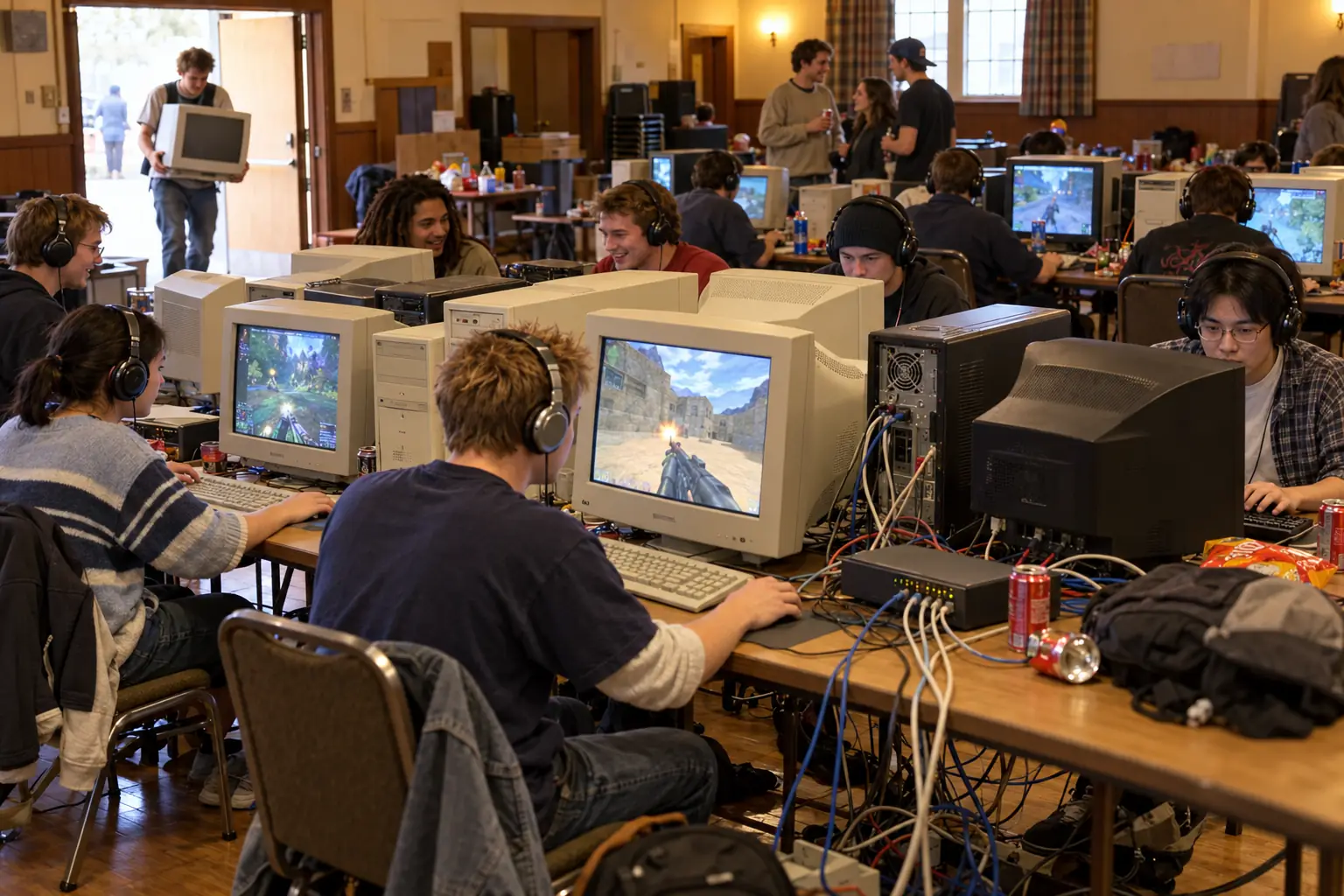
At QuakeCon in 2002, a player rolled a computer into the hall inside a green wheelbarrow. Its clear cover showed off the parts. This was not a normal PC case, but it solved a very normal problem: how do you get your computer to the party?
Reporters Brad King and John Borland describe that odd machine in Dungeons & Dreamers. They also describe a convention hall crowded with nearly 1,300 computers. For most players, getting there involved a much less clever plan: carry the tower, carry the monitor, and hope nothing broke on the way. Their account of QuakeCon captures just how physical computer gaming could be.
A LAN party was a gathering where people connected computers on a local area network, then played together in the same building. A few friends could do it in a bedroom or living room. Larger events filled school rooms and sports halls. Around 2002, this could be the quickest way to get a smooth multiplayer game with friends, even if nobody had a fast internet connection.
But the fun did not begin when the computers arrived. First came the lifting, plugging, configuring, and troubleshooting. A LAN party was half social visit, half temporary computer department.
What went into the car?
The most obvious item was the desktop computer. For a typical early-2000s Windows player, that meant a tower or desktop case, not a thin laptop. The graphics card, hard drive, and network card traveled inside it. The owner still had to move everything that lived outside the box.
Then came the monitor. Many people still used a deep, heavy CRT screen. It needed its own power cable and a video cable to the computer. Add a keyboard, mouse, mouse pad, headphones, perhaps a microphone, and a bag of game discs. Suddenly a night with friends looked rather like moving house.
A LAN card was essential unless the computer already had an Ethernet port. In January 2002, The Honolulu Advertiser advised LAN party visitors to bring their own PC, their own games, and a network interface card. It even pointed readers toward carrying harnesses for PCs and monitors, starting at $26.95, and listed some network cards at about $25. Those were U.S. advertised prices at that moment, not universal costs. The 2002 packing advice is a fine reminder that the baggage was real.
The Ethernet cable could be the smallest item in the bag and the one that ruined the night if it was missing. A power cord was equally easy to forget. Players who expected a long event also packed original game CDs, product keys, driver discs, spare adapters, snacks, and something to sleep in or on.
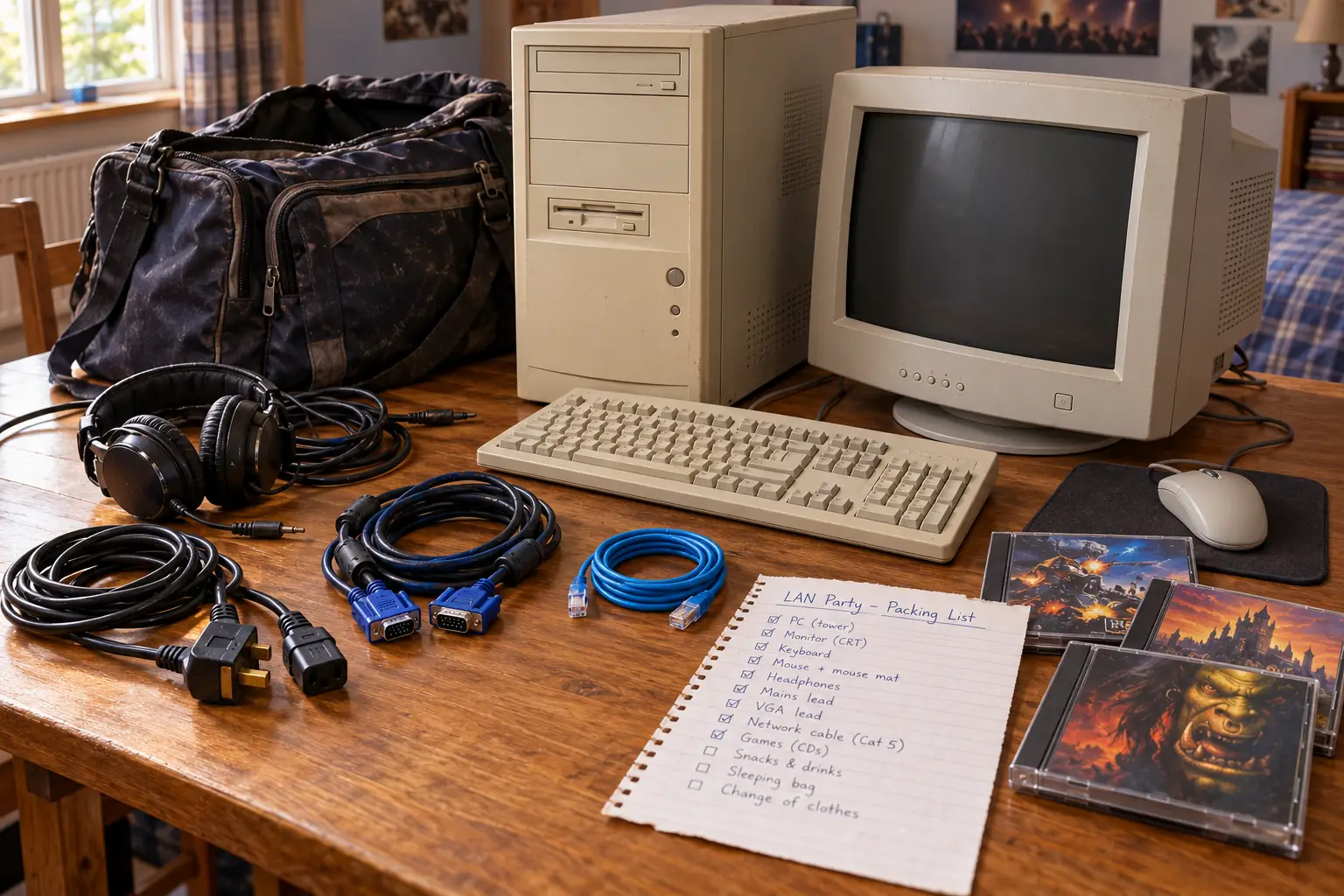
One delightfully thorough example survives from Germany. A tntLAN checklist for a February 2005 event called for a working computer, monitor, 10/100 network card, at least 10 meters of Category 5 cable, headphones, original installation discs, and drivers. It also listed a screwdriver, toothbrush, spare clothes, and an alarm clock. A gathering that lasts all weekend needs more planning than a gaming mouse.
Not everybody had the same budget or setup. A few people arrived with custom-lit cases. Others brought plain family PCs and hoped the latest game would run. Some early-2000s laptops could join, but a desktop with a bulky CRT remained a familiar sight. Hardware differences were part of the event: a game had to work on the machines people actually carried in.
The cables that joined everyone
LAN means local area network. Think of it as a small private road between computers. Instead of sending every move through a distant internet service, the game could pass data from one machine to another across cables in the room.
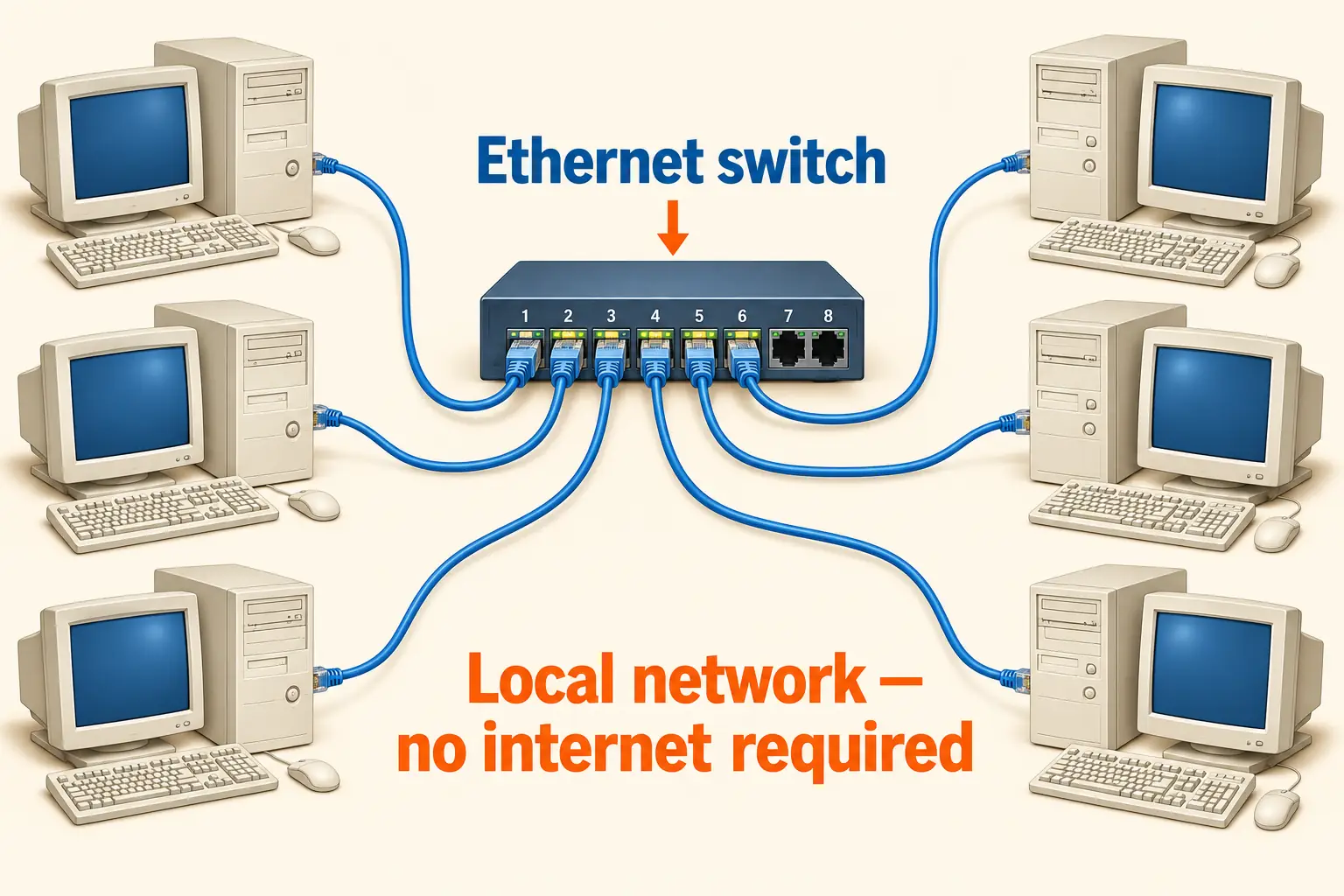
The usual connection was Ethernet. A cable with an RJ-45-style plug ran from each PC’s network port to a central box. Older networks might use a hub, which repeated traffic to every connected port. A switch could send traffic more directly to the device that needed it. For busy game traffic, that made a switch the more attractive choice.
In early 2002, a newspaper guide still described 10Base-T setups, which ran at up to 10 megabits per second. By January 2003, a French how-to guide was recommending 10/100 network cards and an eight-port switch priced around €45–€60. It priced a network card at about €15. These examples show the changeover, not a rule that all parties used the same speed. The contemporary French guide also explains why sharing the price of one switch made a small party practical.
Most PCs plugged into a hub or switch using ordinary straight-through Ethernet cables. For just two older PCs connected directly, without a hub or switch, a crossover cable was often needed. The right cable depended on the ports and equipment. A modem cable or a telephone cord was not a substitute.
Then there was electricity. One PC and one CRT could need two sockets. Multiply that by eight friends, plus the network equipment, and the host suddenly cared about circuits and safe power distribution. Daisy-chaining overloaded strips was not a clever shortcut. Later PCWorld hosting advice treated the room’s electrical capacity as seriously as the network.
None of this meant a LAN party required an internet connection. A game with a proper local-network mode could run with the switch connected only to the players’ machines. Internet access was useful for updates and other services, but it was a separate question from whether the room had a working LAN.
Getting the network to behave
A row of plugged-in cables looked promising. It did not prove the computers could talk.
On Windows 98 or Windows XP, players had to make sure the network card and its driver worked. A few machines could get addresses from a router or a local server running DHCP. With no such helper, someone might assign a set of private addresses by hand, such as 192.168.1.10, 192.168.1.11, and 192.168.1.12, using the same subnet mask, 255.255.255.0. These are example addresses, not values copied from an actual party.
Each PC needed its own address. Two machines using the same one could cause trouble. The next check was whether one computer could reach another. Windows had a command called ping that could test basic network contact. But a successful ping did not mean every game would work; the game still needed the right network settings.
Protocols were another trap. A protocol is simply the set of rules computers use to exchange data. Many later games used TCP/IP. Some older games also used IPX, a different networking system that Windows users might have to install or enable. A computer could be physically connected yet still fail to find a game if the software expected a different protocol.
There was no single magic setting for all titles. Blizzard’s original Warcraft III feature FAQ says that its LAN play needs TCP/IP. The original StarCraft manual, on the other hand, describes an IPX network option for two to eight players, and warns about network settings such as frame types. Even games from the same company could demand different answers.
Version mismatches could be just as irritating. One friend had a new patch, another had an older release, and the game rejected the connection. Players might spend the first hour checking versions, finding discs, installing drivers, or arguing over who was supposed to bring the switch. This was not an exception to the ritual. For some groups, it was part of it.
The game could work without the web
LAN and internet were not the same thing. A properly supported local game could continue even if the building had no outside connection. That independence mattered when home internet was slow, expensive, or tied up by a phone call.
Which games actually worked?
The short answer: games that offered a local-network multiplayer mode and could run on everyone’s hardware. The box art might promise multiplayer, but that alone did not tell you whether a game supported a self-contained LAN. Check the actual game’s menu and manual.
The Honolulu Advertiser named four popular choices in its January 2002 guide: Quake III Arena, Unreal Tournament, Half-Life: Counter-Strike, and Return to Castle Wolfenstein. These were strong fits for rooms full of players who wanted quick rounds and direct competition.
Those games did not all play alike. In Quake III and Unreal Tournament, speed, aim, and map knowledge could settle a match in minutes. Counter-Strike made teams plan attacks and defense; a player knocked out early might be left watching friends finish the round. Return to Castle Wolfenstein brought team objectives into the mix.
A LAN party did not have to be a room full of shooters. StarCraft brought base building and strategy to local play. Warcraft III, released in 2002, offered another mix of strategy and heroes. Diablo II suited players who wanted to fight monsters together rather than shoot one another. The popular games depended on the crowd, the region, the year, and what people owned.
Battlefield 1942 arrived in 2002 with vehicles and large team battles. It supported local multiplayer and could support up to 64 players, but the number a small home party could actually host depended on available PCs and network setup. Its game record lists both LAN play and its large-player multiplayer format.
Most players needed their own installed copy and any license or disc checks required by the game. Copying one disc around a room was not a reliable plan, and software licenses still applied. A host could usually choose a game server or have one of the PCs host a match, depending on the title. Everyone then joined the same game rather than trying to share a single screen.
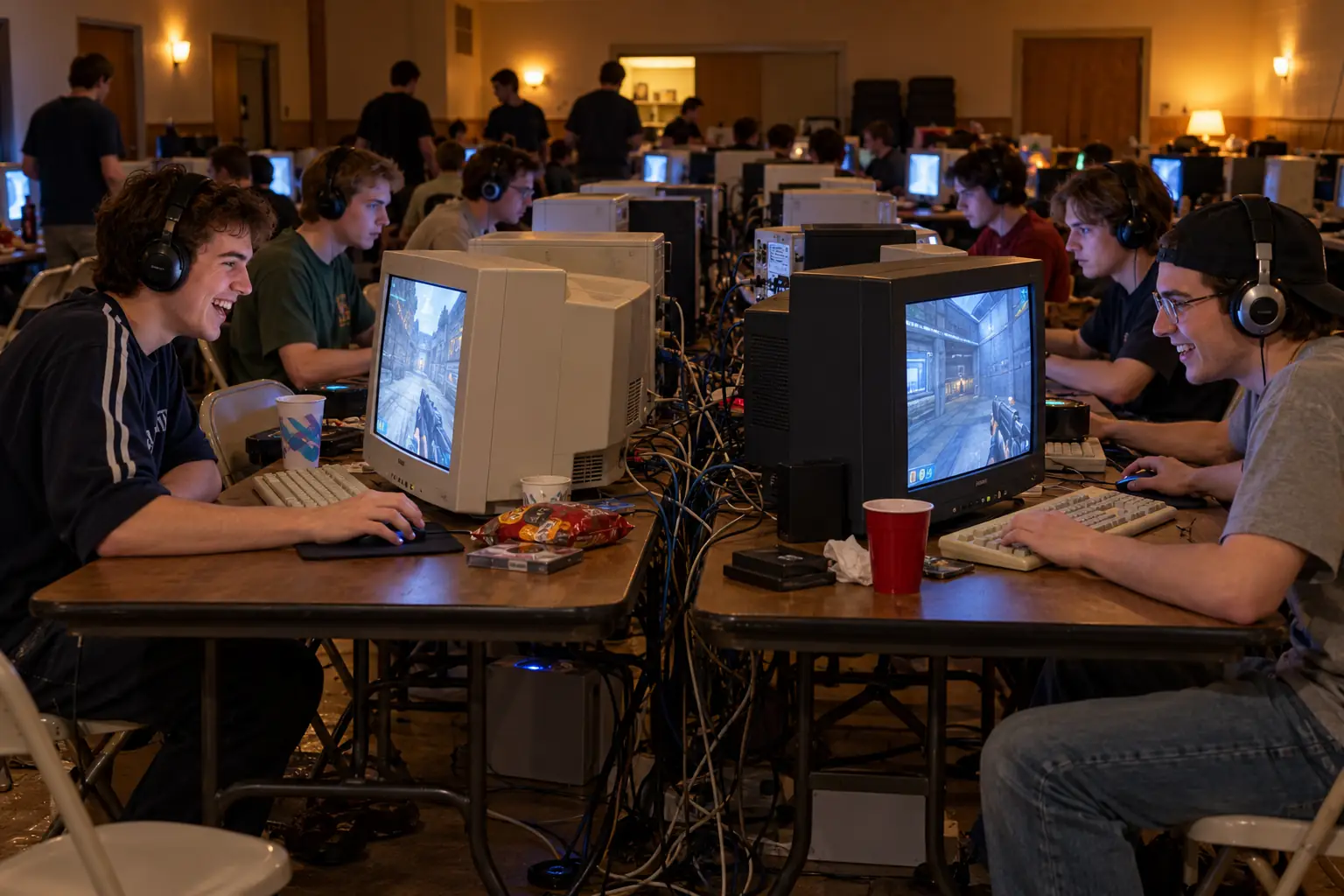
That last part changed the feeling of play. A stranger on an online server was a nickname and a moving character. At a LAN party, the same player sat a few feet away. Victory came with a grin across the table. Defeat could bring immediate, friendly complaints. The computer screen was still there, but it did not separate people in quite the same way.
The rules that kept the party alive
A small party might have just one rule: don’t damage anybody’s equipment. A hall with dozens or hundreds of computers needed more.
The practical rules started with space and power. Organizers could limit how many monitors and plugs each person used. They might tell players to bring headphones instead of speakers. They needed clear walkways, enough tables, and a plan for heat and ventilation. Drinks and food near expensive electronics were not a harmless detail.
At the German tntLAN event in 2005, the rules went further. Each paid place came with one switch port and a power connection. Players were told not to add their own wireless access points, switches, or hubs to the organizers’ network. There was even a separate table for kettles and sandwich toasters, because the gaming power supply was not meant to feed a kitchen. These were that event’s stated rules, not laws for every LAN party.
Network rules mattered too. Hosts might ask people not to flood the local network with large file transfers while games were running. Security was a concern when strangers’ machines shared a network: file-sharing settings and folders could expose private files. Updated software and sensible sharing controls were more useful than pretending everyone connected to a friendly room was automatically trustworthy.
A host also had to settle ordinary human questions. Who chose the next game? Were teams fair? Was there a tournament, or was everyone welcome to jump in? Could someone take a quiet nap? Would there be prizes? Rules varied by event, so there was no universal LAN-party code.
We can see that variety in a real September 2002 Ars Technica forum discussion. One player asked others to share their spoken and unspoken rules, and even brought up whether people should share the snacks they carried in. That was an etiquette question, not a technical fault. It shows how much of the experience happened away from the keyboard.
The German tntLAN list is another useful witness. Alongside cables and driver discs, it included toiletries and sleeping gear. It is hard to make an overnight party work if nobody has thought about the morning after.
From a living room to QuakeCon
LAN parties did not begin with 2002, and they did not belong to one country. In Sweden, DreamHack traces its roots to a 1994 gathering of friends and computers. It later moved into larger venues and became an international gaming festival. DreamHack’s own history describes those small beginnings.
In Texas, Quake fans organized the first QuakeCon in 1996. It was a fan meeting where players could put faces to the names they knew from online chat. The idea was wonderfully simple: if you wanted to play together, bring your computer. The event grew into an enormous annual meeting with games, tournaments, custom hardware, and long conversations outside the matches.
One detail in King and Borland’s report from QuakeCon 2002 captures both the scale and the spirit. Amid rows of close-packed machines, someone had converted a wheelbarrow into a moving PC. Other machines had lit-up cases with windows showing the parts inside. The hardware was useful, but it was also a form of self-expression.
Not every LAN party looked like that. Small local groups had to borrow chairs and move furniture. Bigger events had to work with venue staff, reserve network equipment, and manage safety. The underlying activity was the same: bring separate machines into one place and make them cooperate long enough to play.
Why not just play online?
By the early 2000s, plenty of games already worked over the internet. A LAN party was not the only way to fight a friend in Quake. So why carry a heavy CRT across town?
For one thing, a local connection usually meant lower delay. In a fast shooter, the time between a mouse click and what the server registered mattered. A local network avoided much of the long-distance travel and congestion that could make dial-up games frustrating. That did not make a bad PC faster, and a poorly set-up LAN could still fail. It simply removed one large source of trouble.
Then there was the social part. The group could talk, eat, compare hardware, help a newcomer repair a PC, and start another match. You could learn by watching the person at the next desk. You could also spot exactly which friend was laughing after landing a lucky shot.
For some players, the network was only the excuse to meet. That is why LAN parties kept happening even as broadband connections spread. Dungeons & Dreamers makes the same point in its account of early-2000s gaming culture: better internet did not erase the appeal of being together.
The long goodbye to the heavy monitor
The tools slowly changed. Flat-panel displays grew more common. Laptops became more powerful. Home broadband, voice chat, game services, and online matchmaking made it easier to play with a friend without moving a desk full of hardware. Later, many games also relied on online accounts or services, so an internet-free LAN was no longer a given.
LAN parties did not vanish. Friends still organize them, and some major events still welcome people with their own PCs. But the hard labor of carrying a whole setup has become less central to multiplayer gaming.
In May 2026, DreamHack Stockholm announced it was retiring its BYOC LAN component. The organizers said fewer than 10 percent of their 2025 ticket holders had brought their own computers, and pointed to the growing effort needed to run such a large setup. This was an announcement about that event’s format, not proof that every LAN gathering had ended.
There is a small irony here. The computers, cables, and heavy monitors were obstacles to the fun. They also gave people a reason to help one another. The friend who brought the extra Ethernet lead, found the right driver, or made room for one more CRT could save the evening.
That is what a LAN party really asked people to bring. Not just a game, or even a whole computer. They brought the effort needed to be together in the same room.
Sources and further reading
- The Honolulu Advertiser, January 15, 2002 — contemporary LAN party gear, network speeds, game examples, and U.S. prices.
- France-Jeunes, January 2003 — a period French guide to 10/100 Ethernet, switches, and Windows setup.
- tntLAN 2005 event checklist — a German organizer’s detailed hardware and overnight packing list.
- Brad King and John Borland, Dungeons & Dreamers, second edition (2014) — reported accounts of QuakeCon, including the 2002 wheelbarrow PC and the social side of LAN play.
- Blizzard’s Warcraft III features FAQ and original StarCraft manual — publisher documentation illustrating differing local network protocols.
- DreamHack’s 2020 history note and 2026 Stockholm announcement — the development of a major LAN event and its changing BYOC model.