Before AOL could put a floppy disk in a box of frozen steaks, somebody had to answer a strange question: Would the disk still work after being frozen and thawed?
According to former AOL marketing chief Jan Brandt, her team tested it. The disk survived. AOL could now place its invitation to the online world alongside an order of Omaha Steaks.
Brandt told that story in a 2014 interview with Brian McCullough. It sounds like a joke about the 1990s, but it explains the whole campaign. AOL did not want you to search for its software. It wanted the software to find you.
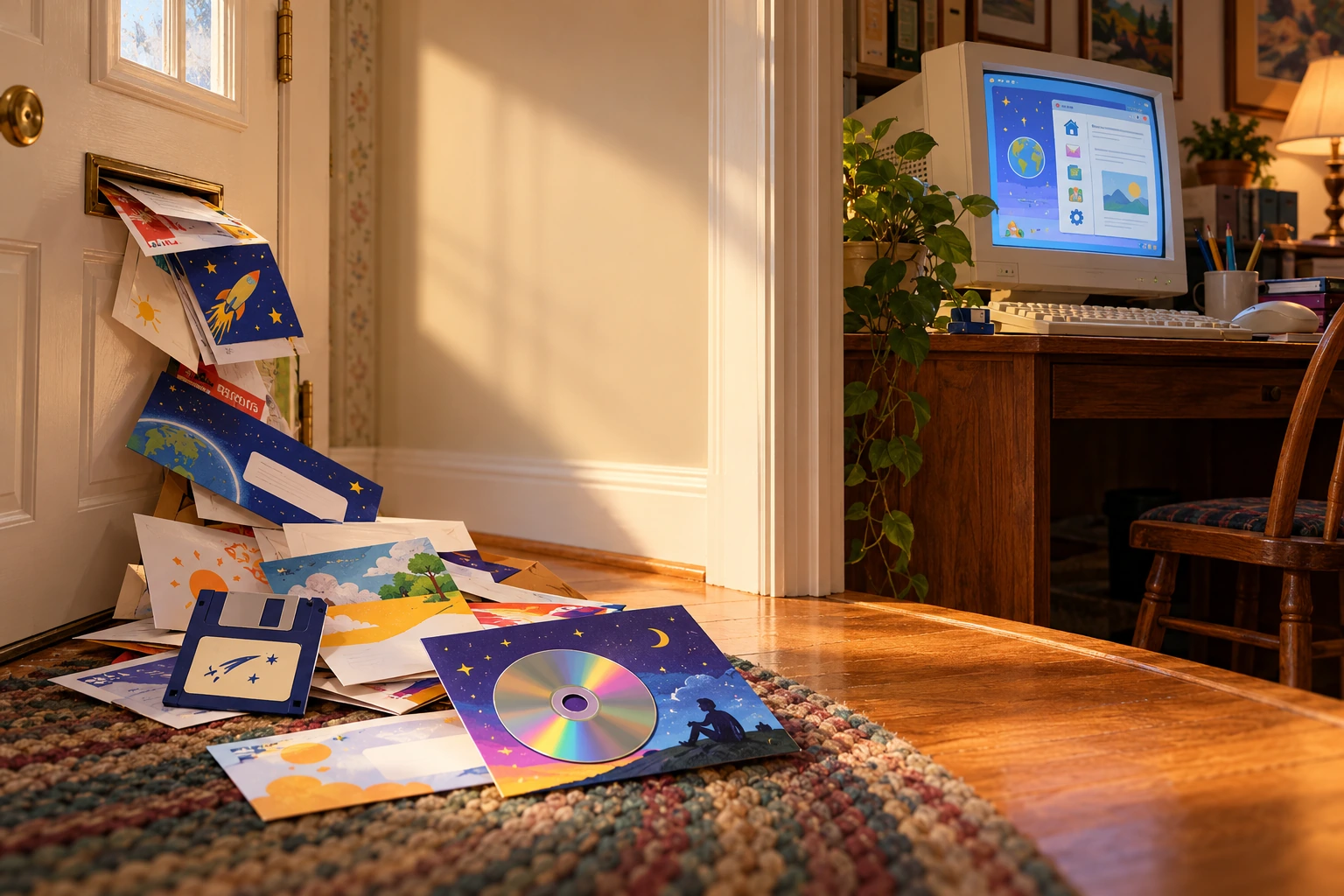
And find you it did. First came floppy disks. Then came CD-ROMs, often in bright cardboard sleeves, through the mail, in magazines, at stores, and in places where nobody was shopping for an internet connection. They invited millions of people to try something new. They also left millions of people wondering where to put the latest unwanted disc.
The $250,000 Gamble
In 1993, the big question was not how to make a better web page. It was how to persuade a family that an online service was worth trying at all.
Many homes had no computer. Plenty of homes with a computer had no modem. The words online service did not explain what a customer would actually do after paying for one.
AOL also faced larger names in the commercial online market, including CompuServe and Prodigy. Television ads could make people curious. They could not put the program needed to join AOL into a floppy drive.
Brandt joined AOL in 1993 and backed a more direct idea: put the installation software in people’s hands. In her later account, CEO Steve Case approved an initial campaign costing about $250,000, a serious bet for the company at the time.
The early packages were meant to be opened. A small box or thick mailer felt more interesting than another letter. Inside was software and an offer to try the service. One 3.5-inch disk was a real object people could hold, use, and even reuse.
Brandt recalled that the first campaign produced a signup response above 10 percent. That is her account of the results, not a response rate to apply to every AOL mailing that followed. The Smithsonian’s preserved AOL disk also records the unusually strong early response.
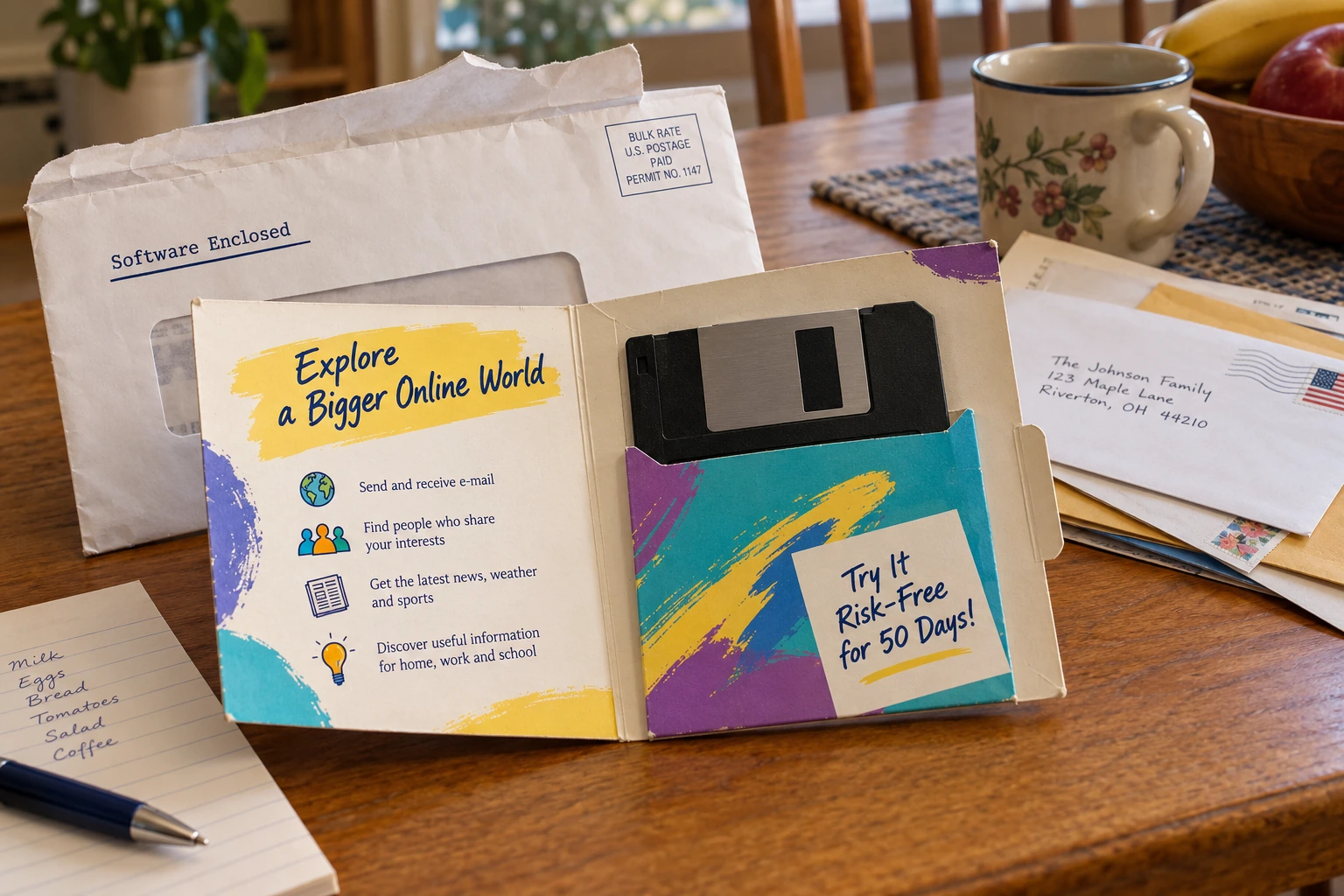
There was a clever bargain hidden in that plain disk. AOL paid for the chance to reach a stranger. If that stranger joined and kept paying each month, the company could earn much more than the disk had cost.
That basic idea explains the mail flood better than any story about a warehouse full of leftover floppies. Sending the software out was part of AOL’s plan to gain paying members.
Why Disks Appeared Everywhere
Once the first mailing worked, the question changed from Will people try this? to Where else can we put a disk?
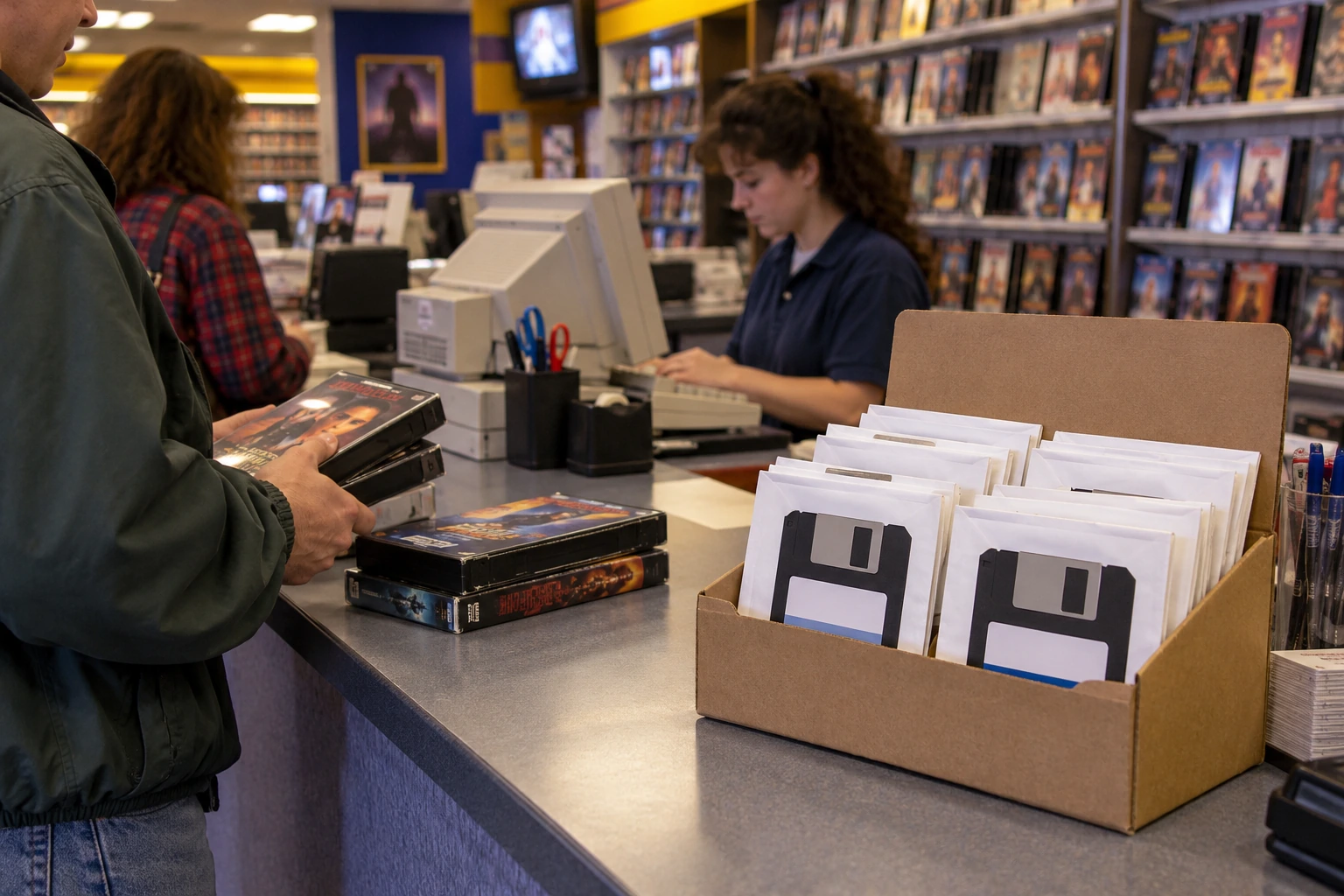
The answer was almost anywhere. Brandt said a visit to Blockbuster Video gave her the idea of slipping AOL disks into free sample boxes offered to video renters. She later described the Blockbuster promotion as a key step toward reaching a wider public.
The Smithsonian’s history of the campaign documents even stranger placements: airline seats, sporting events, and packages of Omaha Steaks. Other disks traveled in magazines and through shops. A person did not need to walk into a computer store to meet AOL.
Behind the Scenes: Keep It on One Floppy
Brandt recalled pushing back when AOL’s installation program grew too large for one floppy disk. She believed making a new customer handle a second disk would add one more reason to quit before joining.
It was not simply a software decision. The shape and size of the marketing package affected the product people received. Brandt described that fight as part of making the service easy for beginners.
The physical work mattered too. Disks needed to be copied, packed, addressed, shipped, and counted. In 2010, TechCrunch reported Brandt’s account that early floppy disks cost AOL $1.19 each to produce, before packaging. She said the company worked with suppliers to automate the packing process and ran many tests to see which promotions brought in members.
So the flood was not just careless spraying of free plastic. It was a measured effort to reduce the cost of finding the next subscriber. Some households still received mail they did not want. Both things can be true.
As CD-ROM drives became common, AOL began using discs that were cheaper to reproduce and could hold far more software. The familiar floppy mailer gave way to the shiny CD in a sleeve, a small booklet, or sometimes a surprisingly large box.
What Your First Sign-On Actually Required
Here is the part the colorful envelope could not do for you: the disk did not contain the internet.
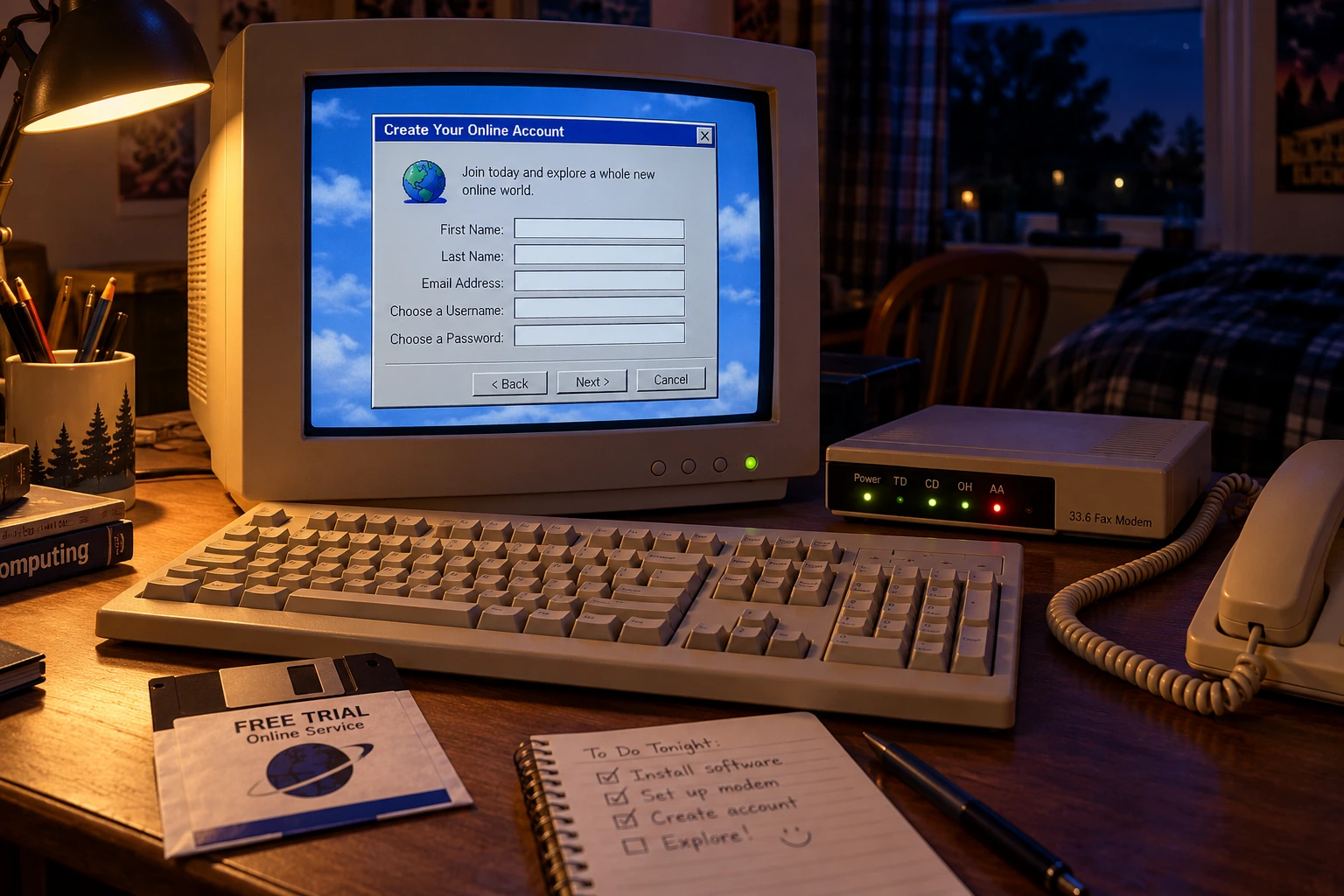
It contained software to install on a compatible computer. To connect from home, you also needed a working modem and a telephone line. The modem called an access number, rather like placing a phone call to another computer. A successful connection brought you into AOL’s service.
In a typical mid-1990s setup, the steps looked like this:
- Put the floppy disk or CD-ROM into the right drive and install the AOL program.
- Set up the modem and choose an access phone number available in your area.
- Connect, register an account, and provide the billing information the offer required.
- Choose a screen name and password, then begin using the online service.
Those steps were not equally easy for everyone. A wrong modem setting could stop the call. A busy access number could send you back to the start. If your chosen number was not a local call, telephone charges might come on top of AOL’s own fees.
Even with a working connection, speed was modest. A February 1995 report described AOL offering 14,400-bits-per-second connections and planning faster service in many places. Large pictures could take time. The household phone line was busy while the modem was using it.
But when it worked, the service gave new users a friendly route into things that had once seemed technical. There were messages, email, chat rooms, discussion areas, news, and places to explore. People could look up interests, meet strangers, and send a note to someone miles away without putting a stamp on it.
AOL’s own areas were part of the appeal. The open World Wide Web grew into a larger part of the service during the 1990s; it was not the whole AOL experience from the beginning. In January 1996, a Washington Post comparison praised AOL’s pop-culture material and active chat rooms but found its built-in web browser limited.
For a newcomer, that trade-off could be welcome. AOL made a confusing online world feel like a place with doors and signs. For a more skilled user, those same doors could feel like walls.
The Price Behind the Free Hours
“Free” was the biggest word on the mailer. It was not the whole story.
Offers changed with the year and the package. The Smithsonian holds a roughly 1995 floppy advertising 15 free hours. Later promotions offered different numbers of hours. One offer could not stand in for every disk that went into a mailbox.
There was also a monthly service price after the trial. In early 1996, AOL’s regular plan cost $9.95 for five hours per month, then $2.95 for each extra hour. That was the service charge, not the cost of buying a computer, modem, or making any billable phone calls.
Ten hours on that five-hour monthly plan would therefore cost $24.70, before telephone charges. The first free-trial period might reduce or remove AOL’s own charge, but the terms depended on the particular offer and when the user signed up.
The most revealing period evidence is the Federal Trade Commission’s AOL complaint. It reproduced the terms of an actual promotional offer: ten free hours to use within 30 days, the first month’s $9.95 membership fee waived, and registration that required a major credit card or checking account.
The same complaint described a crucial catch. The FTC alleged that customers who failed to cancel their trial were enrolled as paying members and could be charged even if they had not used all ten free hours. In May 1997, AOL and two rivals agreed to settle the FTC’s allegations. The final orders in 1998 required clearer disclosures; a settlement should not be mistaken for a trial verdict on every allegation.
What the Paperwork Reveals
The FTC also challenged AOL’s method of counting connected time. The agency alleged that AOL added 15 seconds to each session before rounding billable time upward. This could push a short session into another charged minute.
That complaint concerned metered billing, not users already paying a flat monthly rate. The FTC’s May 1997 announcement explains the allegations and proposed remedies. It is a reminder that a free disk and a free service were two very different things.
The free hours did have real value. They let a person find out whether email, news, and chat were worth keeping. But it was wise to read the fine print, note the start of the trial, and watch the clock. The printed promise and the monthly bill lived in the same envelope.
When the Gifts Became Junk
A single free floppy disk might have been a treat. You could install the program, then erase the disk and use it for your own files. A second one could serve as a spare. By the tenth, the thrill was wearing thin.
CD-ROMs were less useful once the trial offer no longer interested you. They were not normal blank recordable discs. People could pile them up, throw them out, keep unusual designs, or try to turn them into crafts. Much of that reaction is remembered as comedy. Some of it turned into organized protest.
In 2002, two IT workers, John Lieberman and Jim McKenna, were collecting unwanted AOL discs in a campaign called No More AOL CDs. They hoped to gather a million and return them to the company. An article published that November reported more than 83,000 collected at the time.
The target of one million was a protest goal, not a verified total delivered to AOL. Still, the idea captured the mood. A company was mailing out a welcome gift so often that some recipients wanted to send the gifts right back.
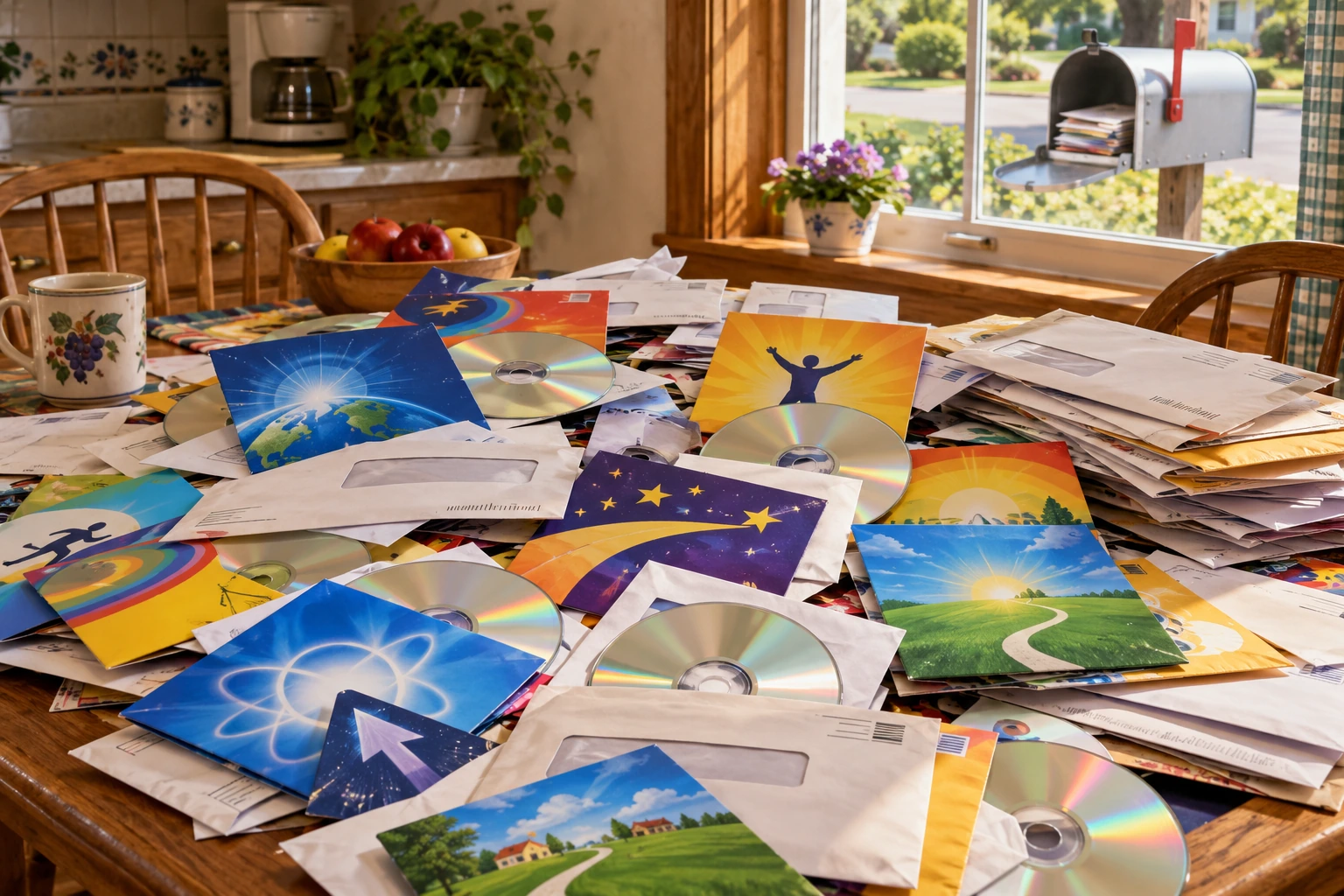
The joke had a serious side. Paper, plastic, postage, and transport were used to reach people who might already be subscribers, lack a compatible computer, or have no wish to join. The campaign was effective for AOL without being welcome at every address.
A Crowded Service Behind the Cheerful Offer
Getting a disk into a home did not mean AOL could give every new user a good connection.
In late 1996, AOL moved toward a simpler price: $19.95 a month for unlimited access. A contemporary Los Angeles Times report described the planned change. For someone who used more than a few hours each month, it sounded wonderful. The meter would stop running.
The trouble was that many more people wanted to stay online. Phone lines and network capacity could not keep up. Users heard busy signals instead of entering their favorite chat rooms.
By January 1997, state officials were pressing AOL for relief. A Washington attorney general announcement said the company agreed to refunds, easier cancellation, and a pause in February advertising while it dealt with access problems. AOL denied wrongdoing under the agreement.
This was a different dispute from the FTC’s concerns about trial terms and billing disclosures. Both mattered to the same broad story: advertising promised a quick way in, while the real service still depended on prices, phone networks, and the small print.
Brandt later recalled that company leaders knew unlimited use would be hard, but had not fully judged how strongly customers would respond. Once people built friendships and routines online, a busy signal did not feel like a minor technical fault.
Did AOL Really Send a Billion Disks?
Big numbers have followed the AOL mailer ever since. You may see claims about a billion discs, half the world’s CDs, or a single giant sum spent on postage.
Be careful with all three.
Brandt has described enormous spending and once claimed that AOL discs made up half of the CDs produced worldwide at the campaign’s peak. Those are her recollections, not independently audited figures for worldwide CD production. The Smithsonian says the exact number and total cost of discs handed out are unknown.
There is, however, hard evidence that customer acquisition was very expensive. In a May 2000 SEC order, regulators described how AOL had treated many marketing expenses as assets in its accounts. Those expenses included sending disks and paying computer makers to bundle AOL software.
According to the SEC, AOL had $314 million in deferred membership acquisition costs on its balance sheet at June 30, 1996. Later, AOL wrote off a larger balance of $385 million. Those figures are not a bill for floppy disks alone, and they should not be presented as the cost of one mailing campaign.
Legend vs. the Record: One Number for Every Disk
The legend: We know exactly how many AOL disks were mailed and exactly how much they cost.
What the record shows: AOL sent millions of promotional floppies and CDs, but available museum records do not establish a final complete count. Former executives have offered striking estimates. SEC filings establish the scale of broader subscriber-acquisition spending, not a precise disk-only total.
That uncertainty does not make the campaign smaller. It makes the real lesson clearer: the disks were not random souvenirs. They were the visible tip of a costly, well-tested system for turning unfamiliar households into monthly subscribers.
When the Internet Stopped Arriving by Mail
By the 2000s, the bargain was changing. More people already knew what the web was. New computers often arrived ready for online setup. Cable and DSL connections let households stay connected without repeatedly dialing a service number.
AOL’s old method was becoming less useful. According to the Smithsonian, the company phased out its direct-to-consumer disk mailings in 2006. That is not the year AOL itself shut down. Its email and other services continued, and the old dial-up access business lasted much longer.
On September 30, 2025, AOL discontinued its dial-up internet service and associated older connection software. AOL’s 2025 reporting said free AOL email accounts were not affected.
The mailed disk had done its job long before then. It brought a complicated service into ordinary homes in a form people could hold. It taught a generation that going online could begin with a simple piece of software and a phone call.
It also taught a marketing lesson that survived the floppy drive: a free offer can open a door, but if you push that offer through every door in town, people may eventually push back.
Some of those disks were saved. Some were erased and reused. Some became unwanted stacks of shiny circles. And some, according to the woman who helped send them out, even survived a trip through a freezer with the steaks.
Sources and Further Reading
- Jan Brandt interview, 2014 — firsthand recollections of the first campaign, packaging, stores, the one-floppy rule, and the frozen-steak test.
- Smithsonian AOL disk record — museum description of a surviving promotional disk, free hours, marketing reach, and limits of the figures.
- Smithsonian marketing history, 2019 — examples of distribution, the consumer experience, rival services, and the mail campaign’s end.
- FTC complaint against AOL and 1997 FTC settlement announcement — trial terms, billing allegations, and what regulators sought to change.
- SEC AOL accounting order, 2000 — original regulatory record on subscriber-acquisition costs and financial reporting.
- Los Angeles Times, October 1996 — contemporary report on subscription pricing and the move toward unlimited use.
- Washington attorney general, January 1997 — contemporaneous account of the access problems and negotiated relief.
- Edie, November 2002 — contemporary reporting on the planned one-million-disc protest.
- AOL, August 2025 — announcement and explanation of the dial-up service’s final shutdown.