
In May 1997, America Online gave away one of the most useful parts of its paid service. You no longer had to subscribe to AOL just to see when a friend was online and send a quick message.
That sounds ordinary now. It was a bold move for a company built around selling access. A May 23, 1997 newspaper report said AOL had not even settled on how it would make money from its new, free Instant Messenger.
What users got was not just a faster letter. It was a little window that could tell them who was home, who was talking, and who might be waiting for them after school or work. For many American users, AOL Instant Messenger—AIM—turned a list of screen names into a daily social meeting place.
AOL and AIM Were Not the Same Thing
To understand AIM, first separate two names that people often mix up.
America Online was a paid online service. It offered access, email, chat rooms, news and other features inside its own software. For many households in the 1990s, getting online meant starting the AOL program and listening to a modem use the telephone line.
AOL Instant Messenger was the separate messaging program launched in 1997. It was free to use. People could install it and create or use a screen name without becoming paying AOL subscribers. They still needed a computer and a working internet connection, which might come from AOL or a different provider.
Early availability depended on the computer. When The Washington Post compared online chat tools on May 30, 1997, it described the new AIM client as a Windows 95 program, with Mac and Java versions expected later. You could not assume that every home computer already supported it.
Once it was installed, the routine was simple: connect to the internet, sign in with a screen name, add other people’s screen names, and look for the ones who were online. A message appeared in its own small conversation window. There was no need to wait for an email reply or hope someone picked up the telephone.
But the program was not magic. On dial-up, using AIM still meant tying up a phone line in many homes. If someone disconnected, their name stopped showing as online. The rhythm of the friendship depended in part on when each person could get to a connected computer.
The Tiny Window That Made People Visible
The Buddy List was AIM’s heart. You entered the screen names of people you cared about. The list showed who was signed in, rather than making you search for each friend again and again.
Think about what this changed. A telephone book held names and numbers, but it could not tell you if the person was ready to answer. An email address worked even when the person was asleep. The Buddy List made presence visible: there they are, on the network, right now.
That small piece of information could feel surprisingly personal. A name appearing after dinner might mean a friend was free to talk. A name disappearing could end a chat without any proper goodbye. And the familiar sign-on and sign-off sounds made those changes hard to miss.
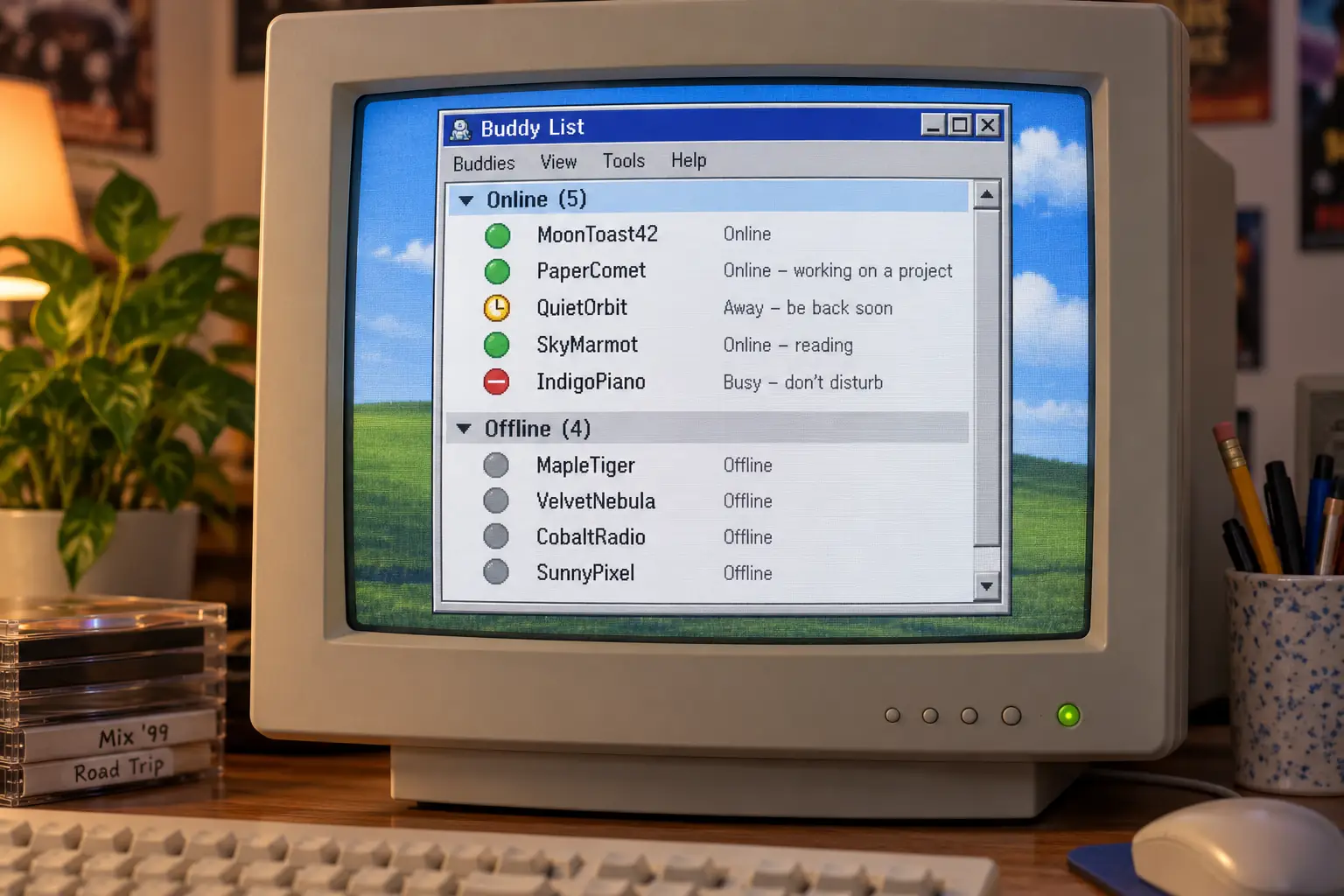
The list could also be arranged into groups. That let users separate classmates from cousins, online friends from coworkers, or people they knew well from people they had only just met. A social circle could sit in the corner of the screen while homework, a document or a browser filled the rest.
Seeing people there did not prove they wanted to talk. But it made starting a conversation feel easier. Instead of calling a house and perhaps speaking to someone’s parent, you could open a window and type a few words.
AIM did not invent the general idea of instant messaging. Other services, including ICQ, were already active in the 1990s. Its special strength was the way AOL’s large community and the free standalone client brought the Buddy List into many more homes and workplaces.
A Screen Name Was a Calling Card
Before a phone number, a social-media profile or a QR code became the normal way to connect, there was the screen name. You chose it yourself. If the obvious name was taken, you tried a new spelling, a number, a favorite band or some private joke.
The result might be funny, mysterious, deeply embarrassing a few years later—or all three. But it was yours. You could hand that name to a classmate without handing over your family’s home telephone number.
AIM also offered profiles, buddy icons and other ways to show a little personality. An away message could tell someone you had stepped out. It might also offer a joke, a line from a song, or a hint meant for one particular person. Those tiny public notes deserve a story of their own; here, their importance is that they gave the Buddy List more to say than simply online or offline.
The difference could be delicate. A person might happily give you a screen name but never offer a phone number. Adding someone to a Buddy List was not quite the same as becoming close friends. Still, it gave a new friendship somewhere to begin.
Fun Fact: A Contact Detail Before a Phone Number
In a 2005 Pew Research Center report, some American teenagers said they gave new friends or possible dates their screen name before their telephone number. The finding covers instant messaging in general, not AIM alone. It shows why handles had become real social currency.
What People Actually Did on AIM
Many AIM conversations were wonderfully small. Someone asked about homework. Someone passed along a funny link. Two friends planned Saturday. A distant cousin checked in. The messages were often ordinary precisely because they were so easy to send.
But AIM was also a place for talks that felt too awkward on the phone. You could type a thought, change it, and then send it. You had room to think without another person hearing every nervous pause. That did not remove embarrassment. It gave embarrassment a keyboard.

We have more than memory to show how common that habit became. In its 2005 study, Pew found that 75% of American teenagers who used the internet also used instant messaging. Among teenage IM users, 90% said they used it to keep in touch with friends who lived far away or went to other schools; 78% talked about schoolwork.
Even romance had moved into the chat window. Among teenage IM users, 20% reported having asked someone out by instant message, and 19% had broken up with someone that way. These figures measured the wider IM world, including AIM’s rivals. They should not be mistaken for AIM-only results.
There was another quiet advantage: one person could hold several conversations at once. You might chat with a cousin, help a classmate and answer a friend, all without hanging up and calling the next person. When conversations went slowly, the windows simply waited.
AIM was not limited to teenagers. In a 2022 Smithsonian magazine interview, writer Jeremy Gordon recalled using AIM as a child and then finding it still in use for office communications when he joined Pitchfork in 2014. One screen name followed him across very different parts of life.
For adults, the point could be practical rather than romantic. A coworker could answer a short question without a meeting. A family member in another time zone might be available for a quick chat. A small business could coordinate work without filling everyone’s email inbox.
Behind the Scenes: The Free Tool AOL Almost Did Not Want
The simple Buddy List had a messy birth.
Engineer Barry Appelman worked on ways for AOL users to see which of their friends were signed in. Eric Bosco and Jerry Harris helped build the larger standalone messaging effort. Their later accounts describe work done with little official support, inside a company whose main business was paid access.
According to Bosco’s recollections in a 2019 Fast Company interview, the small team even reused Hewlett-Packard servers that were due to leave AOL’s data center. He said he maintained servers at night and wrote software by day because the project had no normal budget for those resources.
There was a real business worry behind the resistance. If AOL gave instant messaging to anyone on the wider internet, why would people keep paying for AOL? AIM’s team saw the opposite danger: if AOL did not offer a free messenger, someone else would.
The Builders Heard What Users Wanted
In a 2022 interview with AIM developers, Jerry Harris said the team released changes weekly and read user feedback. Mark Donner, who managed technical work on AIM, recalled that small user requests could lead to important features. Harris also said that file transfer and shared gaming never caught on the way away messages, buddy icons and expressive touches did.
That is a useful clue to AIM’s success: its most loved features were often less about moving data and more about showing who a person was.
The original launch was not a polished parade of advertising. Yet by May 1997 the product was public, and newspapers were already comparing it with other free messengers. AOL soon had to decide how to manage a popular service whose value grew when it reached people beyond the paying AOL world.
By 1998, the company’s attitude was very different. A copy of an April 6, 1998 AOL press release, preserved in a period Usenet discussion, said the Buddy List Network was being included in a Smithsonian information-technology innovation collection. This is evidence of what AOL announced, not an independent check of the museum’s present holdings. It is still a striking change in tone for a once-unwelcome project.
When Being Reachable Had a Cost
The Buddy List made it easy to see friends. It could also make friendship feel like a test.
If somebody was online but did not answer, did they miss the message—or choose not to reply? If a screen name vanished, had the person signed off or blocked you? AIM did not create jealousy, but it supplied a fresh set of clues for people to worry over.
Users found their own ways to manage that pressure. They could set away messages, avoid certain conversations or block people altogether. Pew’s 2005 report found that 82% of teenage IM users had blocked someone at least once. Again, the survey covered instant messaging generally, not just AIM.
Safety was more than a matter of hurt feelings. Screen names could be guessed, passed around or used by strangers. Conversations could be saved or forwarded. A computer in a shared bedroom, school or office might expose private words to someone else.
There were software risks, too. In January 2002, Carnegie Mellon University’s CERT Coordination Center documented a serious flaw in certain Windows AIM clients. AOL made a server-side change and provided a patched version. This is a reminder that a friendly chat window still depended on complex network software.

Workplaces saw both sides. Quick replies helped coworkers. Yet a list showing who was signed in could also create the expectation that someone ought to be available. That tension did not disappear when AIM did. Many workers still know it from modern chat tools.
Rivals, Phones and a Changing Internet
AIM lived in a crowded field. ICQ, Excite’s PAL and other early products let people find friends online. Then came Microsoft and Yahoo’s messaging systems, each with its own users and rules.
One frustrating part was that a friend on one service was not always reachable from another. In July 1999, Microsoft tried to let its new MSN Messenger contact AIM users. AOL and Microsoft soon fought over that connection. A contemporary Washington Post report described the clash. The Buddy List helped connect people, but company walls could still divide them.
That was a business problem as much as a technical one. A network full of friends was valuable. Letting a rival reach those friends could also help the rival grow. Users wanted to talk; companies wanted them to stay.
Then the internet itself changed. Homes gained broadband. People carried phones that could stay connected all day. Social networks offered messages inside their own friend systems, and mobile messengers used phone contacts in place of a carefully chosen AIM handle.
It would be wrong to say AOL simply ignored phones. AIM had an official iPhone app by 2008. In 2011, AOL tested a broader redesign for desktop, web, iPhone and Android. Its preview even replaced the old Buddy List with a view of recent chats, according to contemporary coverage.
That choice says a great deal. The feature that once made AIM feel special no longer fit every new screen or habit. A contact list was giving way to an ongoing stream of conversations.
No single rival neatly killed AIM. Its decline came from a larger shift in where people spent their time, how they connected and which networks their friends already used. A good messenger with fewer and fewer friends on it becomes less useful, even if the program itself still works.
The Last Sign-Off—and What Is Left
AOL announced in October 2017 that AIM would end on December 15, 2017. Its archived shutdown notice gave that date. The original service no longer accepts sign-ins as it once did.

As of October 2026, you cannot bring back your original AIM account, buddy list or old conversations by installing an old program. Unofficial community projects exist: for example, NINA says it rebuilds compatible versions of classic messaging services, but it also states that these are new services without access to the original user data. That is preservation work, not an official AOL relaunch. Old clients should not be treated as safe software for ordinary internet use.
Modern tools such as Signal, Discord, WhatsApp and workplace chat apps cover different parts of what AIM once did: a private message, a group of friends, an availability indicator, a quick question at work. None is a direct doorway back to the old AIM network.
And that is why the disappearance felt bigger than one discontinued program. The window held a particular kind of social map. It was built from names people chose, friends they added and moments when somebody happened to be online at the same time.
The familiar little sounds mattered. So did the long waits, the missed messages, the awkward jokes and the relief when a name finally appeared. AIM’s great trick was not that it made everyone reachable. It made being there together feel visible.
Sources and Further Reading
- San Francisco Chronicle, May 23, 1997 — contemporary reporting on AIM’s free launch and AOL’s uncertain revenue plan.
- The Washington Post, May 30, 1997 — early platform support and comparison with other messaging tools.
- Fast Company, December 10, 2019 — interviews with AIM’s engineers and designers about the project and its use.
- Codecademy, August 10, 2022 — firsthand accounts from Jerry Harris and Mark Donner about the product and its changes.
- Pew Research Center, July 27, 2005 — original research on American teens’ use of instant messaging; figures cover the wider IM category.
- CERT Coordination Center, January 2002 — documented AIM security flaw and AOL’s response.
- TechCrunch, November 16, 2011 — period coverage of AIM’s redesign for desktop and mobile.
- AOL’s archived AIM notice — official stated shutdown date of December 15, 2017.