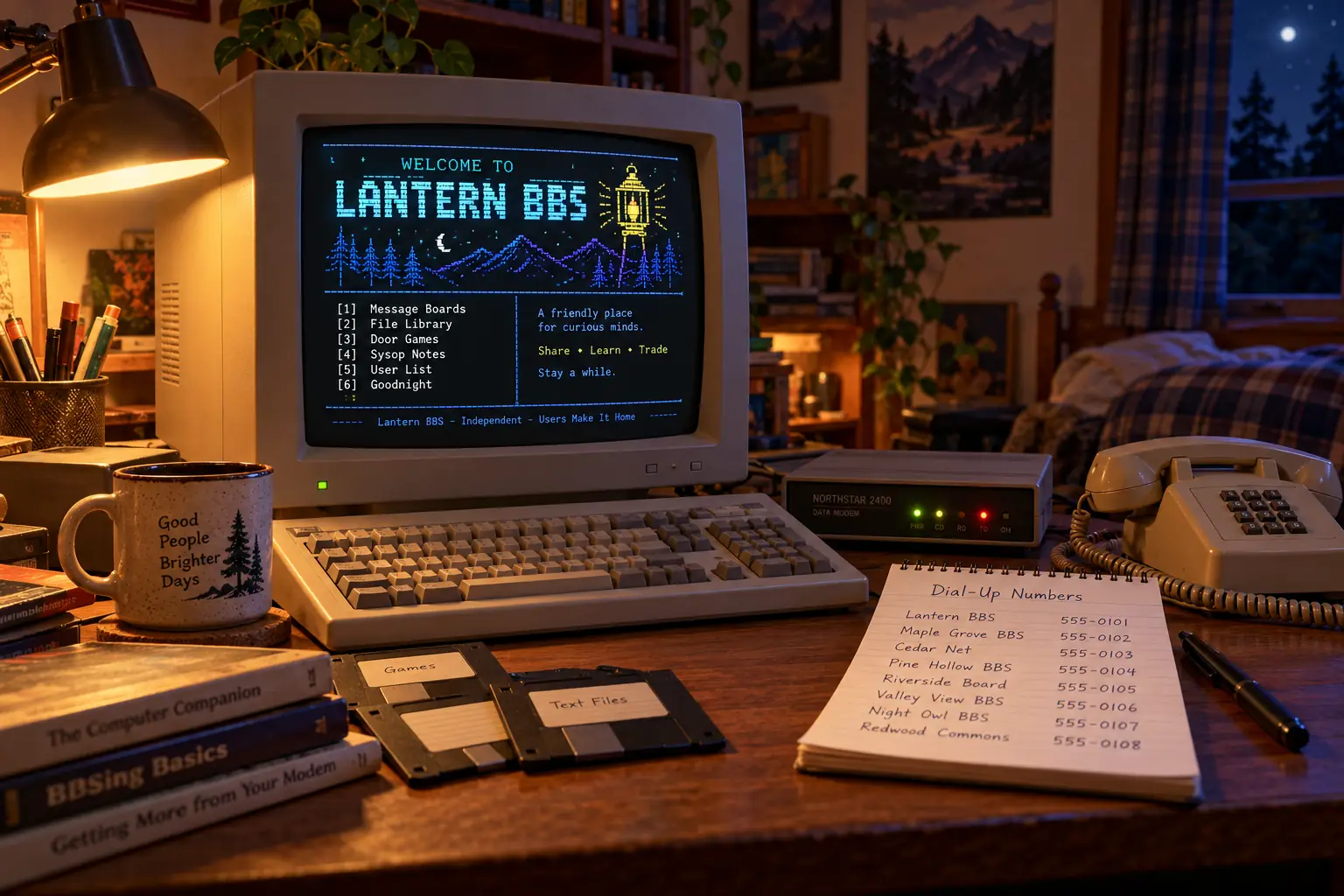
At a Chicago computer club meeting in February 1978, Ward Christensen and Randy Suess showed off a new idea: a computer that answered a telephone call and let people leave messages for one another.
They expected perhaps five or ten people to say they would use it. Twenty-five hands went up.
That small surprise appears in the pair’s own account, published later that year in BYTE magazine. It gives us a better starting point for the history of the bulletin board system than any story about how many millions of users came later. Even before most people owned a modem, there were people who wanted to call.
The machine had no website, no app, and no endless stream of posts. It had a telephone number. If someone else was already connected, you waited. Behind that number was a computer maintained by a person who could answer questions, set rules, or turn the whole thing off.
That person was the sysop, short for system operator. The sysop was a big part of why a BBS could feel less like a service and more like visiting someone’s place.
A computer at the end of a phone line
BBS stood for bulletin board system. The name came from an ordinary idea: the board in a shop or club where people pinned notes. The computer version let callers leave and read those notes without visiting the same building.
To call a typical BBS in the 1980s or early 1990s, you needed a computer, a modem, communications software, and a working phone line. The modem turned computer data into signals that could travel over the telephone network. Your software dialed the board’s number and showed the text sent back.
There was no need for the BBS to be on the Internet. In many cases, the modem called the sysop’s computer directly. The other machine answered the line just as an answering machine would, except it let your keyboard do the talking.
The screen might begin with a plain welcome, a colorful drawing made from text characters, or a request for your name and password. A new caller might fill out an application and wait for the sysop to approve the account. Some boards offered immediate guest access; others were stricter.
On a one-line system, one caller at a time was the rule. The next person got a busy signal. That limit shaped the manners of the place. Many boards set daily time limits so one enthusiastic visitor did not occupy the line all evening.
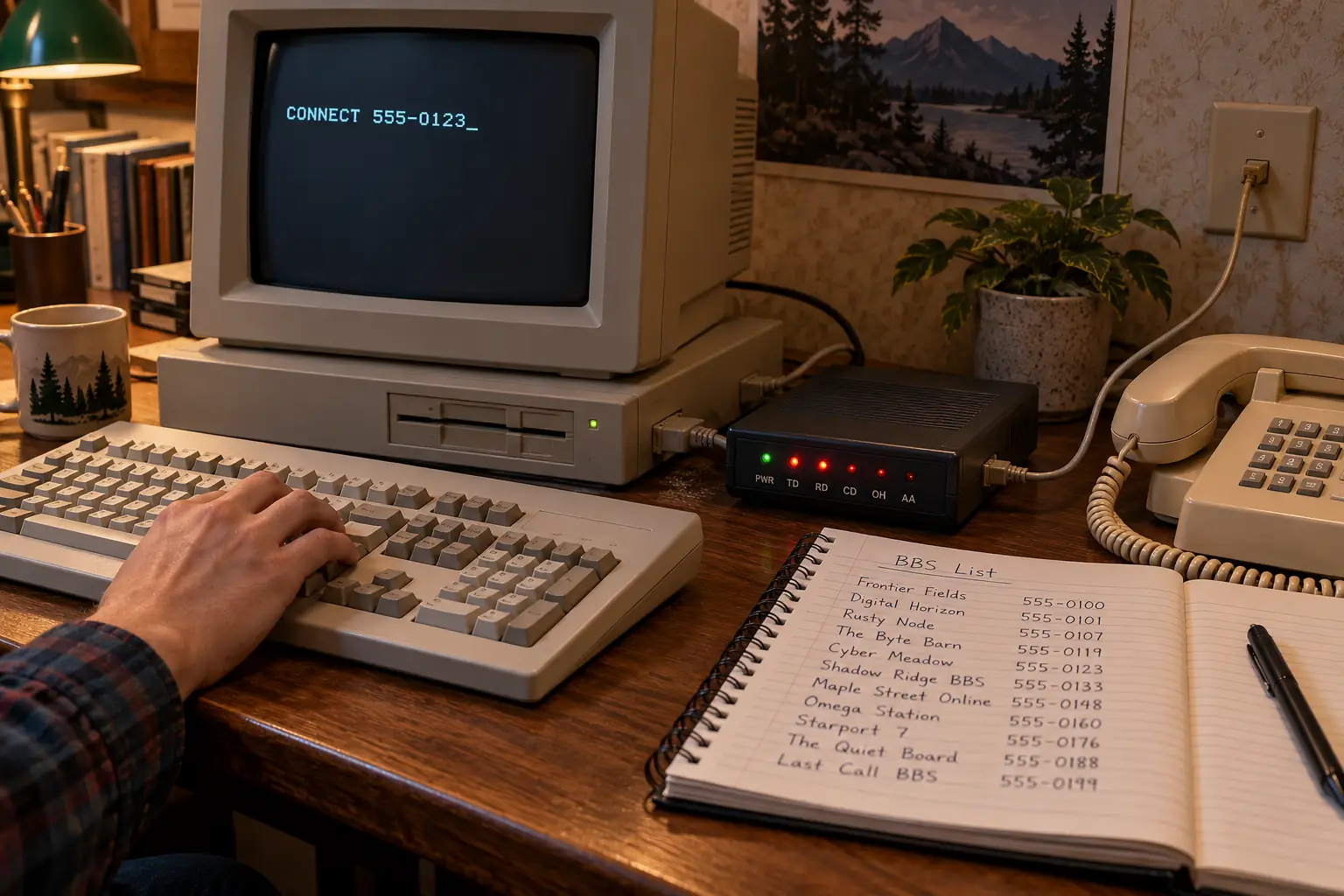
Calls could also cost money. Local calling was often inexpensive or included in a home telephone plan in the United States, but a call to another town might be billed by the minute. The longer you stayed online, the more alarming the phone bill could become. These prices and calling areas varied by country, place, and date.
The Chicago basement that started a movement
Christensen and Suess belonged to the Chicago Area Computer Hobbyists’ Exchange, known as CACHE. They wanted a way for club members to share notices, questions, and technical knowledge between meetings.
They began discussing and building their system on January 16, 1978, after heavy snow disrupted normal life in Chicago. Christensen handled the software. Suess assembled the hardware. Their November 1978 BYTE article says they completed the project by February 16.
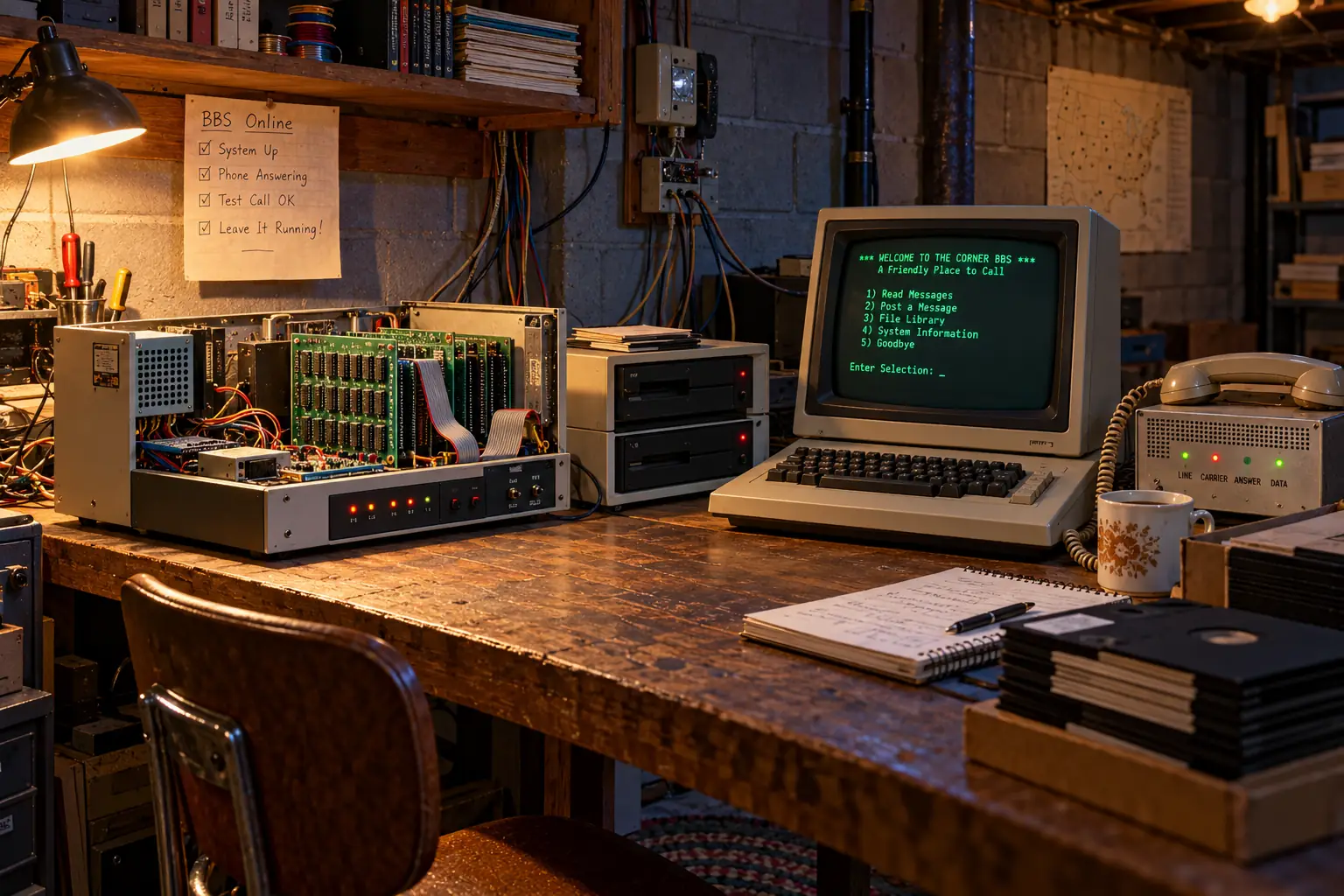
The result was CBBS, the Computerized Bulletin Board System. It ran from a computer and dedicated telephone line in Suess’s basement. It used a floppy disk for messages and answered callers at very slow modem speeds by later standards: 110 or 300 bits per second.
There was another clever detail. Suess arranged the hardware so a ring could restart the machine and launch its message program. That gave the homemade setup a way to recover from many faults before answering a caller. This was not a polished network appliance. It was a hobbyist machine built to keep taking calls.
Behind the Scenes: A basement, a ringing phone, and paper everywhere
In an April 1980 Kilobaud Microcomputing interview, writer Frank Derfler described visiting the CBBS computer in Suess’s basement while Christensen joined the conversation by speakerphone.
Christensen recalled that they had first logged calls using a Teletype machine. Suess sent him long stretches of printed paper. By the time of the interview, the records had moved to disk. The same interview reports more than 11,000 users to date and roughly ten to fifteen new callers each day, according to Christensen. Those were the operators’ reported figures for CBBS, not a count of BBS users everywhere.
Suess said an average call lasted about 20 minutes and that the busiest hours were late evening into early morning. The great new meeting place was also a phone number that people kept trying to reach.
CBBS was an early and hugely influential dial-up hobbyist bulletin board, but it did not invent every form of electronic community. Shared computer messaging and public terminal projects had appeared before it. Christensen himself told the 1980 interviewer that a Kansas City electronic message system might have appeared around the same time; he was not certain which started first. The safer claim is that Chicago’s CBBS became a founding model for the dial-up BBS movement.
What happened after CONNECT
Early CBBS was mainly about messages. You could leave a note, read another person’s note, and learn who was looking for help or had useful information. Its 1978 program recorded items such as the writer, recipient, subject, and date.
Christensen and Suess described a small success that sounds ordinary now but mattered then. Some callers said they had information to share; others posted requests. People reading the board got in touch with them. The computer had helped two people find each other.
Over the following years, BBS software grew far beyond that first set of functions. A typical later board could offer several different rooms or message areas. One might cover computer repairs, another local news, another music or a favorite television show. Private messages were available on many systems too.
File libraries became another big attraction. Callers could download public-domain programs, shareware, documents, patches, and game files. Shareware meant software people could try and then pay to register if they wanted to keep using it under the author’s terms.
Moving a file was slow, sometimes painfully slow. A single download could occupy the telephone line for a long time. Some boards gave users a download allowance or asked them to upload useful files in return. Such rules differed from one board to the next.
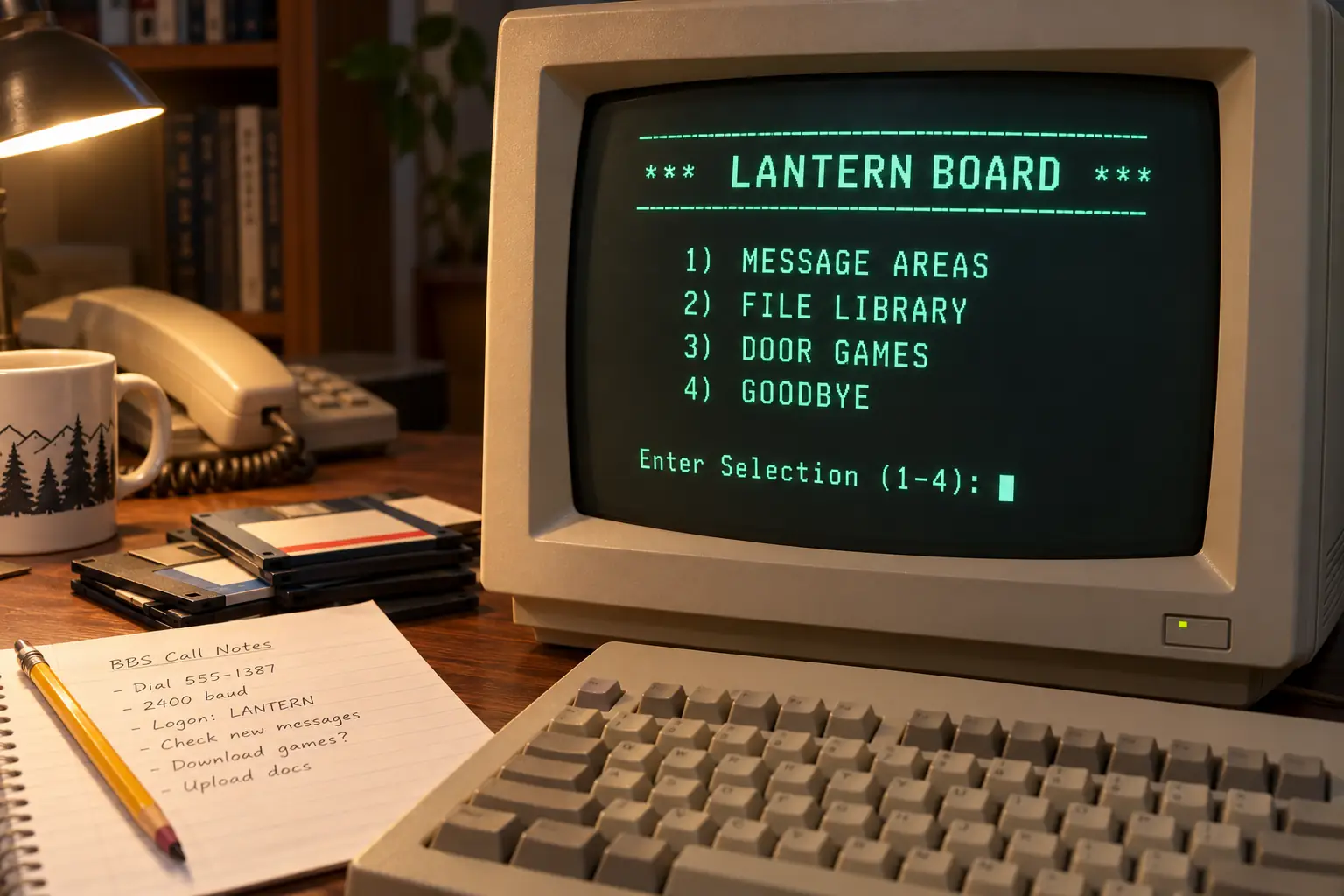
Some boards had small online games, often called door games because the main BBS program opened a separate program for them. Games such as Trade Wars and Legend of the Red Dragon gave players a reason to return day after day. Text pictures, known as ASCII art or later colorful ANSI art, helped give each board its own look.
Not every BBS had every feature. That was part of the point. A board built for a local computer club could feel very different from one devoted to a music scene, role-playing games, community organizing, or technical support.
Fun Fact: Logging off could leave a note
The original 1978 CBBS had a goodbye command that asked callers whether they wanted to leave comments about using the system. Christensen said that this feedback helped the pair make changes. Even the exit was a small way of talking back to the people running the machine.
Who was the sysop?
The sysop could be a student, an engineer, a shop owner, a club volunteer, or someone who just enjoyed making computers work. The title did not require a company or a formal job. It meant being responsible for the system.
On a home BBS, that could mean buying the hardware, paying for the extra phone line, fixing broken software, making backups, checking new accounts, answering technical questions, and deciding what could be posted. If the computer crashed or the modem refused to answer, there was no distant support team. There was the sysop.
Some boards let callers page the sysop during a session. If the operator was nearby and available, a live typed conversation might begin. Otherwise, a caller left a message and hoped for a reply on the next visit. Some sysops also called people by voice before approving full access.
The operator’s rules gave a board its personality. On the Chicago CBBS, Christensen and Suess preferred computer-related notices. In their 1980 interview, they explained that car ads and computer-dating posts did not fit what they wanted their board to be. Other operators were free to make other choices.
That freedom had a cost. The sysop could moderate fairly—or unfairly. They controlled accounts and the machine holding the messages, so users did not have the same privacy they might expect from a private conversation. Operators could also burn out from bills, repairs, disputes, and calls arriving at all hours.
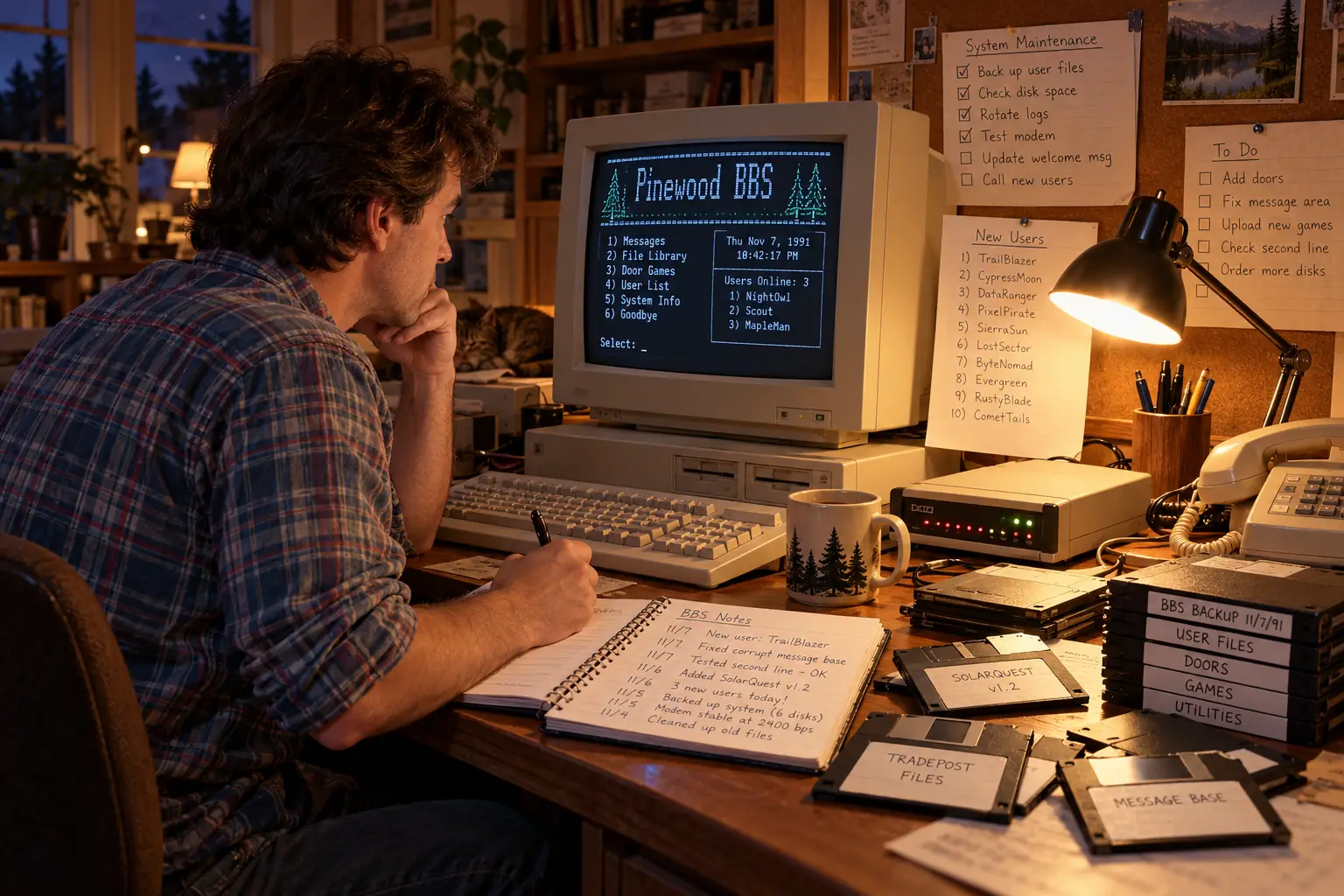
Money made the choices more interesting. Some BBSs were free hobbies, paid for by their operators. Others asked for donations or subscription fees, sold extra access, or ran as small businesses. The original Chicago CBBS intended to stay free for callers, but its equipment still cost real money. In 1980, Suess estimated that a new CBBS-style setup could be built for about $2,000 at that time, while Christensen said they were charging $50 for copies of their software. Those figures describe one particular moment and operation, not the price of every BBS.
A larger board might have several incoming phone lines and let more than one caller connect at once. That took more equipment, more management, and more money. The small board with one line never stopped being a valid choice.
Why did the calls feel personal?
Start with the telephone bill. In much of the United States, it made sense to call local boards and avoid expensive long-distance calls. That meant many callers were living in the same city or nearby towns.
You might never learn another user’s real name. Most boards allowed a nickname, often called a handle. But the person using that name might shop at the same stores or attend the same school. Operators sometimes arranged in-person meetings, turning screen names into familiar faces.
There was also a small-room effect. You noticed when someone came back after an absence. A question might sit unanswered until a helpful regular logged in that evening. A good sysop remembered the people who contributed and set the mood for everyone else.
That did not always make a BBS welcoming. A tight group could be cliquish. New users might feel shut out, and women were often in the minority in early computer circles. Yet the fact that boards were small also let some operators build spaces for people they felt other services ignored.
One striking example was Echo, a New York online community founded by Stacy Horn in 1990. Echo put conversation ahead of file trading. A BBS Magazine profile in June 1995 described its growing staff, thousands of members, and effort to bring more women into its discussions. Horn was not simply keeping a modem running. She was shaping the kind of place people found when they arrived.
There were also serious reasons to connect. IEEE Spectrum documents boards that shared HIV/AIDS information and support at a time when reliable advice and sympathetic communities could be hard to find. These were not merely playgrounds for people who liked blinking lights.
And there was an obvious limit: belonging depended on access. You needed a computer, a modem, a telephone connection, and enough time and money to use them. Rural callers could face high charges or too few local boards. The BBS world was inventive, but it was never open to everyone equally.
When the boards began talking to each other
At first, most bulletin boards were islands. You could be well known on one board and a complete stranger on the next. To read messages elsewhere, you dialed another number and made another connection.
Tom Jennings helped change that in the 1980s with Fido and FidoNet, a way for separate BBS computers to exchange messages automatically. Instead of keeping a person on a costly long-distance call, the systems could gather mail and pass it along during scheduled connections, often at night when telephone rates were lower.
Jennings described the growth and messy practical details in his own February 1985 FidoNet history. The network later supported shared group discussions called EchoMail. A message posted in one town could reach other communities and return with replies.
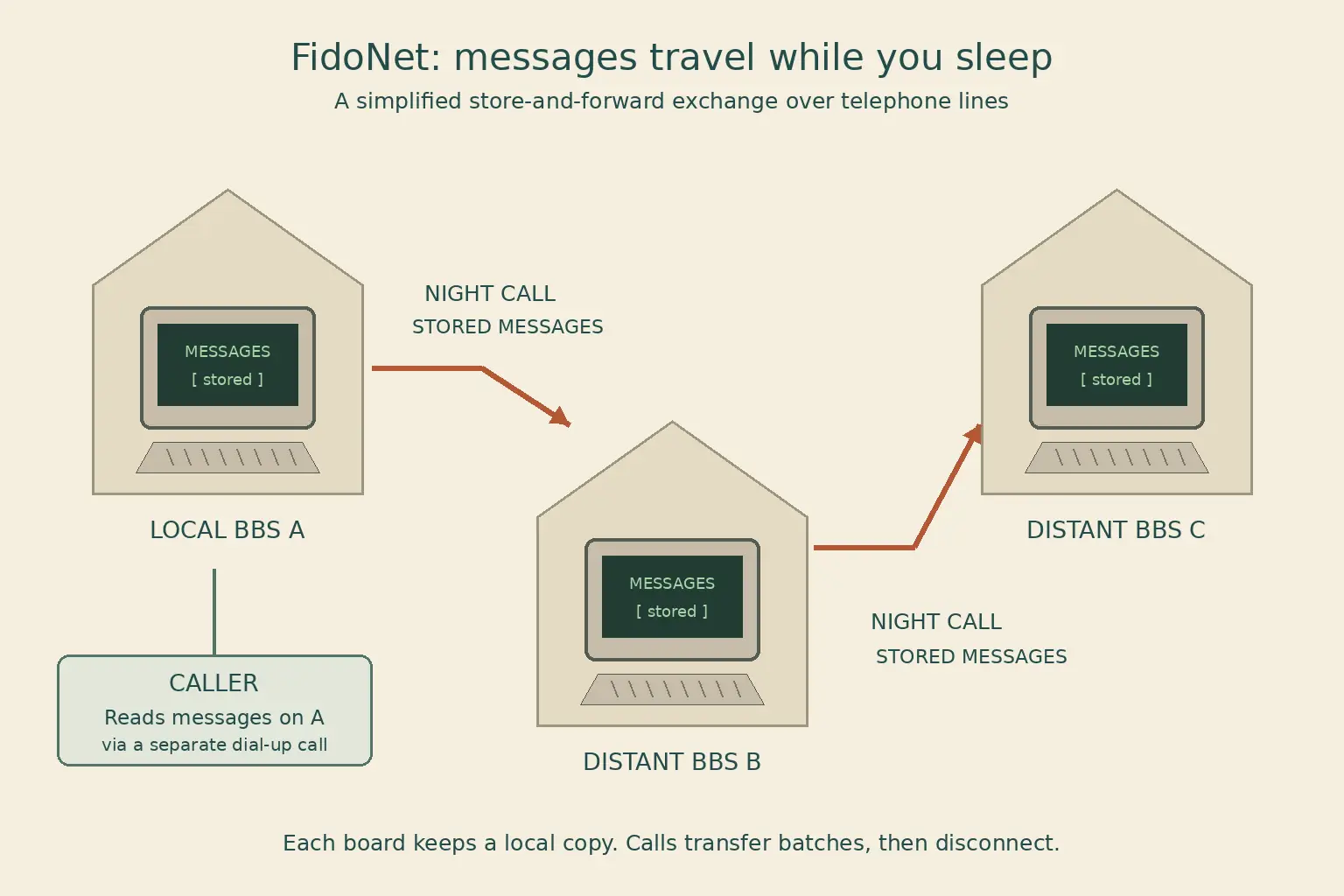
This was not the modern Internet wearing an older costume. Mail could take time to travel. Equipment and phone costs still mattered. Each system kept its own rules and operator. But the conversation was no longer limited to the people who could afford to dial the same town.
FidoNet spread internationally. By the early 1990s, its network reached users in many regions, not just North America. The social map was growing, even while many people still entered it through one small local computer.
What the web changed—and what survived
During the 1990s, dial-up Internet providers, email, web browsers, and web forums gave people new ways to meet online. Instead of remembering a list of local BBS numbers, a user could connect to an Internet provider and reach many services in one session.
Many BBSs closed. Their sysops could no longer justify a separate phone line, a busy home computer, and hours of unpaid care. Others changed shape. Some operators became Internet service providers; some communities moved to web forums or other online spaces.
The web also changed what people expected. A single small board no longer had to keep all the files or host every talk. Yet bigger services could be more distant. A user might gain a million possible connections and lose the feeling of knowing who kept the lights on.
Legend vs. the Record: Did the web simply kill the BBS?
The easy story: Browsers arrived, so bulletin boards vanished.
The fuller record: The 1990s brought new costs, choices, and ways to connect. Many dial-up boards shut down, but others became Internet businesses, changed access methods, or kept serving small groups. The culture did not end on one date.
As of October 2026, it is still possible to visit modern BBSs. Some accept Internet connections through Telnet or SSH, and a smaller number still publish dial-up phone numbers. The Telnet BBS Guide lists active-looking systems, although listings do not guarantee that a particular board will answer at any moment.
For someone curious about trying one, a modern terminal program and a public BBS directory are easier starting points than finding an old modem. Prefer SSH where offered, avoid reusing important passwords, and treat open Telnet connections as unencrypted. Follow each operator’s rules. There is no need to download abandoned commercial software to understand the experience.
The heart of the story goes back to those 25 hands in Chicago. Christensen and Suess built a machine that let people leave notes for strangers. The notes led to answers. Soon other people built their own boards, each with a different welcome, different rules, and someone responsible for making it all work.
A busy signal could be frustrating. A download could take ages. The sysop might tell you to save the car ads for somewhere else. But when you finally got through, you had reached a place made by people—not an endless, faceless feed.
Sources and further reading
- Christensen and Suess, “Hobbyist Computerized Bulletin Board”, BYTE, November 1978, pp. 150 onward. The original account of the design, first users, call handling, message fields, and goodbye comments.
- Frank L. Derfler Jr., “Dial Up Directory”, Kilobaud Microcomputing, April 1980, pp. 80–82, transcribed by Port Commodore. Creator interview covering cost, users, moderation, physical operation, and uncertainty about “first.”
- Kevin Driscoll, “The Bulletin Board System: Social Media’s Dial-up Roots”, IEEE Spectrum, November 2016. Careful history of local communities, FidoNet, inclusion, and the move toward Internet services.
- Tom Jennings, “FidoNet History and Operation”, February 1985, with later material. A creator’s record of early BBS networking.
- Kevin Driscoll, The Modem World, Yale University Press, 2022. Scholarly history of BBS communities, operators, and the social side of early networks.
- Telnet BBS Guide: SSH listings, checked October 24, 2026. A present-day directory, not a guarantee of service uptime or security.