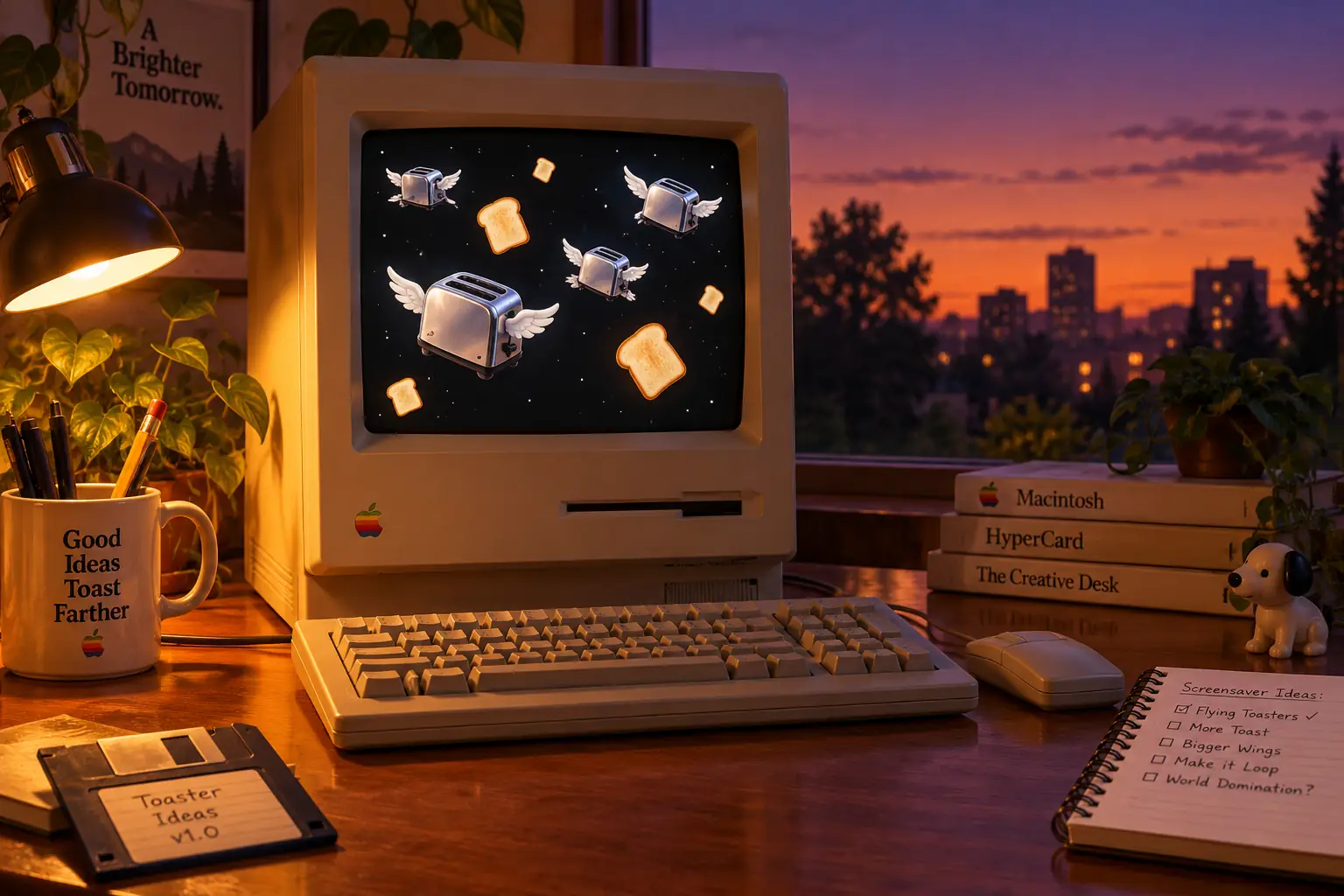
In 1994, a federal judge had to consider a question that sounds like a joke: who had the rights to pictures of flying toasters?
The appliances were not real, of course. They were small animated toasters with flapping wings, passing across computer screens with loose slices of toast. They came from Flying Toasters, a display in Berkeley Systems’ After Dark screen saver.
By then, the flying kitchenware had become famous enough to inspire arguments about copyright, a rock band’s album art, and even a cartoon penguin with a shotgun. But its first job was far less dramatic. It was supposed to protect a monitor while its owner was away.
How did a bit of software made for an empty desk become something people would stop working to watch?
First, Save the Screen
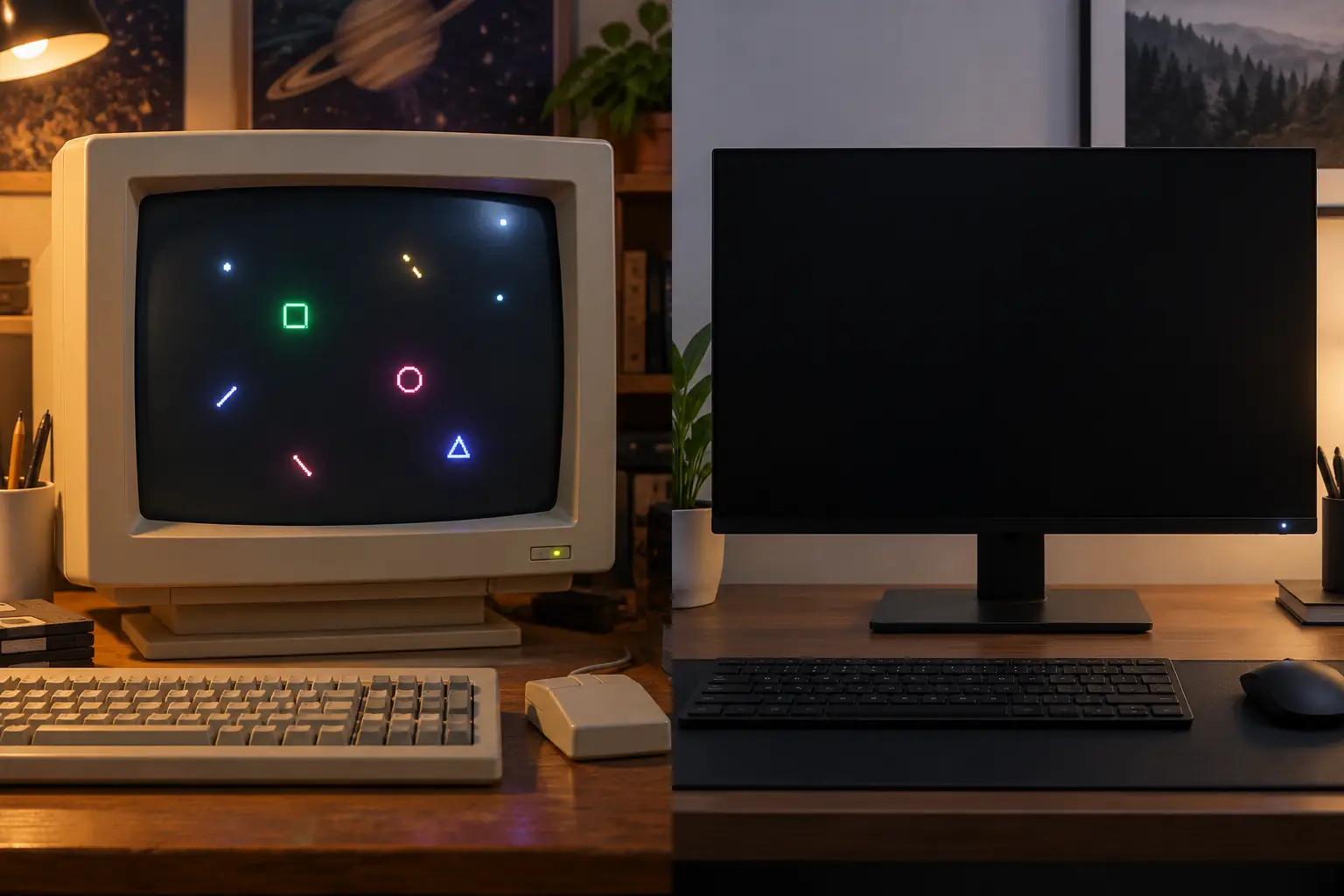
A screen saver once had a literal job. Many desktop computers used cathode-ray tube monitors, or CRTs. An electron beam lit up a coated glass screen. Leave the same bright shapes in the same spots for long stretches, and some displays could develop a lasting ghost of those shapes. That damage was called burn-in.
For an office, the risk was easy to grasp. The computer might spend hours showing the same menu, spreadsheet frame, or company program. Replacing a monitor was not cheap. One simple answer was to blank the screen when nobody touched the keyboard or mouse.
Blanking worked, but it was not much to look at. Earlier screen savers also offered simple movement, such as patterns or fireworks. The need for protection came first; entertainment was a bonus.
That changed when software makers realized an idle computer was also a tiny, unattended stage.
Berkeley Systems released After Dark for the Macintosh in 1989. It was software you added to the computer, not a little show built into every machine. The Centre for Computing History preserves a 1989 Macintosh copy on floppy disk.
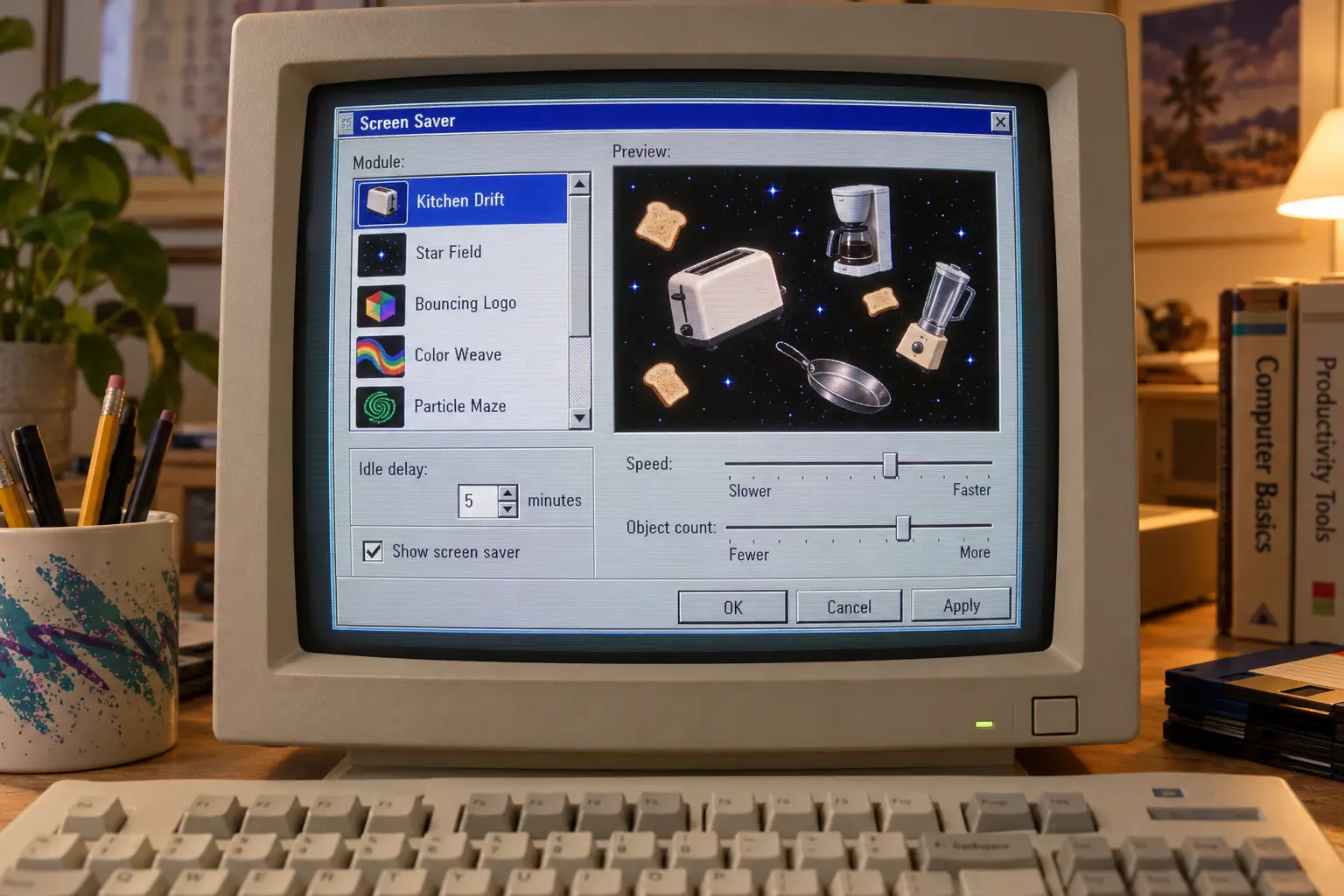
Its key idea was choice. Instead of one fixed effect, After Dark could run different little displays, called modules. Each was a different act on the same stage.
Jack Eastman, a physicist who taught himself Macintosh graphics programming, was central to that idea. He wanted to switch among the animations he was making rather than live with one screen saver. He later explained in a museum interview that getting it to work meant changing parts of the operating system itself. He recalled making 93 system patches to make his screen saver behave reliably.
That is an astonishing amount of work for something that appears only when you are not using the computer. It also explains why a good screen saver could be a serious software product.
A Toaster in the Kitchen
After Dark 1.0 did well enough to encourage a more ambitious second version. Eastman and his colleagues wanted effects that felt more like short cartoons than moving math problems.
According to Eastman’s later account to the Dutch design institution Nieuwe Instituut, the idea arrived while he was awake late at night, struggling to invent an engaging animation. He wandered into the kitchen, noticed a toaster, and imagined it with wings. He went back upstairs, drew a few black-and-white animation frames in an icon editor, and coded the idea that night.
It is hard to find a better origin story for a piece of software. Not a grand business plan. Not a market survey. Just a household appliance taking flight in a tired programmer’s head.
Behind the Scenes: More Than One Pair of Hands
Eastman describes the original Flying Toasters idea and early animation. He also names Patrick Beard as the colleague who introduced him to Berkeley Systems founder Wes Boyd. Designer Bill Stewart describes leading and refining other After Dark animations, including work on its Windows-era experience. These are connected but distinct roles; the entire project should not be credited to one person.
The two designers’ separate museum accounts show how much effort went into a product that looked effortless.
The famous Flying Toasters module appeared in After Dark 2.0 in 1990. That distinction matters: After Dark began in 1989, but Flying Toasters was not the original 1989 release. A later federal court opinion also dates the toaster module to 1990.
Its recipe was almost silly in its simplicity. Little toasters flew across a dark background, flapping their wings as slices of bread drifted along. Their path repeated, yet the combined movement kept the view alive. The black space did the practical work of avoiding a fixed, bright desktop image; the flying objects gave people something to notice.
The result was instantly easy to understand. No rules. No score. No instructions. You could glance at it for two seconds or let it float past for twenty minutes.
Fun Fact: You Could Adjust the Toast
In versions of Flying Toasters, users could change the amount or darkness of the toast, along with other display settings. Even breakfast could be customized. Bill Stewart later recalled that people enjoyed tinkering with the fish in one module and the toast in another.
Choosing Your Own Idle Screen
Using After Dark was not like opening a word processor. On the Macintosh, it lived among the system’s control panels and extensions. You installed the software, chose an animation, set the idle delay, and went back to normal work. When you stopped using the machine, After Dark took over. Moving the mouse or pressing a key brought your work back.
Getting the timing right was part of the experience. Set it too short and the display arrived while you were reading a long page. Set it too long and you barely saw your favorite animation. And once it started, you might find yourself watching instead of returning to work.
The package did not offer only toast. Fish swam. Stars moved. Lines and shapes twisted. Meteors crossed the screen. Some effects were soothing; others were proudly absurd.
After Dark 2.0’s 1990 retail packaging advertised more than 30 displays, sound, password protection, and ways to show your own message or company logo. It even described a MultiModule feature for running several effects together. An idle screen could become a personalized little exhibition.
There was a real business behind the fun. After Dark was commercial software, sold in boxes and through retailers. A January 1992 Washington Post report described a US price of $49.95 for Macintosh and Windows versions. That was real money to spend on something that ran mostly while you were not there.
But buyers got several things at once: protection from burn-in, some privacy through password controls, and a small measure of joy. In a workplace, the first two helped justify the purchase. At home, the third might be all someone needed.
Windows users joined the audience in the early 1990s. The software reached a much wider world of office PCs as well as Macs. Bill Stewart, who worked on the Windows side and other animations, later wrote that a crucial design goal was to make the program simple enough that anyone could set it up and enjoy changing it. A screen saver that crashed your computer would not remain charming for long.
That ease was part of its charm. After Dark made a hidden piece of utility software feel like a personal choice. Two workers could have the same beige PC and completely different idle screens. A small slice of individual taste had slipped into the office.
Remember This?
The computer is left alone for a few minutes. First the spreadsheet disappears. Then little shapes begin moving over a dark background. Someone walking past notices the monitor, stops, and watches. The machine is technically idle; its audience is not.
This is a representative period scene, not a claim about a particular person or office.
When the Toasters Went to Court
A company does not usually end up in a copyright fight over an appliance from the kitchen. Flying Toasters managed it twice.
In 1993, Berkeley Systems sued Delrina over an animation in Opus ‘n Bill, a competing screen saver based on Berkeley Breathed’s comic-strip characters. In it, Opus the penguin shot at winged toasters. Berkeley Systems argued that the use of its flying-toaster design was infringement. Delrina said the scene was parody.
A judge issued a preliminary order against Delrina’s disputed image. The rival company then offered an altered version using propellers instead of wings. In December 1993, the firms settled outside court; the terms were not made public.
The next dispute came from a very different place: a rock album.
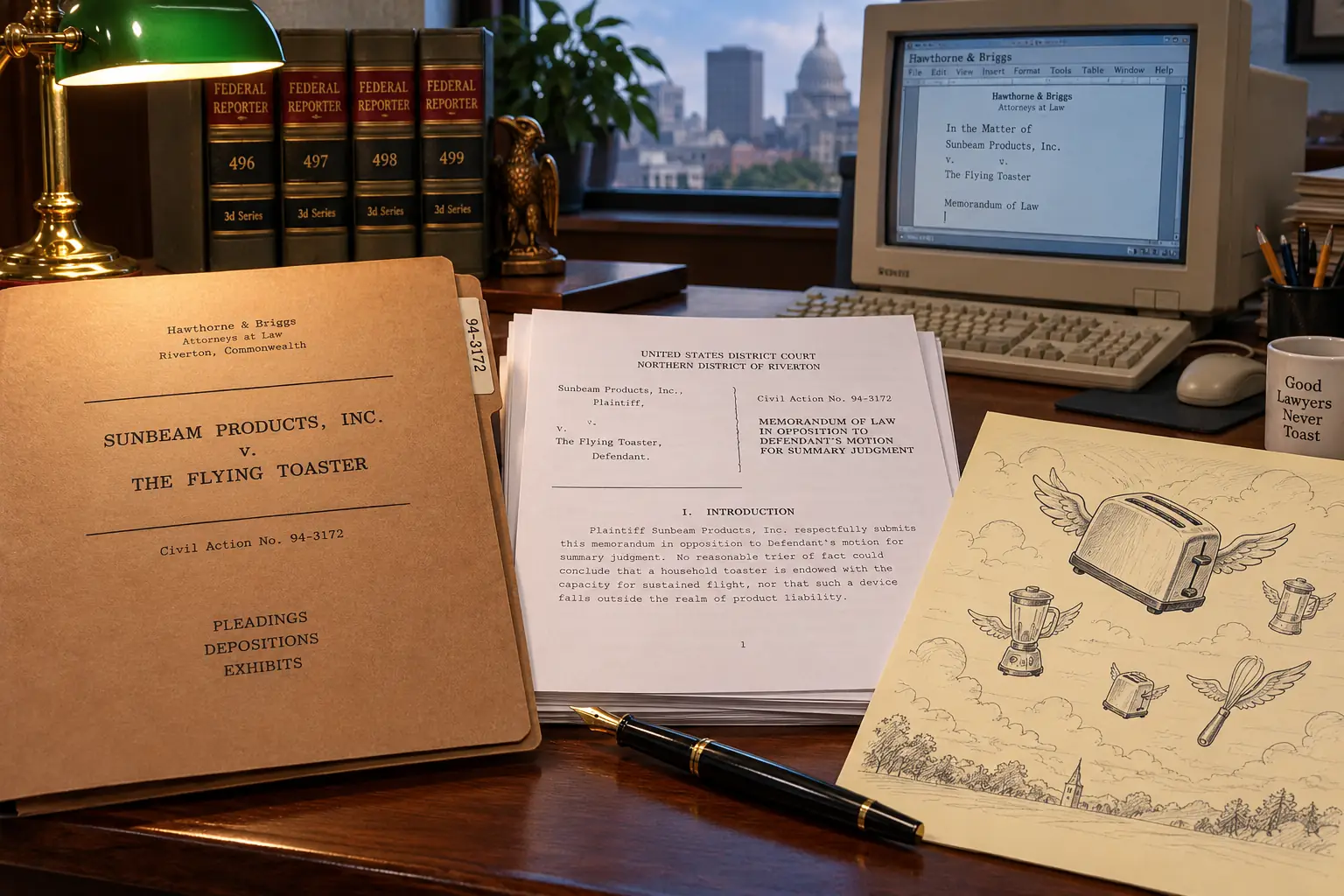
Jefferson Airplane’s 1973 live album Thirty Seconds Over Winterland had cover art showing winged toasters in formation. In 1994, the band’s business interests brought a case against Berkeley Systems over the resemblance to Flying Toasters.
Legend vs. the Record: Did the Court Decide Who Invented Flying Toasters?
No. The 1994 federal ruling did not settle who first thought of putting wings on a toaster. The judge dismissed the band’s federal copyright claim because the sound-recording registration relied on in the case did not cover the disputed album-cover art. The court also declined to hear the remaining state-law claims.
That is narrower than saying a court proved the screensaver design was original, or that the earlier album artwork had no protection of any kind. The actual October 4, 1994 decision is the best source for what was decided.
The disputes are funny only from a distance. For a software maker, the image was valuable enough to defend. For an artist or musician, visual credit and ownership also mattered. A flying toaster had crossed a line from harmless screen decoration into recognizable commercial art.
That may be the strongest proof of its place in computer culture. People were no longer discussing whether a screen saver worked. They were arguing over who owned a character from one.
The Long Flight Home
By the middle of the 1990s, screen savers were everywhere. Operating systems offered their own effects. Rivals sold fish, patterns, and other animations. Berkeley Systems expanded the After Dark line, while themed collections tied screen savers to familiar entertainment brands.
The original reason to buy a separate screen saver was also weakening. Built-in screen-saving and screen-blanking tools improved. Monitors changed. Then computers began turning the display off after periods of inactivity, which saved electricity as well as hiding the picture.
There were practical problems, too. Software that reached deep into an old operating system could break when the system changed. In January 2000, Macworld reported that Berkeley Systems had no plan to make After Dark compatible with Mac OS 9. That was a serious blow to anyone hoping to carry a favorite old control panel into a new Mac.
Yet the toasters did not disappear all at once. In 2003, Macworld reported a return through Japanese developer Infinisys and its rebuilt After Dark X products for Mac OS X. The animations had moved from a fragile old system add-on toward the screen-saver facilities provided by newer operating systems.
That is the unusual fate of Flying Toasters. It outlasted much of the reason it was originally sold. People still wanted the animation after they no longer needed that exact screen-saving tool.
What Is Left Today?
For an ordinary modern LCD monitor, a moving screen saver is usually not needed to stop the kind of phosphor burn-in that threatened old CRTs. A blank screen or automatic display sleep is generally a better energy choice. The US Department of Energy is clear: animated screen savers do not save electricity and may keep a computer working when it could sleep.
There is an important exception to the broad idea that burn-in is gone forever. OLED screens can still show lasting wear from long-term static images. The risk and the best protections depend on the display. A cheerful animation is not a substitute for appropriate screen-off, dimming, and display-care settings.
Can you still run the original Flying Toasters? On its intended old Macintosh or Windows systems, vintage copies remain part of software history, though compatibility depends on the exact edition and machine. Modern emulators and recreations also exist. They are not the same thing as a currently supported, licensed version of the 1990 module.
As checked in October 2026, the Japanese publisher Infinisys lists its After Dark X and related products among discontinued items, with support downloads intended for existing purchasers who have serial numbers. That should not be mistaken for a current retail recommendation. Old installation files from random websites also deserve caution.
For everyday screen care, use the sleep and lock features already in your operating system. For the old feeling, seek out museum accounts, period packaging, or a clearly identified modern tribute. There is no need to risk your main computer just to make breakfast fly again.
And perhaps that is why people still remember Flying Toasters. The software had a useful purpose, but it offered something beyond that purpose: a tiny, unexpected moment of humor in an ordinary workday. A screen could have turned black. Instead, it sent a toaster across the room.
Sources and Further Reading
- Jack Eastman interview, Nieuwe Instituut — firsthand account of After Dark’s development, the operating-system work, and the kitchen idea.
- Bill Stewart interview, Nieuwe Instituut — the design goals, team roles, and value of screen savers to workplaces.
- After Dark 2.0 retail box record — 1990 packaging details, modules, and stated functions.
- Lee Gomes, Washington Post, January 1992 — period reporting on the price, appeal, and competitors.
- Jefferson Airplane v. Berkeley Systems, 1994 — original federal ruling, including its limits.
- Los Angeles Times, December 1993 — contemporary report of the Delrina settlement.
- Macworld, January 2000 — contemporary report on After Dark and Mac OS 9 compatibility.
- US Department of Energy display guidance — why modern screen savers do not reduce power consumption.