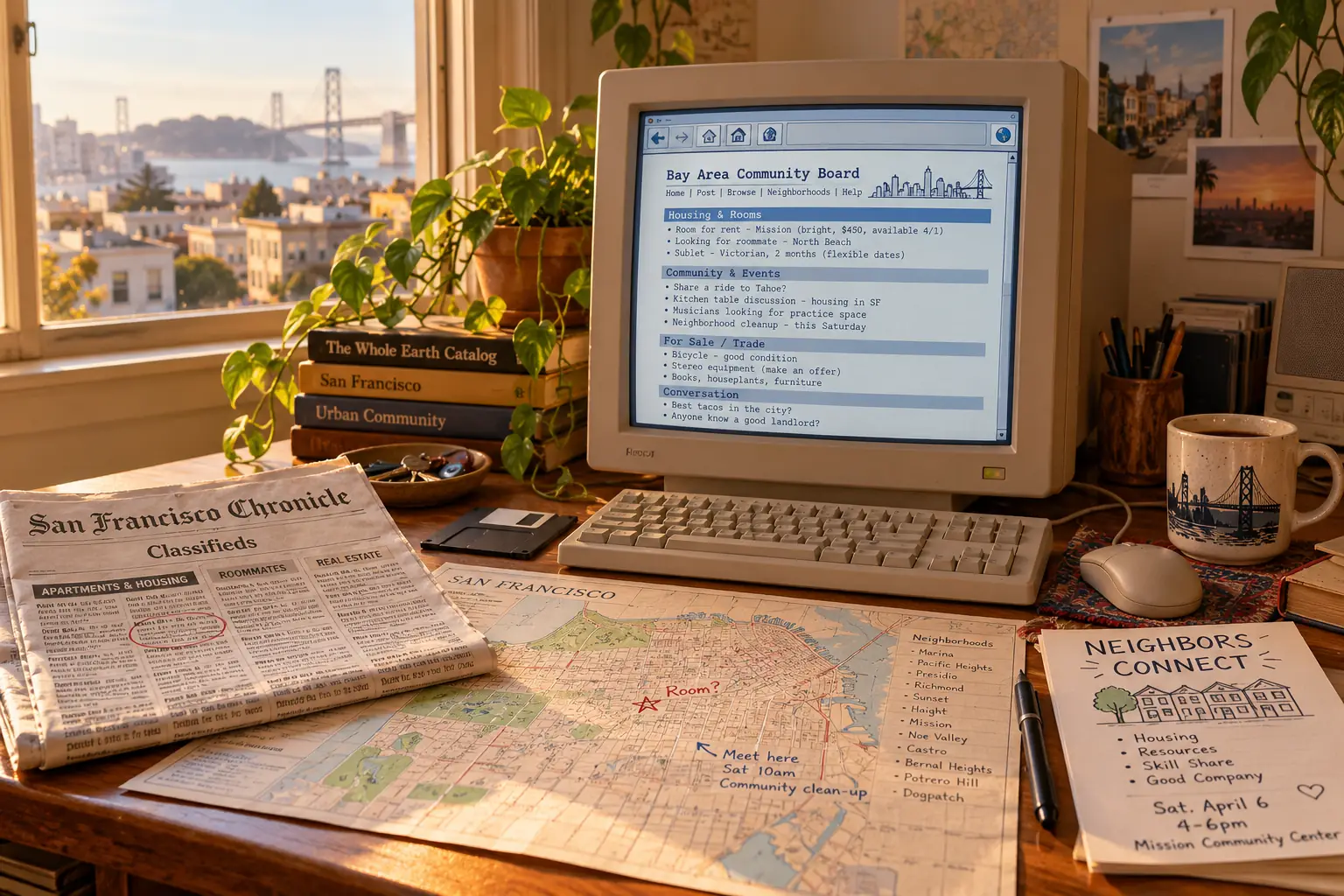
Craigslist nearly got a much duller name. In 1995, when Craig Newmark’s email list grew too large for the way he was sending it, he thought of calling the new mailing list SF Events. His friends had other ideas. They were already calling it Craigslist.
That small naming choice mattered. A few notes about art shows and technology gatherings in San Francisco were turning into something people felt belonged to them. Soon the same list would help someone find a room, fill a job, sell a chair, or give away a box of old things.
Newmark later told Computerworld in 2007 that the email list held about 240 addresses when his copying-and-sending method broke down. It is an unusually modest beginning for a service that would one day worry newspaper publishers across America.
It Started With Places to Go, Not Things to Buy
In the mid-1990s, Newmark was a programmer in the San Francisco Bay Area. He had worked at Charles Schwab and had been exploring the early Internet. In online spaces such as the WELL and Usenet, he noticed people sharing tips and helping strangers without asking for a fee.
He decided to pass along news of local arts and technology events. His own account of the site’s origins names gatherings such as Anon Salon and Joe’s Digital Diner. These were the sorts of events a newcomer might not see advertised in a newspaper.
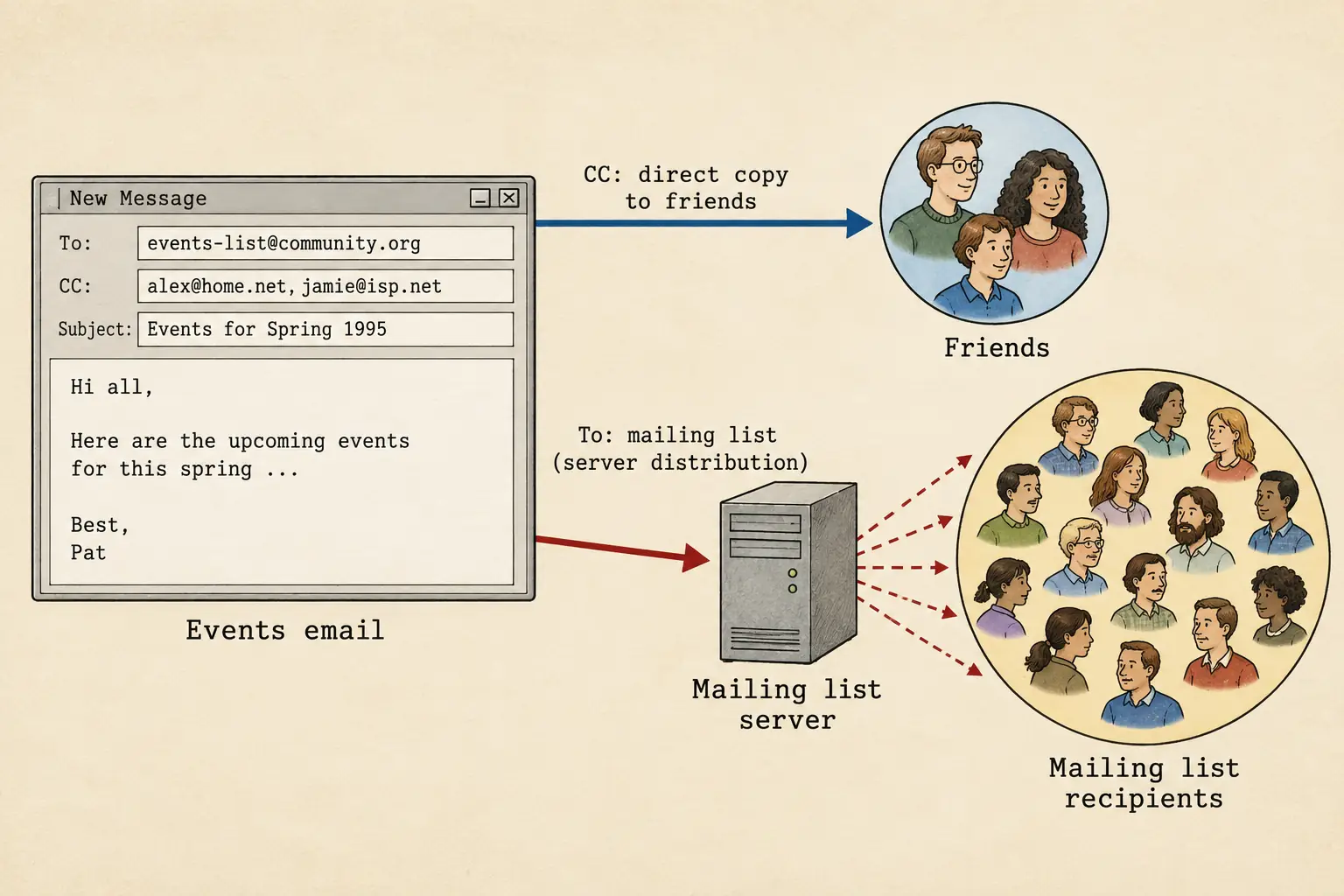
At first, there was no famous website to visit. Newmark sent a message to a group of people using email’s CC field. You may know CC as the box where you add more recipients. It was never meant to run a fast-growing city guide.
People told friends. Friends asked to be included. They also began asking if the list could carry more than events: perhaps an open job, an item for sale, or a place to rent. Newmark added these things as people requested them. Apartment notices were especially useful in a Bay Area already struggling with tight housing.
Behind the Scenes: The first thing to break was the mailing method
Newmark recalled that by the middle of 1995 his CC list had about 240 names, and his email tool could no longer handle it. He moved to a mailing-list program, which sent messages to a whole group without copying every address into a single email. He wanted the plain name SF Events, but his friends persuaded him to keep the nickname they had given it.
The 240 figure and naming story come from Newmark’s later interviews, including his 2004 interview with SFGATE. They are his recollection, not a surviving subscriber count from 1995.
By late 1995, Newmark was thinking like a programmer again. If email could carry the notices, software could turn them into web pages. His accounts place that idea in late 1995; the public web service is usually dated to 1996. It is better to keep the idea, the coding, and the move to a working site separate than to pretend there was one grand launch day.
Even then, the website did not suddenly replace the mailing list. In his 2007 interview, Newmark said the email version remained the main attraction for some time. He could not recall exactly when web use overtook it.
A City’s Noticeboard, With No Need to Buy a Newspaper
Think about the problem from a renter’s side. You needed an apartment. You could ask friends, read signs in windows, or buy a paper and search its small-print classified columns. If you were late, the best place might already be gone.
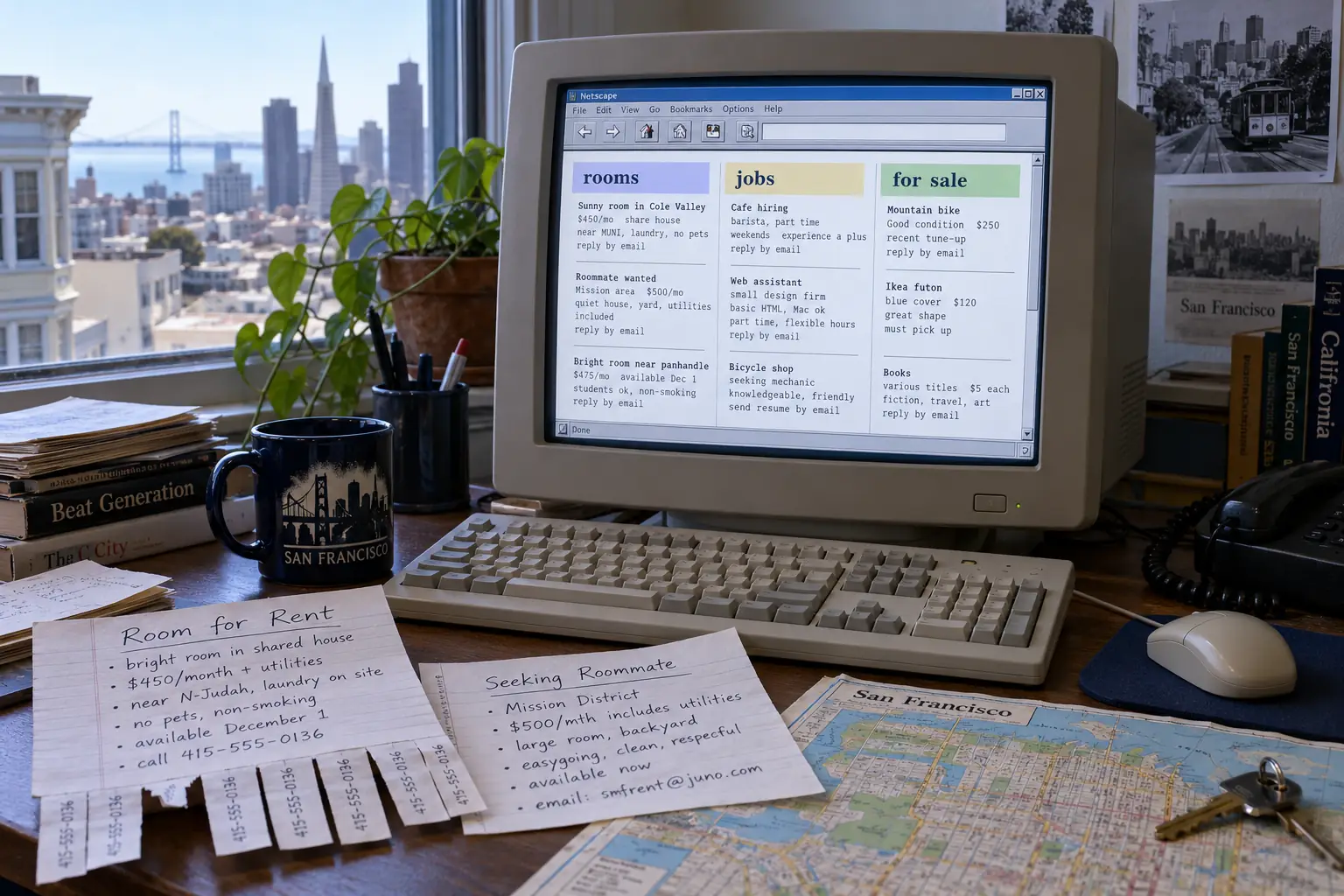
On Craigslist, a local notice could appear on a screen and be read by people looking for that very thing. A seller could describe a used table. A student could search for a room. An employer could advertise an opening. A neighbor could offer a box of packing supplies to anyone willing to collect it.
This was not a magic door to the Internet. In the 1990s, you still needed access through a home modem, workplace, school, or another connected computer. Once online, though, a user could visit the local Craigslist site with a browser. A listing could be viewed without buying a daily paper or waiting for the next issue.
The website also looked almost stubbornly plain. Lists of words and links did most of the work. Flashing ads, heavy graphics, and fancy design were not the point. The page was a tool you could read, even on an older connection.
The difference was not just speed. A printed classified ad was often a paid message placed with a publisher. Craigslist let many ordinary people publish their own notices, usually for free. This changed who could put a message in front of the neighborhood.
It was also a strange mix of public and private. The notice was public. The answer might come by email. The real exchange took place at an apartment, an office, or a street corner. Craigslist helped people find one another, but it did not supply a delivery truck, inspect the sofa, or guarantee the person who replied would be honest.
Remember the short, hopeful listing?
A few lines of text could do a lot of work: a rough price, a neighborhood, an email reply, and perhaps a photo when such things became easier to include. You still had to arrange the meeting, carry the furniture, and find out whether “good condition” meant the same thing to both people. This is a general description of the experience, not a copied historical ad.
A Free Noticeboard Still Needed Someone to Run It
One big choice came in 1997. According to Newmark’s recollections, Microsoft’s Sidewalk service approached him about banner advertising. Those ads could have brought in money. He turned the idea down.
That did not mean Craigslist would stay a one-person hobby forever. As traffic grew, so did the work. In 1998, Newmark tried a volunteer approach. He later described it as a failure: important tasks simply did not get done.
So in early 1999 he turned Craigslist into a company with paid staff. Charging for some employer job notices helped cover its costs while most community postings remained free. The result was not a nonprofit charity and not a website without a business model. It was a for-profit operation that chose to charge for a narrow slice of its service.
The distinction mattered. Craigslist could avoid the usual banner ads and still pay the bills. It also meant a large business did not have to turn every visitor into a sale.
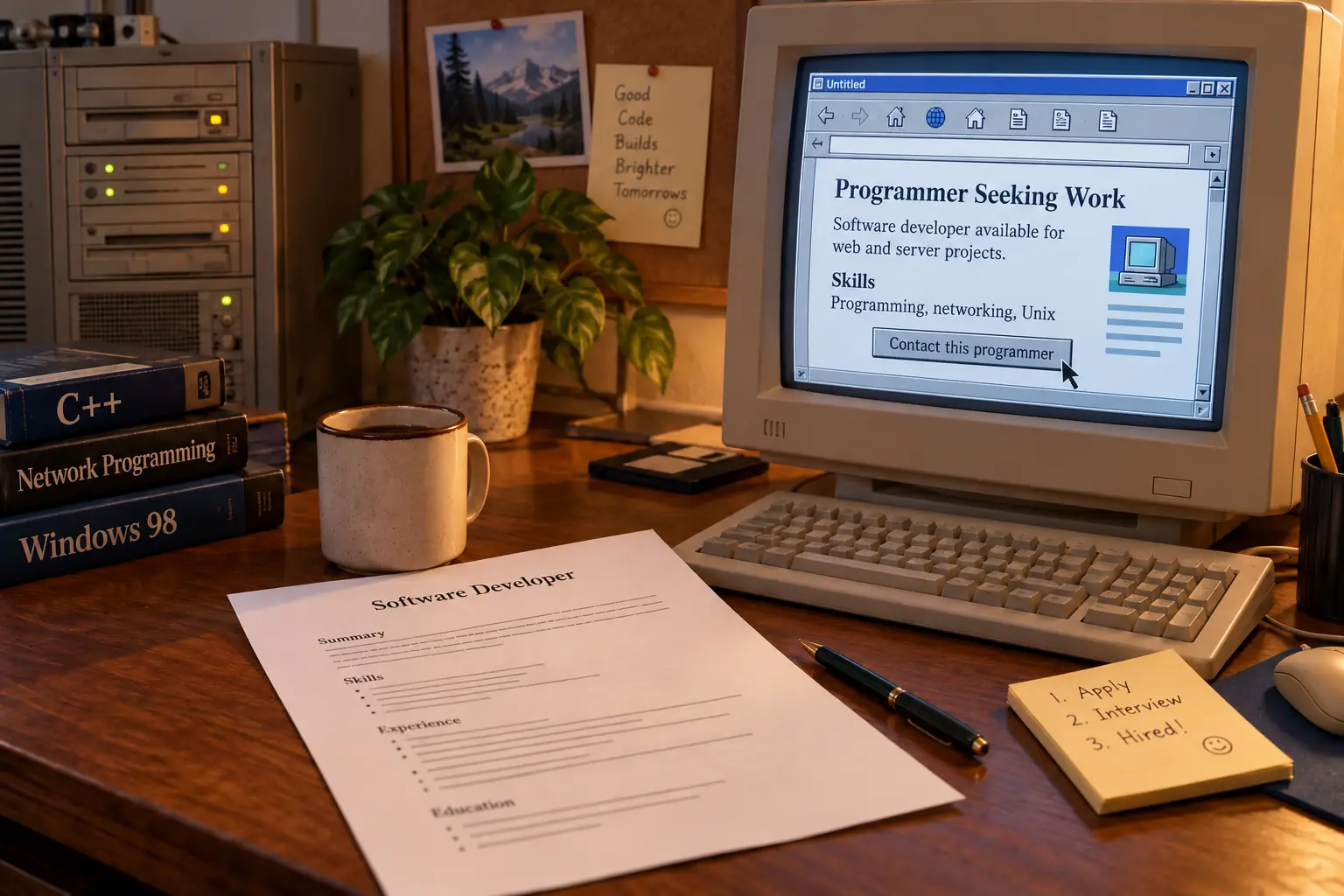
Newmark soon found a better person to manage the growing operation. Jim Buckmaster’s route into the company tells the story nicely: he had posted his own résumé on Craigslist. Newmark noticed it and hired him.
Buckmaster joined around 1999 and became CEO in 2000. He helped move the site beyond a small computer setup and build search, user posting, local city pages, and tools for community review. In a 2004 BusinessWeek interview preserved by Craigslist, he described a shift from posts reviewed by hand to a service that people could use themselves.
In other words, two kinds of work mattered: the social idea behind the list, and the quieter software needed to make it useful when strangers arrived by the thousands.
From San Francisco to Many Local Cities
Craigslist kept the neighborhood idea even as it spread. Rather than asking every person in America to search one giant pile of ads, it created pages for different cities and areas.
The company’s own expansion record lists the San Francisco Bay Area in March 1995, Boston in June 2000, and a group of cities in August 2000 that included Chicago, Los Angeles, New York, Portland, San Diego, Seattle, and Washington, DC. Those are dates for local services, not dates when each place first heard of the Internet.
By 2004, contemporary reporting described 45 Craigslist city sites and roughly five million unique monthly visitors. These figures belong to that year. They should not be mixed with later numbers as if they were measured at the same time.
The old site had become much larger, but the basic promise stayed local: here are people and things near enough for you to meet, help, hire, rent, or trade.
A Bargain for Users, a Shock for Newspapers
For years, newspaper classified pages helped pay for the news around them. Ads for jobs, housing, cars, and used goods made real money. A paper could charge for the small notice at the back and use part of that income to support reporting at the front.
Craigslist attacked that arrangement without publishing news of its own. Many of its ads were free. Local searches were quick. Buyers and sellers could contact one another directly. For a person with an old chair to sell, that was welcome news. For a newspaper that sold those little ads, it was a serious problem.

Researchers have measured part of this change. A study by Robert Seamans and Feng Zhu, published in Management Science in 2014, found that newspapers more dependent on classified ads suffered bigger business effects after Craigslist entered their markets. Their model estimated about $5 billion in savings to classified-ad buyers, in year-2000 dollars, over 2000–2007. That is a research estimate for a stated period, not a count of money Craigslist itself earned.
A later study by Milena Djourelova, Ruben Durante, and Gregory J. Martin reached further. Published online in 2024 and in the May 2025 issue of The Review of Economic Studies, it examined Craigslist’s staggered move into U.S. counties from 1995 to 2009 and records from more than 1,500 daily newspapers.
The authors found that after Craigslist arrived, newspapers that had relied more on classified ads lost more classified space and cut more jobs. For those more exposed papers, the study estimated a fall of about 4.2 percentage points in the share of pages used for classifieds, and about three staff jobs on average. The authors also found reductions in local political coverage.
This does not mean Craigslist alone ended the newspaper business. The Internet changed news, readers, advertising, and local economies in many ways. But it does mean that a cheap online noticeboard was part of a measurable loss of income that had helped pay local reporters. The humble secondhand chair had a connection to the local city hall beat.
For readers who want the numbers and methods, see the original Seamans–Zhu paper and the Djourelova–Durante–Martin study.
The Trust Was Real. So Were the Risks.
A name chosen by friends and a plain design can make a site feel human. It cannot tell you whether a stranger is safe. As Craigslist expanded, the same openness that made it useful created room for fraud, false ads, and harmful behavior.
The company added tools to let people flag suspect posts and developed other ways to handle complaints. Buckmaster described community flagging as one of the changes he helped introduce. Still, a flag is a warning signal, not a background check.
Some of the site’s troubles became public fights. In 2010, Craigslist closed its U.S. adult services section after pressure from officials and groups concerned about illegal activity and exploitation. A company representative told a congressional hearing that the section had been discontinued on September 3 and would not return. That record is available in the U.S. House hearing transcript.
In March 2018, Craigslist also removed its U.S. personals listings after Congress passed legislation known as FOSTA. The company said it feared the legal risk posed by unlawful use of those pages. Its own explanation shows how far the service had traveled from a trusted circle of acquaintances: it now had to decide which kinds of connections it could safely host.
The history is not simply one of a friendly website being spoiled by bad users. It is the larger problem of any open meeting place. Easy posting helps good neighbors find each other. The same ease can be abused.
Why a familiar-looking listing is not a promise
Craigslist’s current scam-avoidance guidance tells users to deal locally and face to face, avoid paying before meeting, and be wary of requests for money transfers, gift cards, or verification codes. A listing, a reply, and a friendly tone are not proof that a deal is genuine.
The Old-Fashioned Page That Never Quite Left
Craigslist was still operating when this story was checked in October 2026. Its official fee page showed that most posts remained free, while some job ads, dealer sales, services, and other categories carried fees that varied by place and type. The service’s help pages also said an account was not required just to make a post.
You could find much of the same work on other services: buying used goods, hunting for housing, looking for work, and arranging a local pickup. Craigslist was no longer the only online place to do it. But its spare design and city-by-city structure kept something of its early character.
Its deeper mark is easy to miss because it feels normal now. A person can put a small local notice online and reach people nearby without paying a newspaper to print it. That is ordinary behavior in the modern world. In the mid-1990s, it was a fresh way to connect.
The name, too, still tells the story. The founder wanted a neat label for an event list. His friends preferred a person’s name because the list felt like something shared among people they knew. It grew far beyond that circle, and it carried both the help and the hazards of meeting strangers. But the first idea was small and clear: someone has something useful to say; someone nearby might need to hear it.
Sources and Further Reading
- Craigslist, “Mission and History” — the company’s account of the email list, early uses, and choices about advertising.
- Computerworld interview with Craig Newmark (2007) — Newmark’s recollections of the 240-address list, naming, website, and failed volunteer phase.
- BusinessWeek interview with Jim Buckmaster (2004) — Buckmaster on his arrival, early computers, and changes to posting and moderation.
- Craigslist’s city expansion timeline — the service’s dated record of new local sites.
- Seamans and Zhu, Management Science (2014) — an economic study of the effect of Craigslist on newspaper markets and classified-ad buyers.
- Djourelova, Durante, and Martin, The Review of Economic Studies (2025) — evidence on classified ads, newspaper staffing, and local news after Craigslist entered markets.
- Craigslist posting fees and scam safety advice — current service rules checked October 24, 2026.