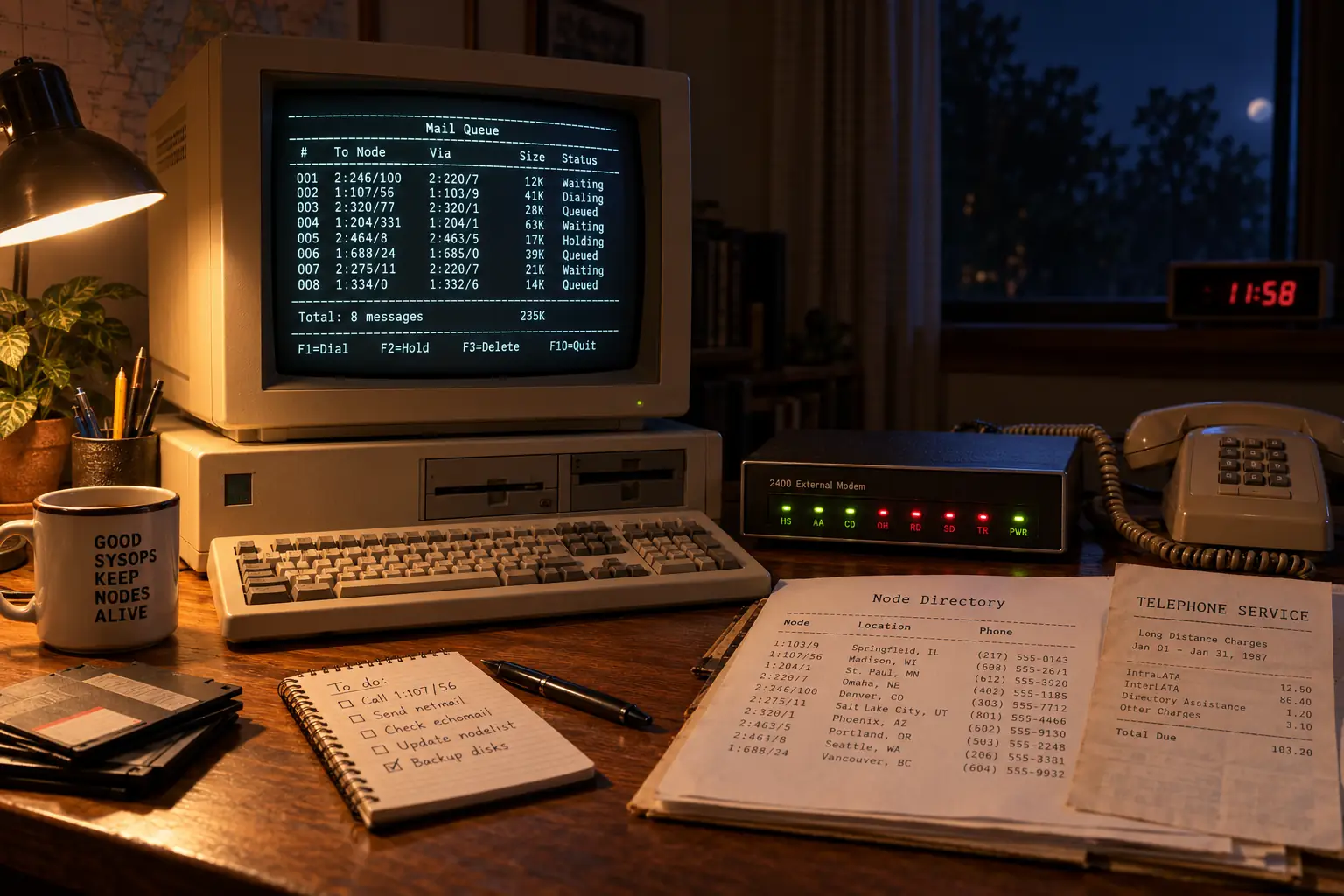
At four in the morning, the phone rang. Then it rang again. And again, every couple of minutes. When someone answered, there was no person on the line. Just a computer trying to reach another computer.
This was not a horror story about a machine taking over the house. It was a real problem in the early days of FidoNet. A wrong number had slipped into the network’s list of computers. The software kept calling a home that had nothing to do with it.
Tom Jennings, who created FidoNet, described the embarrassment in a history he wrote on February 8, 1985. He had to explain bulletin boards to a very unhappy person who had been woken up in the night.
The mistake reveals something wonderful and slightly alarming about FidoNet. It was a worldwide communications system built from ordinary computers, modems, phone numbers, and people willing to keep the whole thing running. Often, the computers did their most important work while their owners were asleep.
Long before a home internet connection became routine, a note typed on one local bulletin board could find its way across the country, or much farther, without its author making the distant call. That was FidoNet’s trick. The bill, and the hard work, still had to land somewhere.
Two Computers, One Unlikely Network
In 1984, most home computer users could not simply open a program and send an electronic message to someone in another state. Universities and big organizations had networks. Many ordinary PC owners had a telephone line and a modem, if they were lucky.
They also had bulletin board systems, or BBSs. A BBS was a computer waiting for phone calls. You dialed its number, read notices, wrote messages, and sometimes downloaded files. The operator, usually called the sysop, supplied the machine, software, storage, phone line, and patience.
Most boards were local islands. Calling a nearby number might be affordable. Calling a board thousands of miles away could make the next phone bill memorable for all the wrong reasons.
Tom Jennings was developing an MS-DOS BBS program called Fido in San Francisco. John Madill was running a Fido system in Baltimore. The two worked on a way for their boards to exchange messages automatically.
Jennings’s own 1985 account names his San Francisco system as Fido #1 and Madill’s Baltimore system as Fido #2. He described the first tests as an experiment done partly for the pleasure of seeing whether it would work. The useful result came fast: instead of signing on to each other’s boards or making voice calls, they could send electronic notes through the machines.
By roughly June 1984, Fido version 7 could put messages into a packet, call the other board, and transfer them. Jennings was clear about what it could not do yet. There was no clever routing, no full cost tracking, and little of the error handling that a large network would need.
That makes the first achievement more interesting, not less. FidoNet did not begin as a polished national service with offices and a subscription plan. It began as two computers learning to call each other.
Behind the Scenes: The St. Louis Problem
By August 1984, Jennings recalled, the network was approaching 30 nodes. Six were in St. Louis. His San Francisco board was placing separate calls to each one, even though one St. Louis board could collect messages for the others.
That waste helped push FidoNet toward routing through local groups. The same early history describes incorrect phone numbers, failed connections, and callers reaching homes instead of modems. Its most memorable lesson was simple: a global computer network still had to get the local phone number right..
What Using FidoNet Felt Like
For the person at home, FidoNet usually did not look like a grand international network. It looked like the same local BBS they already knew.
You needed a computer, a modem, communications software, and a phone connection. You found a BBS number in a computer club list, a magazine, or through a friend. Then you dialed it. With a one-line board, a busy signal meant someone else had got there first.
Once connected, you entered a name or account details, read menus made of text, and chose a message area. Some boards also had games, files, technical help, or local notices. The screen was not a web page. In the early years it was commonly plain text flowing over a slow modem connection.
You might post a message for a person in another city, or reply to a topic shared with other boards. Then you disconnected. The message did not need you to stay online. Later, the sysop’s software would do the shipping.
That was an important difference from live chat. A FidoNet reply could arrive hours later, sometimes longer. You checked back on your next visit, much as you might check a mailbox after the postman had been.
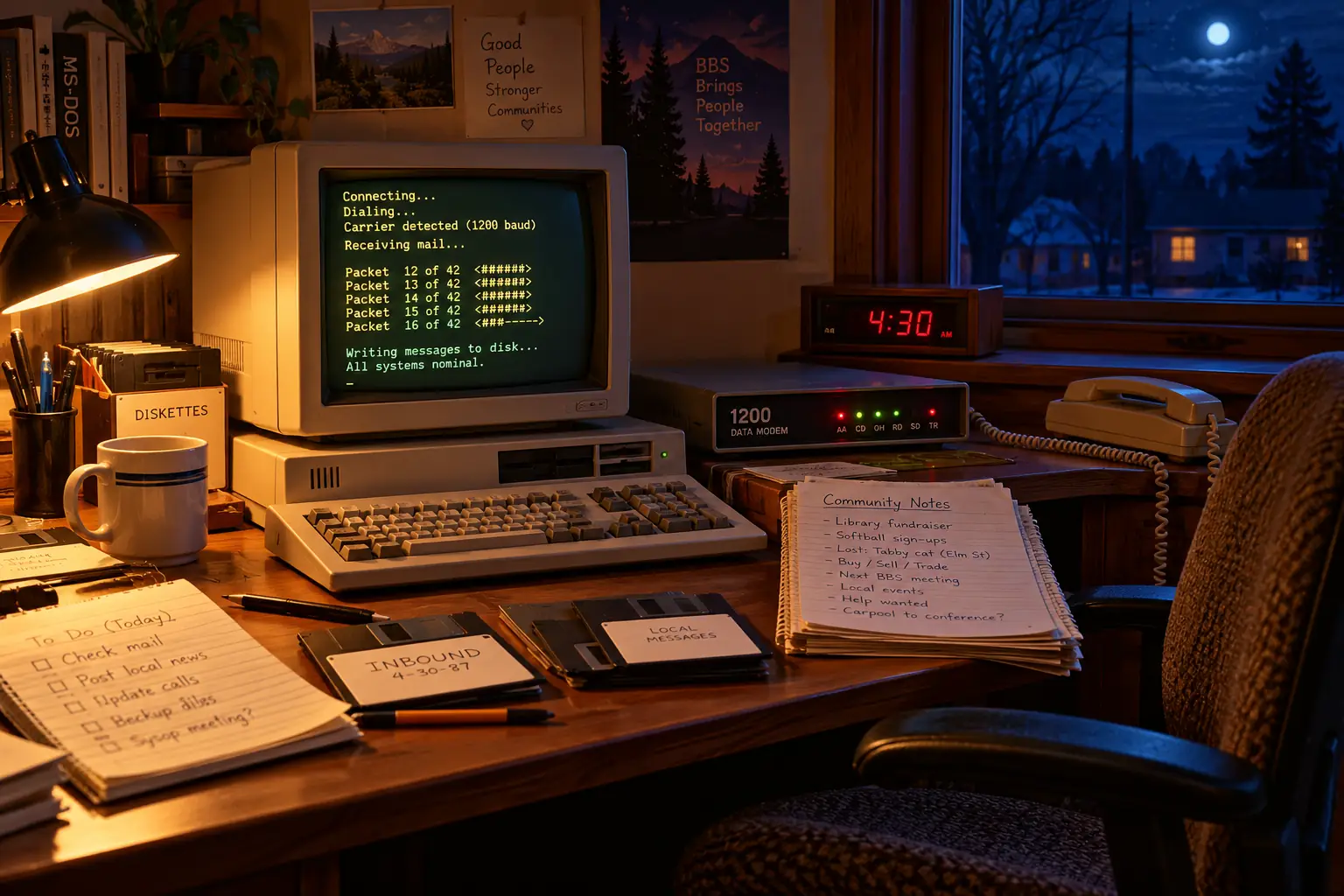
There was something appealing about this delay. The network did not demand an instant answer. Someone could write after dinner, the computers could trade messages overnight, and a stranger on another continent might read the note the next day.
But the pace also had a hard edge. If a connection failed, a board was down, or a message took a slow route, there was no promise of immediate delivery. The system depended on a chain of people and machines keeping their part of the bargain.
How One Message Crossed the Country
The easiest way to understand FidoNet is to follow a made-up example. The people and message below are illustrative; the steps reflect how routed BBS mail worked, though the exact schedules and routes varied.
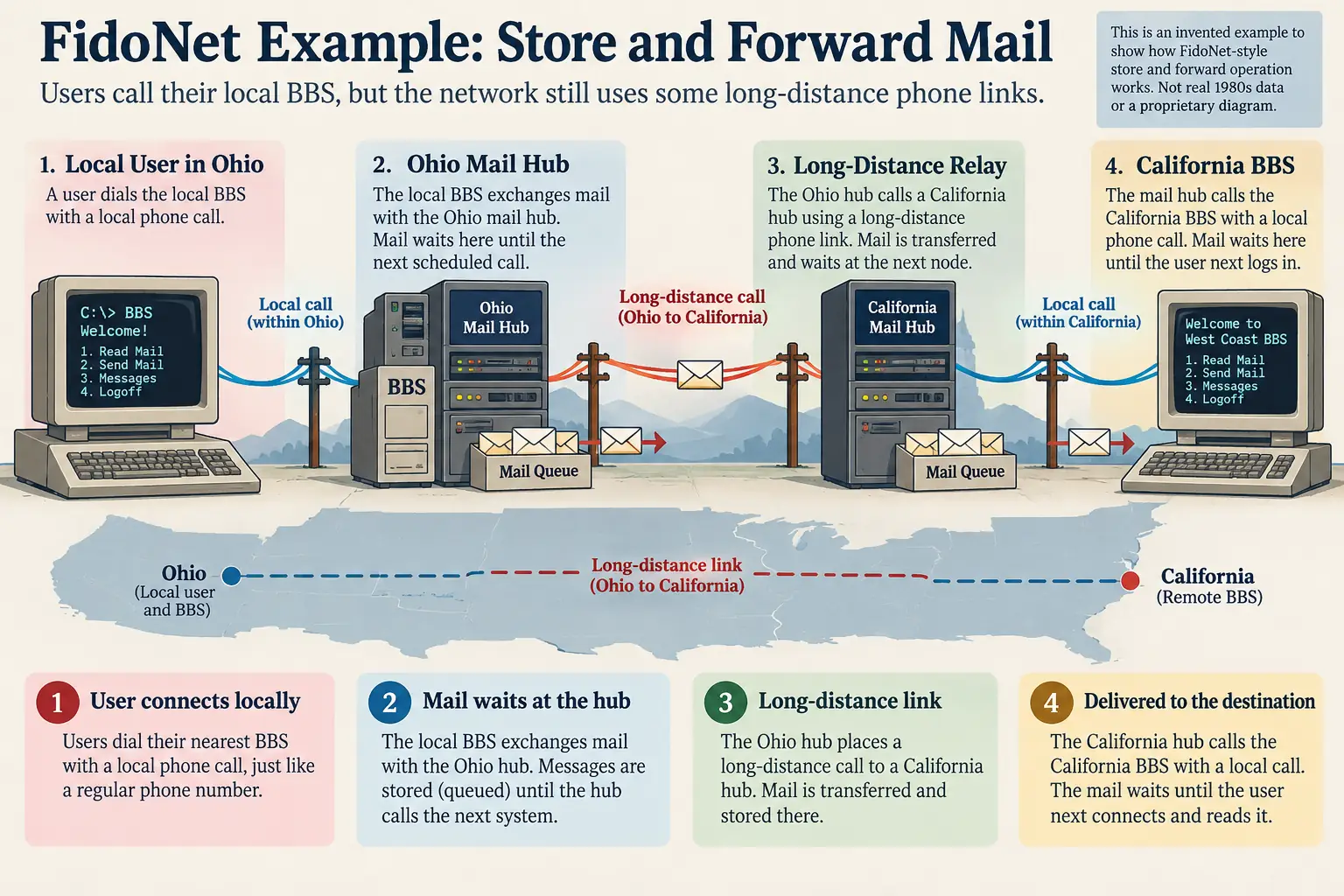
Suppose someone in a small town in Ohio wants to send a note to a FidoNet user in California.
- Write locally. The Ohio user dials a nearby BBS, signs in, writes the note, and logs off. The local phone call ends.
- Wait in the outgoing mail. The BBS stores the note with its destination address. It is not sent the instant the writer presses a key.
- Call a collection point. At a planned time, the board’s modem calls another node, often a local network host. Messages meant for distant places are grouped together.
- Travel by stages. A host or other routing node makes the longer calls needed to move mail toward California. Each stop can store the packet and send it on later.
- Arrive on the destination board. The final BBS receives the mail and makes it available for its user to read on the next login.
This is called store and forward. Think of letters moving through post offices. A letter might wait in a local bag, move to a regional center, and continue on another vehicle. FidoNet used files, modems, and telephone calls in place of bags and trucks.
A node was a participating system, not a single human user. A nodelist told other systems where to find it. As FidoNet expanded, its addresses grew more structured, with zones for broad parts of the world, networks for groups of systems, and node numbers for individual boards. This gave the network a shared map.
One board could also call another directly, especially when speed mattered and the caller was willing to pay. Routing was the money-saving option, not a rule that every message followed one fixed chain.
In a 1986 Compute! column, writer Arlan R. Levitan described a particular network schedule: local systems sent outgoing mail to their hosts around 4:30 a.m., and hosts sent incoming mail back around 5:00 to 5:30 a.m. Those are valuable details about one period’s operation, not a timetable for every FidoNet node everywhere. Read the period description.
The late-night window helped for two reasons. It avoided interrupting BBS users, and long-distance calls were often cheaper during off-peak hours. A period devoted to automated mail became known as national mail hour. Some boards stopped answering normal users while the machines exchanged packets.
A Network Without a Central Phone Bill
FidoNet is often remembered as a way to send a message around the world for the price of a local call. There is truth in that memory, but it leaves out the people who paid for the longer calls.
The local user might owe nothing beyond their own call to the board. The network itself still used real telephone lines. Long-distance connections cost money. So did extra phone lines, computer equipment, disks, electricity, and the sysop’s time.
What made the service affordable was shared effort. Nearby boards could pool their distant mail. A regional host could make one call carrying many messages instead of each board making several costly calls. Compression could shorten the transfer, saving phone minutes.
Some operators accepted the expense as a hobby. Others shared charges with fellow sysops or asked users for small dues. In 1993, a Washington Post report gave examples of local boards contributing about $5 a month toward long-distance costs, and some BBSs charging around $20 a year for access. Those were examples, not a worldwide FidoNet tariff. Many boards remained free. See the contemporary cost report.
There was no single company mailing every FidoNet user a monthly network bill. That helped independent boards join. It also meant the system depended on uneven local arrangements and the willingness of certain people to carry extra traffic.
Legend vs. the Record: Was Every FidoNet Call Local?
The tempting version: Worldwide messages crossed the globe through nothing but free local calls.
The record: Many users reached their BBS locally, and nearby boards often called a local host. But hosts and independent nodes still made long-distance calls to connect distant parts of the network. Routing reduced and shared costs; it did not make telephone companies disappear. The Compute! article and the 1993 cost report both describe this distinction.
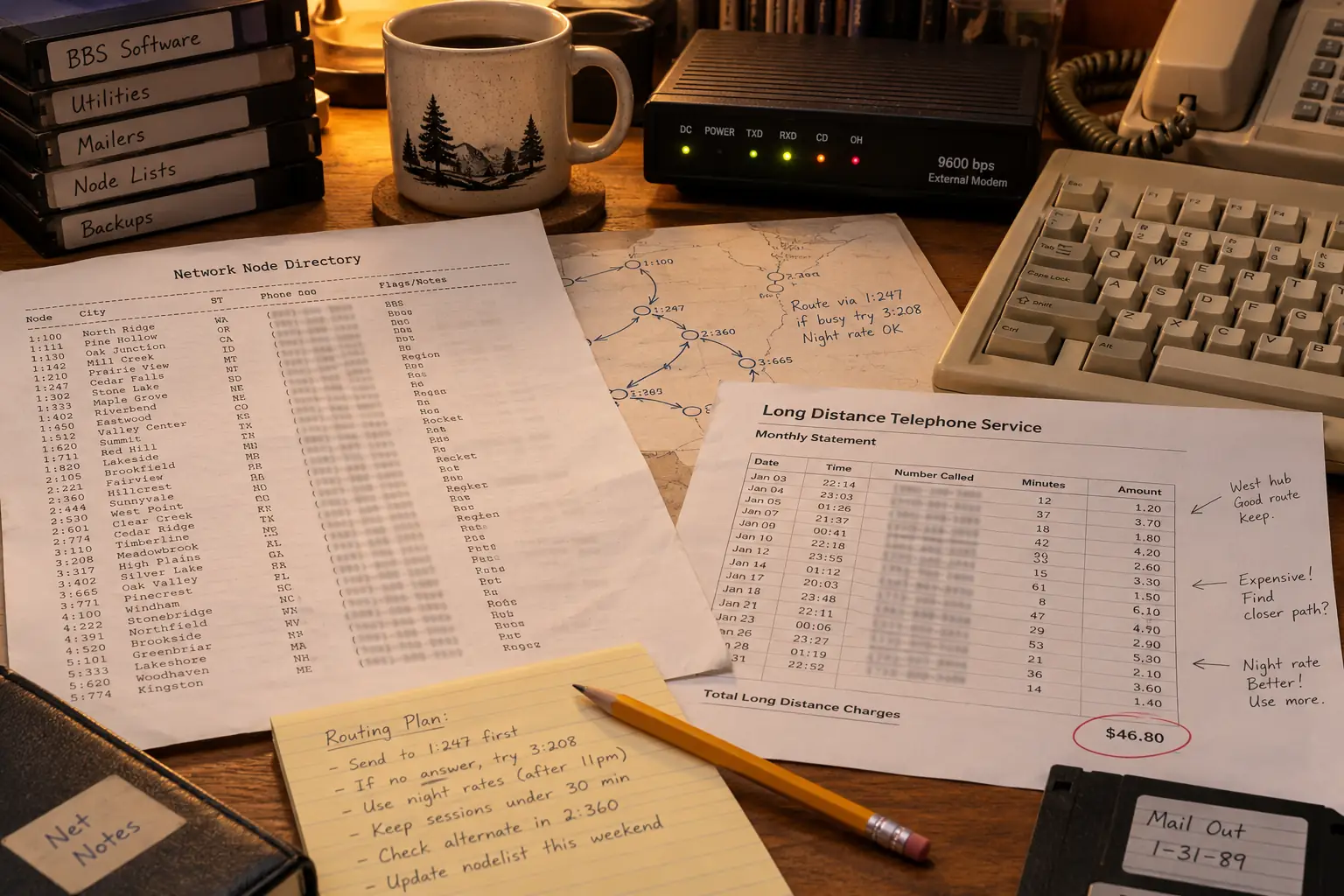
The nodelist mattered as much as a road map. If a number changed, the next call could fail. If a modem did not answer, a scheduled exchange might be missed. If a board stayed offline, messages could pile up. The machines could automate the calls. They could not automate away the need for reliable neighbors.
From One-to-One Mail to Everyone Talking
FidoNet’s first job was personal mail between boards, often called NetMail. It was useful, but people wanted more than electronic letters. They wanted the kind of public conversation that was happening on local message boards, only with a wider audience.
In the Dallas area, a group of sysops discussed ways to share conversations between their BBSs. Jeff Rush developed an answer that appeared in 1986: EchoMail.
Instead of carrying one private note to one destination, EchoMail let participating boards copy and pass on messages from shared discussion areas. One board could host a topic on computer hardware, another could carry the same topic, and a reply posted in one city could appear on boards elsewhere after their next exchanges.
The software needed to collect new messages, package them for neighboring boards, and place received messages into the right topic areas. People called some of those tools scanners and tossers. Odd names, perhaps, but the job was practical: sort the mail, send copies, and put new contributions where readers expected them.
A February 1989 EchoMail policy document credits Rush’s early programs and explains how these shared message areas developed. Kevin Driscoll’s 2016 history for IEEE Spectrum also describes EchoMail’s role in making FidoNet a place for wide-ranging conversations. Read the period EchoMail policy.
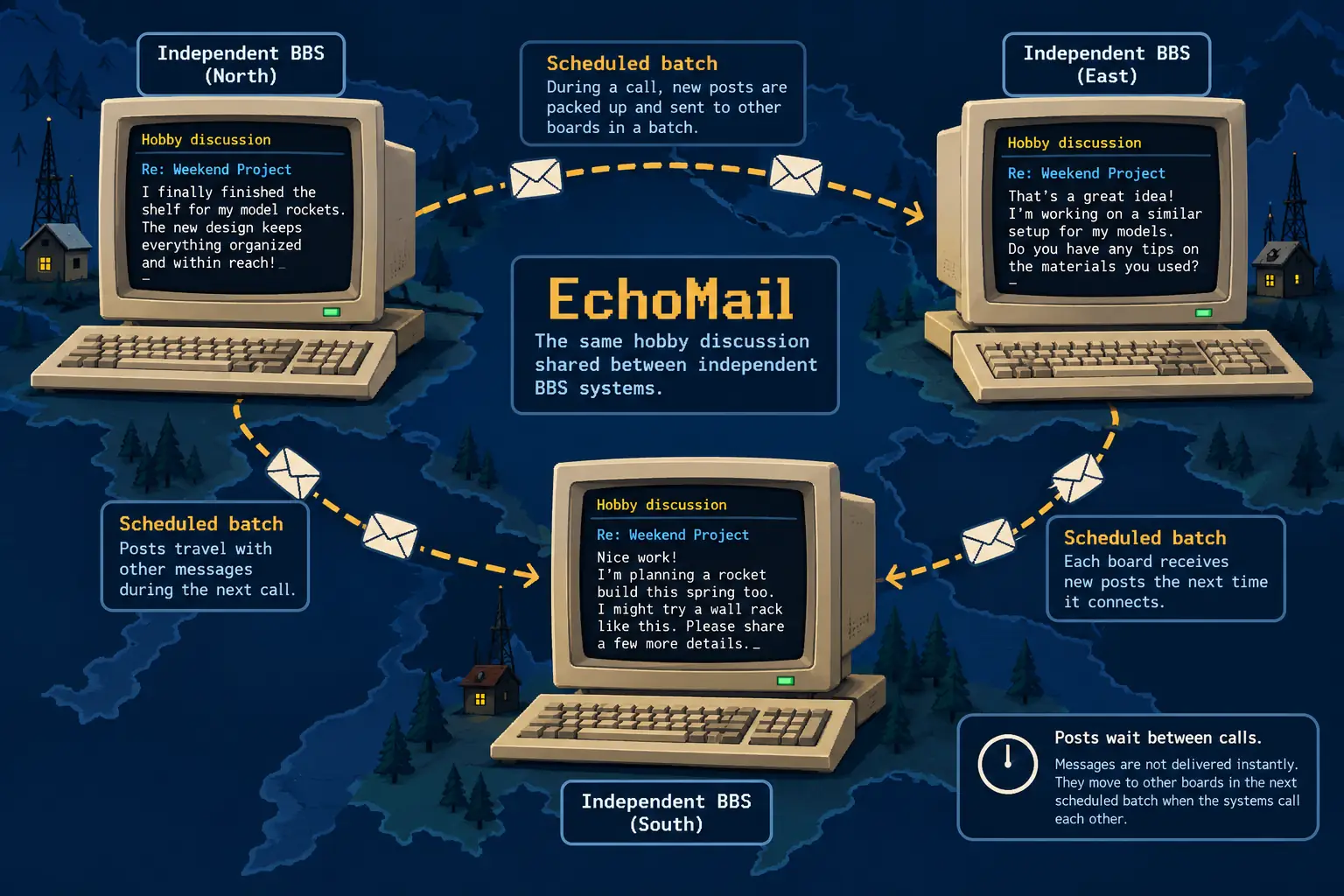
That was the human breakthrough. A board could keep its own name, local rules, members, and personality, while sharing part of its conversation with people who had never dialed its phone number.
It was not quite the same as a modern social network. The messages moved in batches. Different boards subscribed to different discussions. Rules and moderation depended on the people carrying each area. A post could spread widely, but there was no single giant website controlling every conversation.
The delayed pace also shaped the talk. Arguments and jokes could move across time zones one batch at a time. You could join an international discussion while still feeling attached to a very local machine run by someone you knew.
The Bigger FidoNet Became, the Harder It Was to Run
Growth came quickly. Jennings wrote that the network approached 30 nodes in August 1984. A 1986 Compute! report described more than 1,000 participating Fido systems. A 1993 Washington Post article counted more than 25,000 nodes. These figures describe different dates and contemporary counts; they should not be treated as measurements made by one uniform modern database.
They still show the scale of the achievement. Thousands of independently operated machines, with different owners and local conditions, agreed to trade information in a common format.
That success created arguments as well as friendships. Who decided which boards appeared in the nodelist? Who handled a bad address? What happened when a host could not afford the traffic? Which message areas should be shared? Could a volunteer network remain loose and friendly while it needed rules to function?
Its 1989 Policy 4.07 document shows how formal some of those answers had become. It defined network roles and described a weekly nodelist and coordinator structure. FidoNet did not stop being a volunteer project. But a network of this size could no longer rely on everyone knowing everyone else.
Technical limits remained. An ordinary BBS might have only one phone line. A modem could stay busy, a disk could fill, and a failed call could delay a whole queue. EchoMail discussions could generate more traffic than a host wanted to pay for. The act of joining a worldwide conversation still had a local cost.
Privacy was limited, too. A private message was not the same as modern end-to-end encrypted mail. Depending on its route and the software in use, it could pass through systems run by people the sender had never met. A sensible user did not treat ordinary FidoNet mail like a sealed, private vault.
Fun Fact: The Original Directory Was Also a Safety Tool
Jennings said he eventually required a message from a new node before adding its phone number to the directory. The test showed that a real Fido system was answering. In a network that placed calls without a human at the keyboard, confirming the number was not a small detail.
When the Internet Arrived, FidoNet Did Not Simply Vanish
As public internet access spread through the 1990s, the old economics changed. Electronic mail and discussion groups no longer had to depend on a volunteer chain of off-peak telephone calls. Faster connections and always-available internet services made the wait between BBS mail runs feel less attractive to many users.
FidoNet’s decline was not one dramatic shutdown. Boards closed at different times. Others changed software or began moving their mail over internet connections. The broad culture of dial-up BBSs grew smaller, but it did not end on a single day.
The key idea survived: independent systems could agree on a format, exchange messages, and let communities travel between places. FidoNet did not invent all of those ideas, and the modern internet did not descend from FidoNet alone. Still, it offered ordinary PC users a striking demonstration of shared communication before the web was a household habit. Kevin Driscoll’s BBS history for IEEE Spectrum places that achievement in the wider story of online social life.
And FidoNet is not merely an old name on a museum card. As checked on October 24, 2026, public archives were still listing FidoNet node directories dated into October 2026. Modern systems may move their traffic over the internet rather than over nighttime telephone lines. A listing shows ongoing network activity, though it does not prove that every listed board is reachable or busy. Explore the current nodelist archive.
Someone who wants to explore the old experience today can look for a maintained BBS reachable by telnet or another supported connection, then ask its operator whether it carries FidoNet message areas. Use current connection instructions and normal care with personal information. An open port or an archived number is not proof that a board is safe, active, or set up for visitors. There is no need to recreate an expensive international phone bill.
What stays memorable is the arrangement itself. A user wrote a few lines on a computer in one town. A sysop supplied the board. Another sysop carried a batch of mail. Still another delivered it. Each person saw only a little of the whole route.
And somewhere along the way, one wrong digit could wake a stranger at four in the morning.
FidoNet connected the world not because the telephone network was free or the machines were magical, but because enough people thought sharing the work was worth it.
Sources and Further Reading
- Tom Jennings, FidoNet History and Operation (February 8, 1985) — creator’s contemporary account of the first two nodes, early routing, St. Louis and mistaken telephone numbers; a later-hosted text copy.
- Arlan R. Levitan, Compute!, “Telecomputing Today” (1986) — period explanation of hosts, mail schedules, regional organization and shared costs.
- FidoNet EchoMail policy (February 1, 1989) — period description of shared conferences and their history.
- FidoNet Policy 4.07 (June 9, 1989) — formal structure and nodelist responsibilities.
- Steve Snow, The Washington Post (July 1993) — contemporary user costs, direct versus routed mail, and the scale of the network.
- Kevin Driscoll, IEEE Spectrum (October 24, 2016) — researched social and technical context for the BBS and FidoNet years.
- FidoNet nodelist archive (checked October 24, 2026) — evidence that network directories continue into the present; directory inclusion does not establish individual uptime.