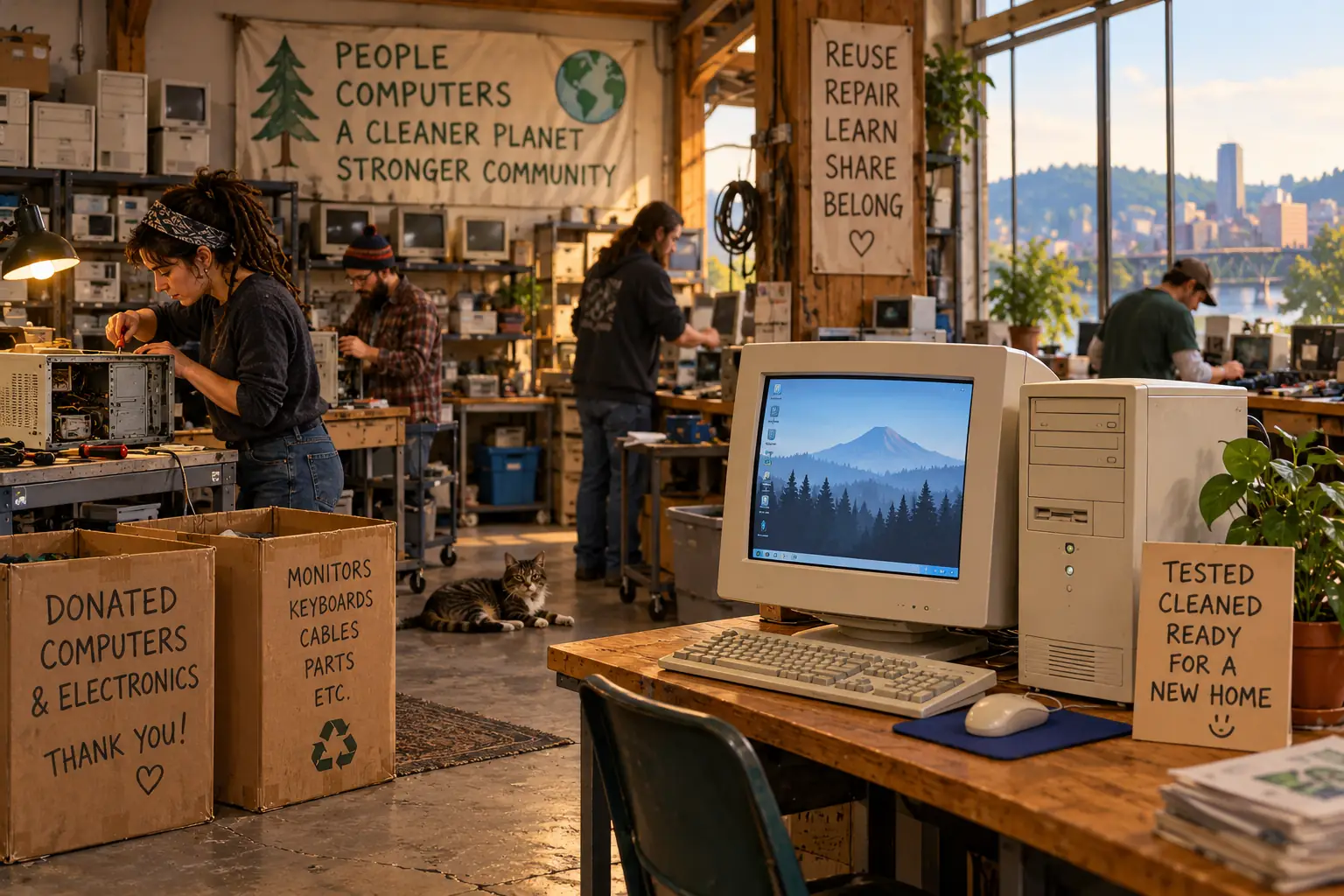
In June 2001, a post on a computer forum offered an unusual deal in Portland, Oregon. Help a local group with community service, and you might go home with a computer. The forum listing described a Pentium PC with 48 megabytes of memory, a hard drive of at least one gigabyte, a CD drive, a floppy drive, and a dial-up modem.
The software list included Linux Mandrake 7.2, AbiWord, Netscape Navigator, and The GIMP. No Windows license. No shiny new hardware. Yet one reader replied that it sounded like a good deal; another wondered whether the idea could work in Chicago. The exchange is still there in a June 18, 2001 forum thread. It is a user’s description of the offer, not an official Free Geek hardware specification.
In an era when even a secondhand computer could cost real money, that old beige box had value. It could help someone write a résumé, learn how the web worked, or discover what was inside a machine instead of treating it as a sealed mystery.
The group was Free Geek. Its clever idea was that two problems could help solve each other: Portland had growing piles of unwanted electronics, and some Portlanders had no computer of their own. Put the two together, add people willing to teach and learn, and the junk pile might become a doorway.
How a Pile of PCs Started a Movement
Free Geek made its public debut on Earth Day, April 22, 2000, at Pioneer Courthouse Square in downtown Portland. Its founder, Oso Martin, had been involved in planning that event. On September 1, the group opened a place on Southeast 10th Avenue where people could bring old electronics for reuse or recycling. These dates come from Free Geek’s own history.
It did not begin as a polished operation with rows of trained technicians. Martin later told a researcher that a discussion about unwanted computers brought an offer of help: money to file nonprofit papers and access to dozens of old machines at Lewis & Clark College. His account, retold in a 2013 case study, gives the early project a wonderfully modest starting point. It was a community idea that had found a pile of computers, not a technology company unveiling a product.
And the need was obvious. Offices and households were replacing machines. Some old computers were slow, but still useful; others were broken beyond sensible repair. Parts that had little value on their own could sometimes make another system work.
At the same time, a person without a computer had fewer chances to practice basic digital skills at home. A public terminal or borrowed machine helped, but it was not quite the same as having a working PC on your own desk.
Word traveled fast. Free Geek says a January 2001 article in The Oregonian about free computers for volunteers brought so much interest that the organization had to set up a waiting list. A project built around donated junk had found something it could scarcely keep up with: demand.
The 24-Hour Deal—and the Catch
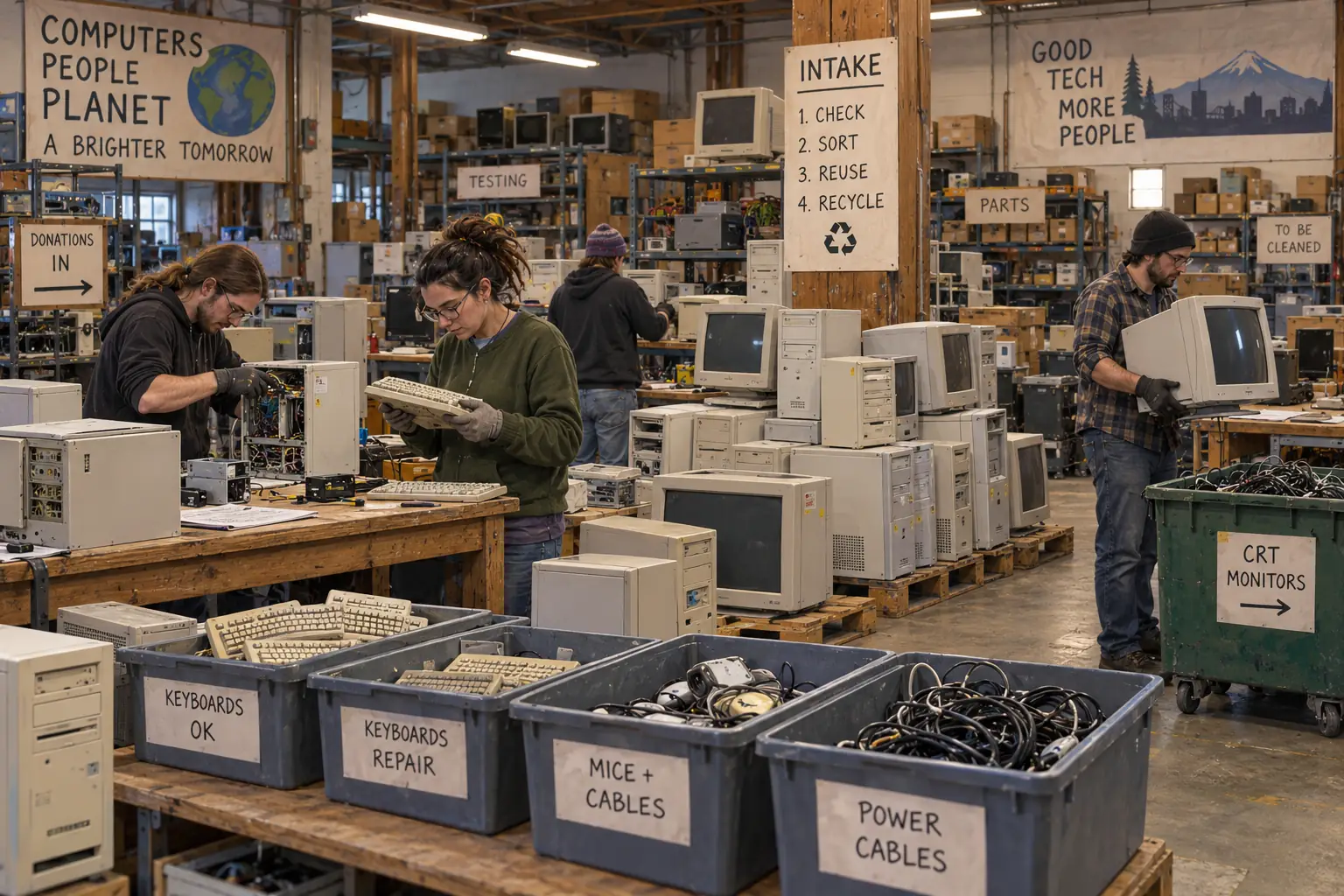
Here is the detail that gets lost when people retell the story: the rule was not always 24 hours. According to Free Geek’s historical account, its first computers went out after 12 hours of volunteer work. The requirement rose to 18 hours and then to the familiar 24. Free Geek called this the Adoption Program.
By the 2000s, 24 hours had become the number most people remembered. But it was not a cash price and it was not always a promise of an instant handover. People contributed labor over a series of shifts. Free Geek also had to have a suitable rebuilt computer ready for them.
What could a new volunteer actually do? They could receive equipment, sort parts, take apart machines, and help move the stream of donations through the workshop. The jobs did not all require a deep knowledge of computers. That mattered: a program meant to welcome new learners would fail if it demanded that every newcomer already knew how to rebuild a motherboard.
An old Free Geek telephone information script, preserved in the organization’s wiki and updated through 2014, spells out the bargain. It says a person could volunteer 24 hours at the facility to earn a computer. After those hours came a three-hour class to learn to use the machine, plus one year of technical support. The script also described seated tasks and an accessible facility. These were the rules described by that historical document; they should not be assumed to apply in every year.
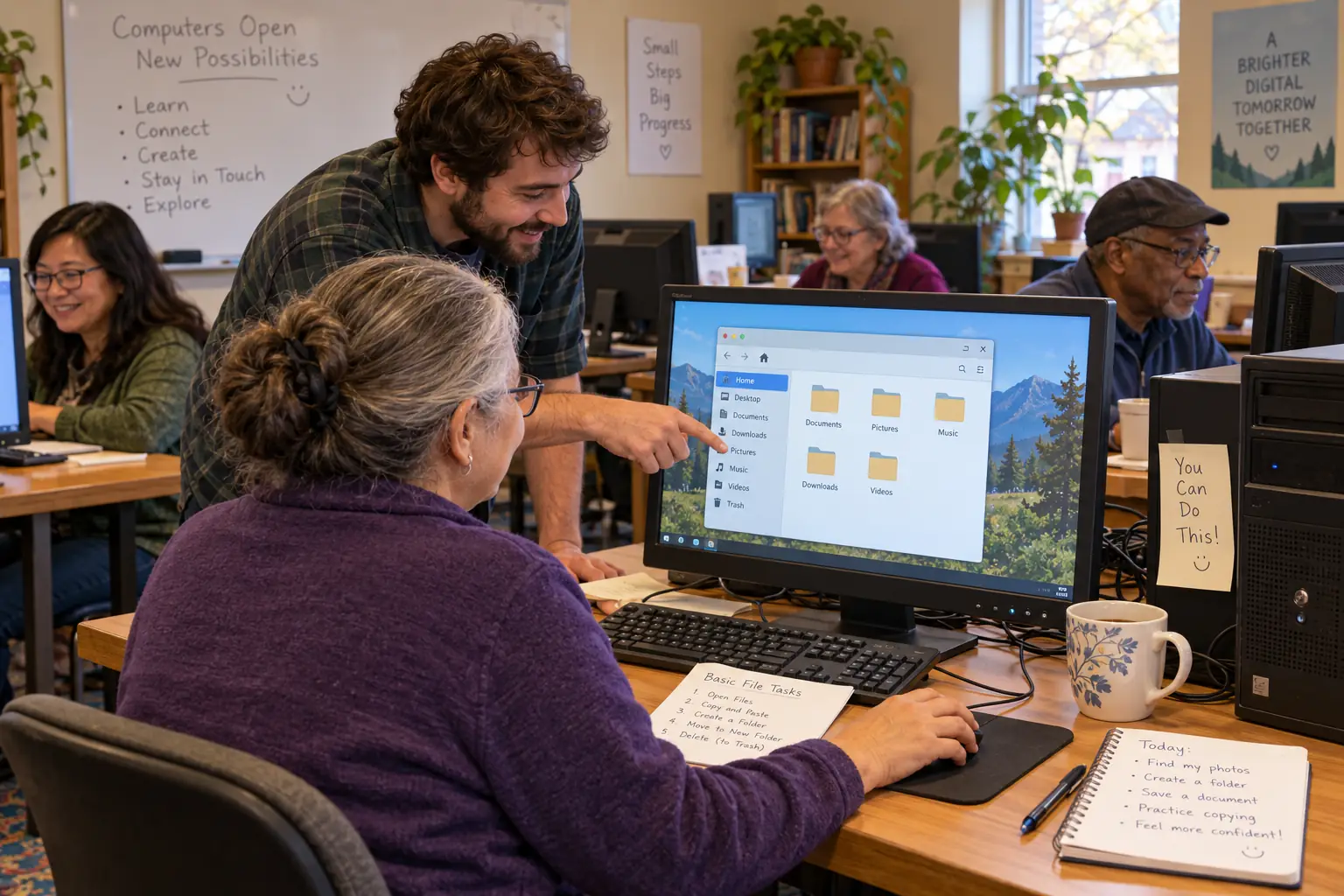
There is a quiet kindness in the class requirement. Handing a person an old PC is only half the job. What happens when it will not connect to the internet? How do you find a file, install a program, or ask for help? Free Geek was trying to give people a machine they might actually use, not just another object to take home.
Legend vs. the Record: Exactly 24 Hours for Everyone?
The short version: Volunteer 24 hours; get a free computer.
The fuller history: Free Geek began with 12 hours, later used 18, then 24. In 2002, a CIO report described service requirements ranging from 24 to 72 hours for different kinds of rewards or tasks. The Build route followed a different path. Twenty-four hours became the best-known rule, not a timeless rule for every person and every program.
What Happened to Donated Machines?
A donated computer did not automatically become somebody else’s computer. First came a choice: reuse it, strip it for working parts, or send its materials for proper recycling.
That choice sounds simple until a truckload of mixed electronics arrives. A beige tower might hold good memory and a dead power supply. Another might be missing its hard disk. A monitor could be too old, too damaged, or too costly to handle. The useful parts had to be tested, labeled, stored, and matched with other pieces. The rest needed a responsible route out of the building.
In a 2002 Salon interview, Martin estimated that about half the equipment coming in was junk. That was his period estimate, not an audited rate for all of Free Geek’s history. It still explains why a recycling center and a computer-building shop had to work side by side.
Getting the machines ready took more than collecting spare parts. Someone had to test the screen, keyboard, drives, and other components. Someone had to install usable software. Another person had to make sure the computer could survive the trip home and be set up by its new owner.
Free Geek did not treat all electronics as treasure. Keeping unusable equipment in the warehouse forever would defeat the point. Responsible recycling was a core part of the mission, and handling old displays and other components took care, space, and money.
The result was a busy flow of donated goods, volunteers, repair work, sales, and giveaway programs. In July 2002, CIO reported more than 16,000 pieces of equipment handled and more than 875 refurbished computers donated. Those were figures from an early snapshot, not lifetime totals.
Five for the Community, One for Home
Not everyone wanted only to earn a finished machine. Some wanted to learn how to assemble one. Free Geek built a second route for those volunteers: the Build Program.
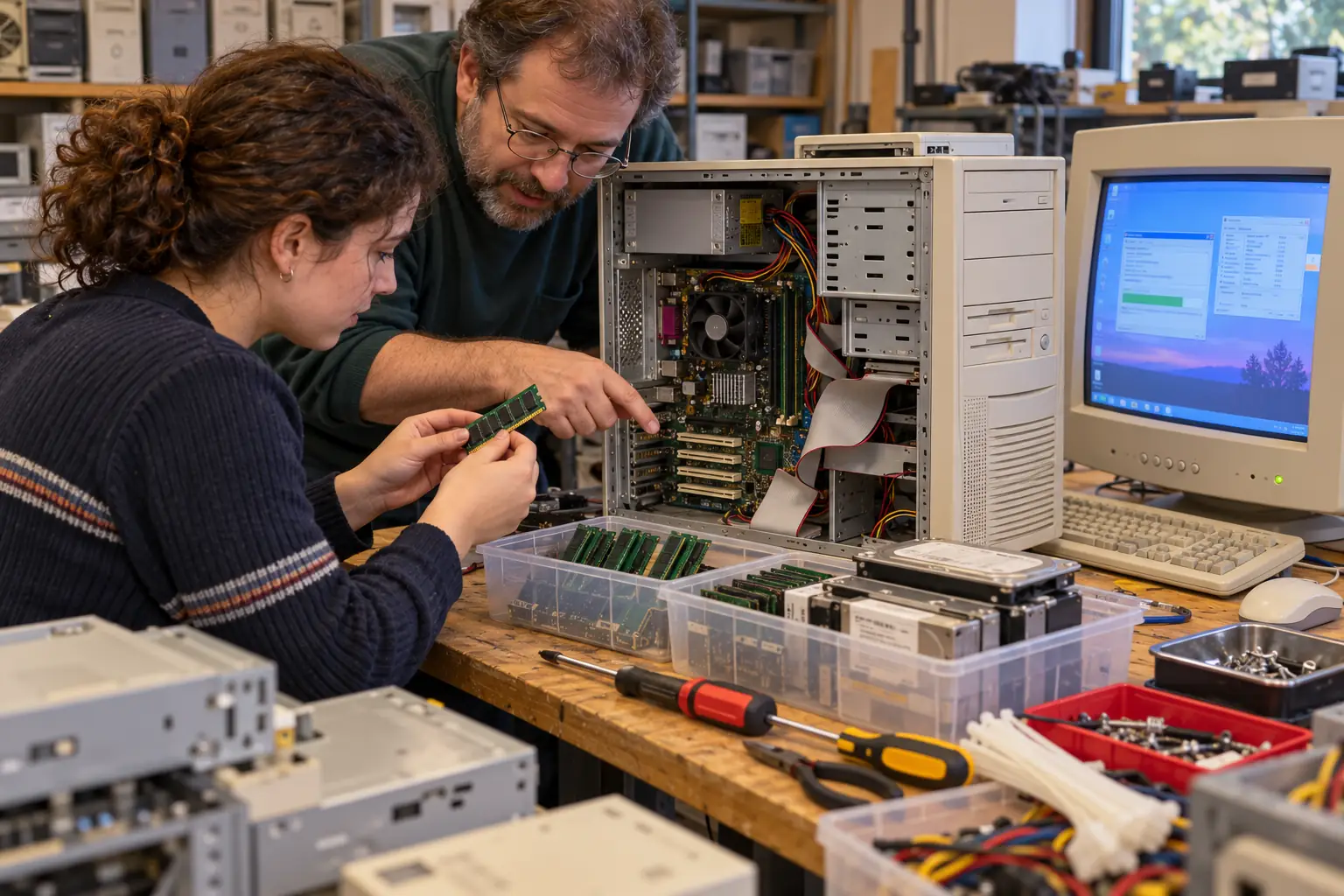
The rule had a satisfying rhythm. Learn the parts. Build computers for other people. After five completed machines, take the sixth one home. In his 2002 reporting, journalist Farhad Manjoo described that arrangement and spoke with Free Geek volunteer coordinator Phil Sano.
It was a different kind of bargain from sorting donations for 24 hours. Free Geek’s later telephone script estimated roughly 60 to 80 hours for builders to learn and assemble the required computers. That amount was tied to the skill path in that document, not a universal time limit for everyone who ever joined.
Think of what those hours could teach. A computer stops being a box that somehow works. The volunteer learns which cable powers the disk, how a memory stick fits, why a fan matters, and what to check when the machine refuses to start. Building one machine can be intimidating. Building several with instruction can make the process familiar.
Sano told Salon that part of the point was to remove the mystery that kept people from using computers. That is a bigger lesson than how to fit a card into a slot. A learner who can fix a machine has more control over it.
The sixth computer was therefore more than a reward. For some builders, it was proof of a new ability. They were taking home equipment they now understood.
From Free Geek’s Own Phone Script
The historic script lists two routes: Adoption (24 hours, a computer-use class, and support) and Build (roughly 60–80 hours, at least five computers built for Free Geek, and the sixth taken home). It also tells interested newcomers they did not need prior computer experience. This internal operating document is more useful for the rules of that period than a later one-line summary.
The Software Was Part of the Gift
Old hardware was only affordable to give away if it could also run useful software. Free Geek leaned on free and open-source software: programs people could use without buying another commercial license for each refurbished PC.
The 2001 forum post named Mandrake Linux, AbiWord, Netscape, and The GIMP. Later Free Geek systems ran other Linux versions, including Ubuntu. These were not the same exact desktop across the organization’s entire life. The operating system changed as the machines and the people using them changed.
There was a practical reason for that choice. A volunteer could load a working office tool, browser, and image editor onto a donated machine without adding the price of a fresh Windows or Microsoft Office license. Linux also suited Free Geek’s culture of sharing skills and learning how systems worked.
Of course, it could create a new learning curve. Someone used to a Windows PC at school or work might not know where to find the settings on a Linux computer. That is why a class and support line mattered. Free software removed one cost, but it did not remove the need for patience, teaching, or maintenance.
The People Behind the Curtain
Free Geek began as a volunteer-run effort. As more equipment and more people arrived, it needed regular staff, instructors, systems for tracking machines, and policies for how things should run.
Its early culture was unusually open. Free Geek describes a council of staff and volunteers making decisions by consensus. The work was physical and sometimes repetitive, but the group also wanted people on the floor to have a say in how the place operated.
One of its staff members had a title fit for a computer repair story. In a 2009 interview for Grassroots Economic Organizing, Richard Seymour was introduced under his official title: “That Man Behind the Curtain.” He explained that people in other places soon wanted to build their own versions of Free Geek.
That was a compliment with complications. Free Geek shared information about its methods, much as open-source software shares code. But copying a program is not as easy as downloading instructions. A new group also needs volunteers, storage space, suitable equipment, local money, safe recycling partners, and a way to make decisions.
Seymour told the interviewer that helping new groups took time away from the daily work in Portland. The original organization also worried about groups using the Free Geek name without following the same rules. In 2009, the report said there were nine related organizations in the United States and Canada, while noting problems with how some were run. Those were counts and concerns from that year, not a claim that all later groups were identical.
Free Geek eventually set out principles for groups that wanted to use its name. These covered low-cost technology, free software, ethical disposal, nonprofit goals, and democratic methods. The story is not simply that Portland invented a popular giveaway. It tried to share a way of working—and learned that good intentions needed clear standards.
Behind the Scenes: Open Source for an Organization
Free Geek’s open-source idea went beyond Linux. According to Jim Johnson’s 2009 interview with Richard Seymour, the group made many policies and founding documents public so other communities could learn from them. Seymour also described the hard part: keeping that open spirit while protecting private information and checking that new groups would follow its values.
What Became of the 24-Hour Computer?
For years, Portland Free Geek used volunteer labor, rebuilt computers, training, and recycling as connected parts of one operation. But it was not locked in the year 2001.
Free Geek says it merged the Adoption and Build routes into one Volunteer Program in 2016. Volunteers could work in recycling or reuse toward earning a computer. As refurbishment methods changed, the organization later moved some energy toward structured hardware education, including the TECHS Academy launched in 2018.
Its mission also widened. The challenge was no longer only getting somebody a working desktop. People needed access to laptops, digital skills, help using online services, and support that did not depend on their being able to perform volunteer shifts. Free Geek developed programs for individuals and nonprofit groups as well as its long-running recycling work.
By October 2026, the old 24-hour offer should not be treated as a current sign-up deal. Free Geek’s volunteer page says its structured free-computer program for volunteers is paused. Its individual assistance page points instead to need-based device programs and a laptop waitlist, subject to current availability. Its site also reports a move in October 2026 from the old Southeast 10th Avenue address to 1700 SE Grand Avenue in Portland.
The present programs have their own rules. A reader looking for help today should check Free Geek directly rather than show up expecting the bargain described in a twenty-year-old article.
A Computer You Helped Rescue
The little computer in that June 2001 forum post was no speed monster. Forty-eight megabytes of memory would make a modern browser laugh. But in its own moment, it could be a first home computer, a place to learn Linux, a way to write documents, or a machine to take apart without fear.
Free Geek’s great idea was not that old computers were secretly new. They were old. Some were broken. Some really did need to be recycled.
The better idea was about people. A donor could stop a useful machine from becoming waste. A volunteer with no repair skills could learn to sort it. A builder could learn why it worked. And someone who could not afford a new PC could take home a computer, along with a little knowledge of how to keep it running.
That is why the 24 hours still make a good story. Free Geek was giving away computers, yes. But it was also helping people become the kind of person who could open the case and know what to do next.
Sources and Further Reading
- Free Geek: History — the organization’s account of its 2000 launch, waiting list, changing volunteer-hour rule, Build Program, and later changes.
- AnandTech Forums, June 18, 2001 — a period user posting a detailed Linux PC offer; a useful snapshot, not an official equipment guarantee.
- Simone Kaplan, CIO, July 1, 2002 — early refurbishment totals, service requirements, and the nonprofit’s operating model.
- Farhad Manjoo, Salon, September 23, 2002 — interviews with founder Oso Martin and volunteer coordinator Phil Sano; explains the Build route.
- Free Geek’s historical telephone script — internal descriptions of Adoption, Build, classes, support, and access. The wiki notes that some material is old or moved.
- Jim Johnson, Grassroots Economic Organizing, May 20, 2009 — firsthand interview with Richard Seymour on staff culture, shared principles, and replication.
- Greg Bloom, Free Geek case study, 2013 — later founder recollections and a study of the worker-managed model.
- Free Geek: Volunteer and Free Geek: Individuals — status of computer-access and volunteer programs, checked October 24, 2026.