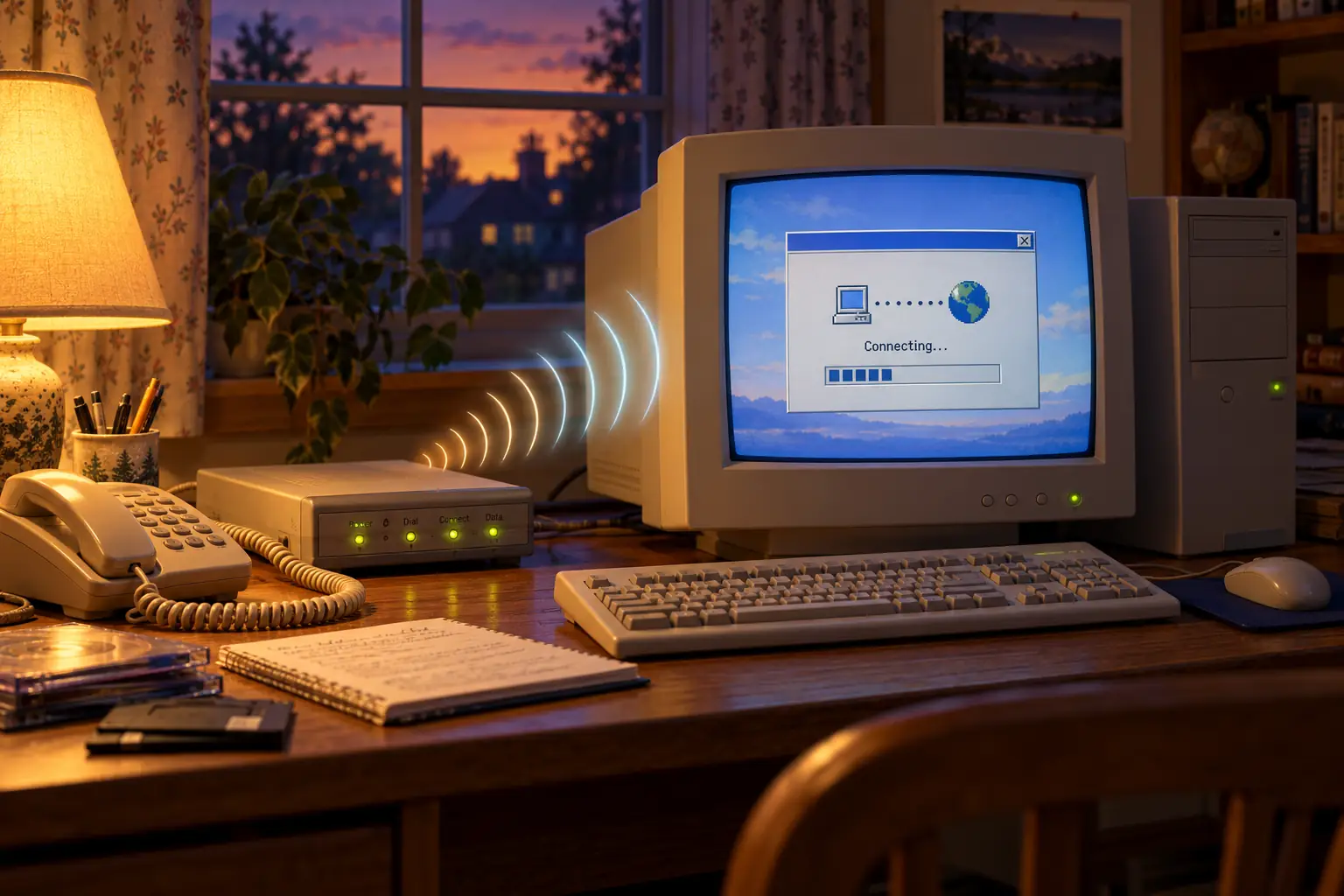
In 2012, signal researcher Oona Räisänen took a familiar old noise and turned it into a picture. She placed the sound of a dial-up modem on a chart that shows how sound changes over time. Suddenly, the screech had parts. There was a phone dialing, an answer, a test, and a careful agreement about how to talk.
Her annotated sound study used a recording made by William Termini on an iMac G3. The result was a small revelation: the noise that many families heard as a single shriek was a conversation with a purpose.
But that conversation was only half the story. Around the year 2000, it might begin after several busy signals, take over the one phone line in the house, connect at a disappointing speed, and leave someone watching the clock. A successful handshake felt like a tiny victory. It was also the start of another wait.
Using the Phone to Get Online
A dial-up modem did not bring the internet into a home on its own wire. It borrowed the ordinary telephone line. The computer asked the modem to call an access number supplied by an internet service provider, or ISP. At the other end, a bank of equipment answered the call and helped the computer reach the wider network.
On many Windows PCs, the user opened a connection window, picked a saved service, and clicked a button to dial. Earlier setups might use separate communications software or a terminal program. You had to enter the right phone number, set up the account, and sometimes add a prefix to reach an outside line. There was no single setup shared by every home or country.
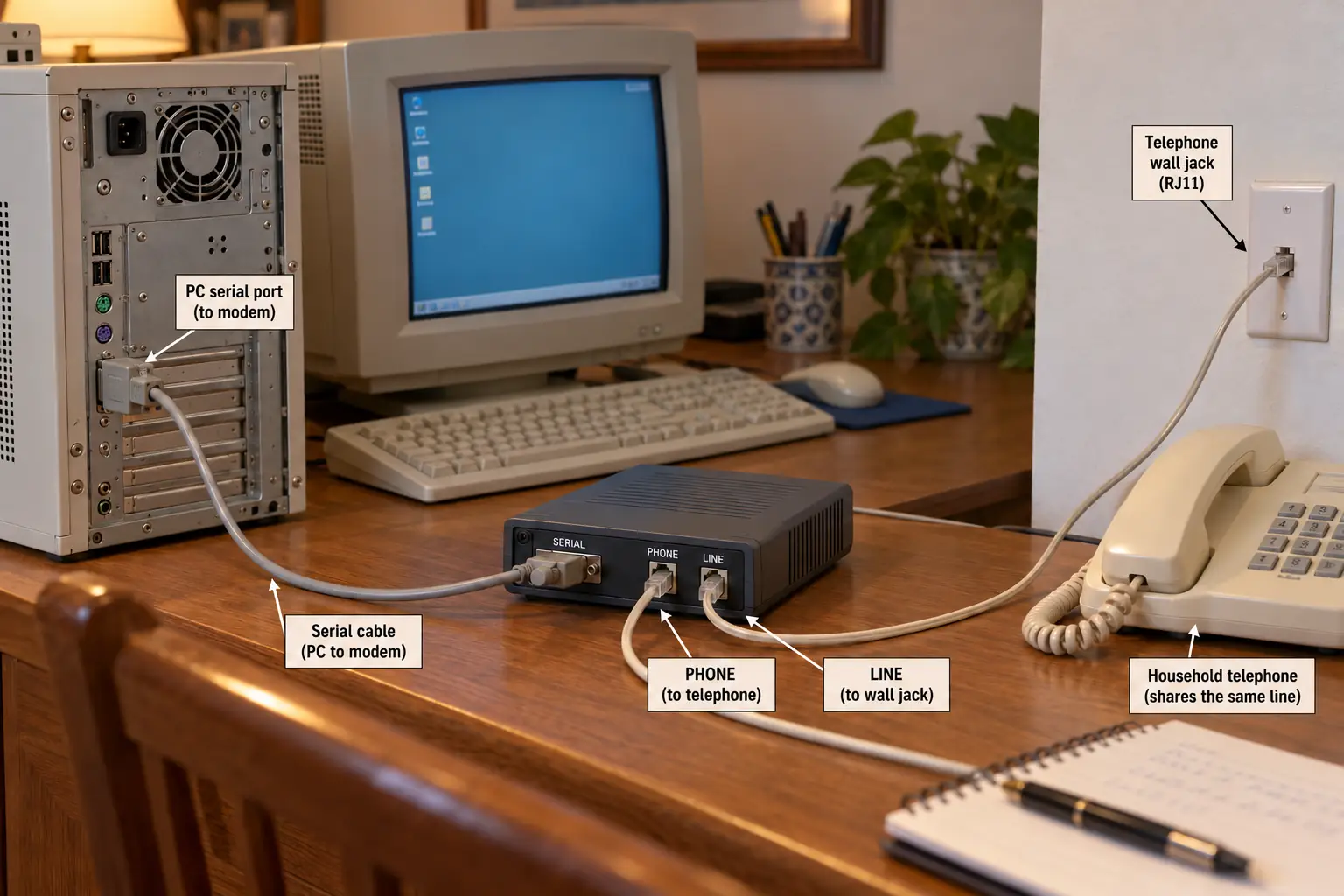
The modem could be a box with blinking lights beside the monitor, or a card hidden inside the computer. A cable ran to the telephone wall jack. Sometimes a telephone shared the same socket through the modem or a splitter. If the phone system expected a local area code or special dialing pattern, the software had to get that right too.
When dialing began, a relay might click. You might hear the usual dial tone, the short musical notes of the phone number, and a ringing sound from the network. Then came the famous rising whistles and harsh bursts. All this was audio traveling over a line built for voices.
It helped to remember what the modem’s name meant: modulator-demodulator. It changed computer data into signals a voice telephone circuit could carry, then changed received signals back into data. No one at the other end was supposed to listen. Another modem was listening instead.
What the Screech Actually Said
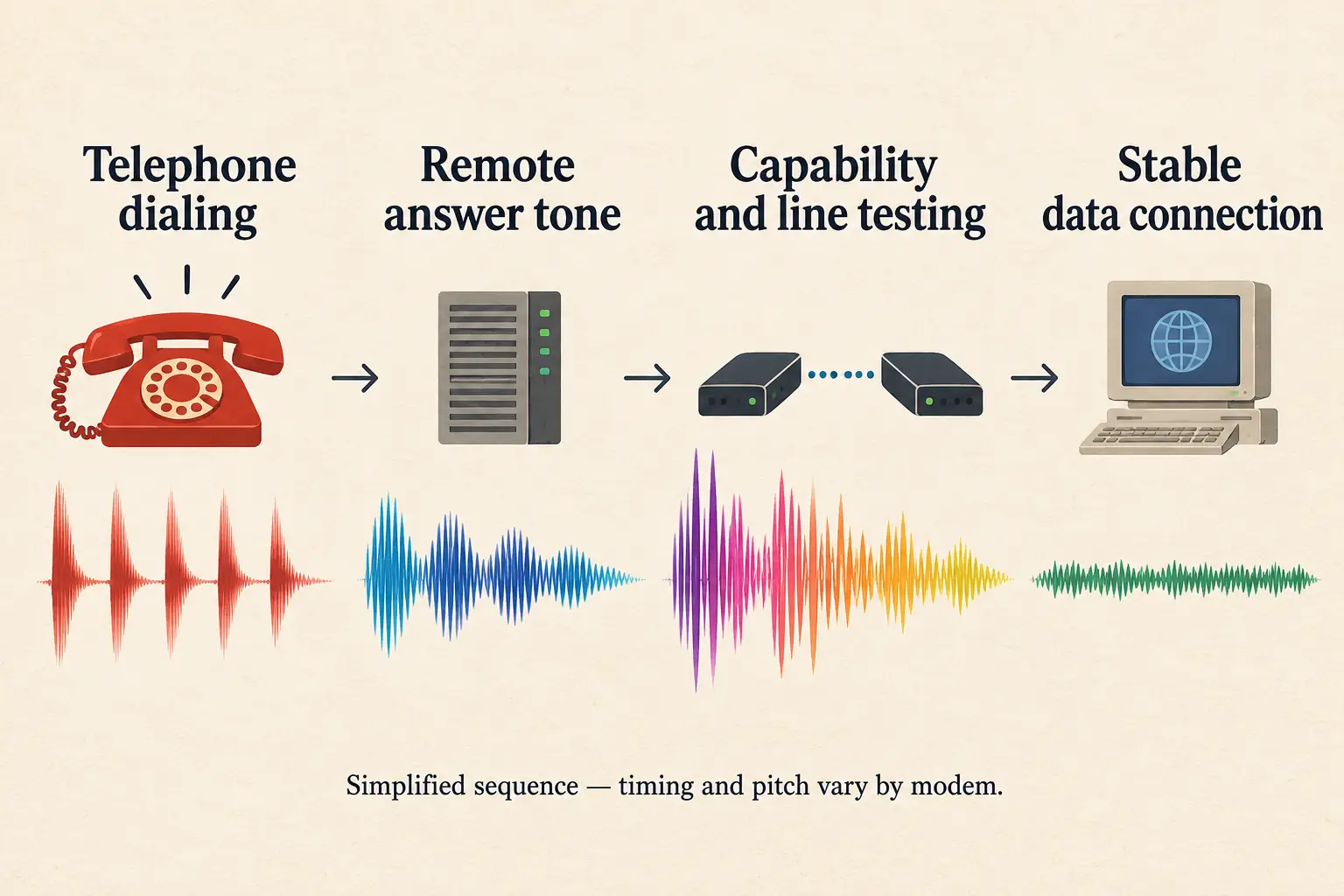
The noises changed with the modem model, the equipment at the ISP, and the connection method. There was no single tune that every dial-up call played in exactly the same order. Yet the common late-1990s and early-2000s handshake followed a clear idea: identify the other machine, choose a method both understand, and test the line.
First: Is anyone there?
Dial tone and dialing sounds came from the telephone call itself, before the two modems could exchange useful data. When the answering modem picked up, it sent a special tone. In one common procedure, that answer tone was based on a sound at 2,100 hertz. The tone could also include carefully timed changes meant to tell phone-network equipment to stop removing echoes.
Why would a modem care about echoes? Old phone networks used equipment that made voice calls sound better by reducing a speaker’s returning voice. Data devices, however, often needed to send and receive signals at the same time. The trick that helped a person hold a conversation could ruin a modem conversation. The peculiar answer tone was partly a request to leave the signals alone. The technical account in RFC 4734 describes these tones and their role.
Next: What language do we share?
The machines then exchanged short signals about which modem methods they supported. The international V.8 start-up standard describes that early agreement. The list of possibilities mattered because a faster modem had to deal with older equipment too. If the other end could only speak a slower method, the call could still work at a lower rate.
Finally: How good is this wire?
The sweeping chirps and scratchy stretches were more than a test of patience. The modems sent known signals, measured what came back, and worked out how well the line carried them. They adjusted to the line’s limits and settled on a data rate they could manage.
Think of two people trying to talk across a crowded room. First they find each other. Then they agree on a language. Then they change how loudly and quickly they speak. A modem did a far more exact version of that work, using sound patterns rather than words.
After the modems had established their data connection, the speaker often went quiet. That silence was not the end of the work. Many internet connections still had to agree on network settings and, where required, check the customer’s login. The 1994 PPP specification describes those later steps. Hearing the screech finish did not guarantee that the password would be accepted or that a web page would load.
Fun Fact: You Could Turn Off the Concert
The handshake sound was not music the modem had to play for the person at the keyboard. It was the line audio sent to a small monitor speaker. Many modems let users mute that speaker. A common command was ATM0, although options varied by model and software. The two modems could still exchange their signals in silence as far as the room was concerned.
A Busy Signal Was Not a Handshake
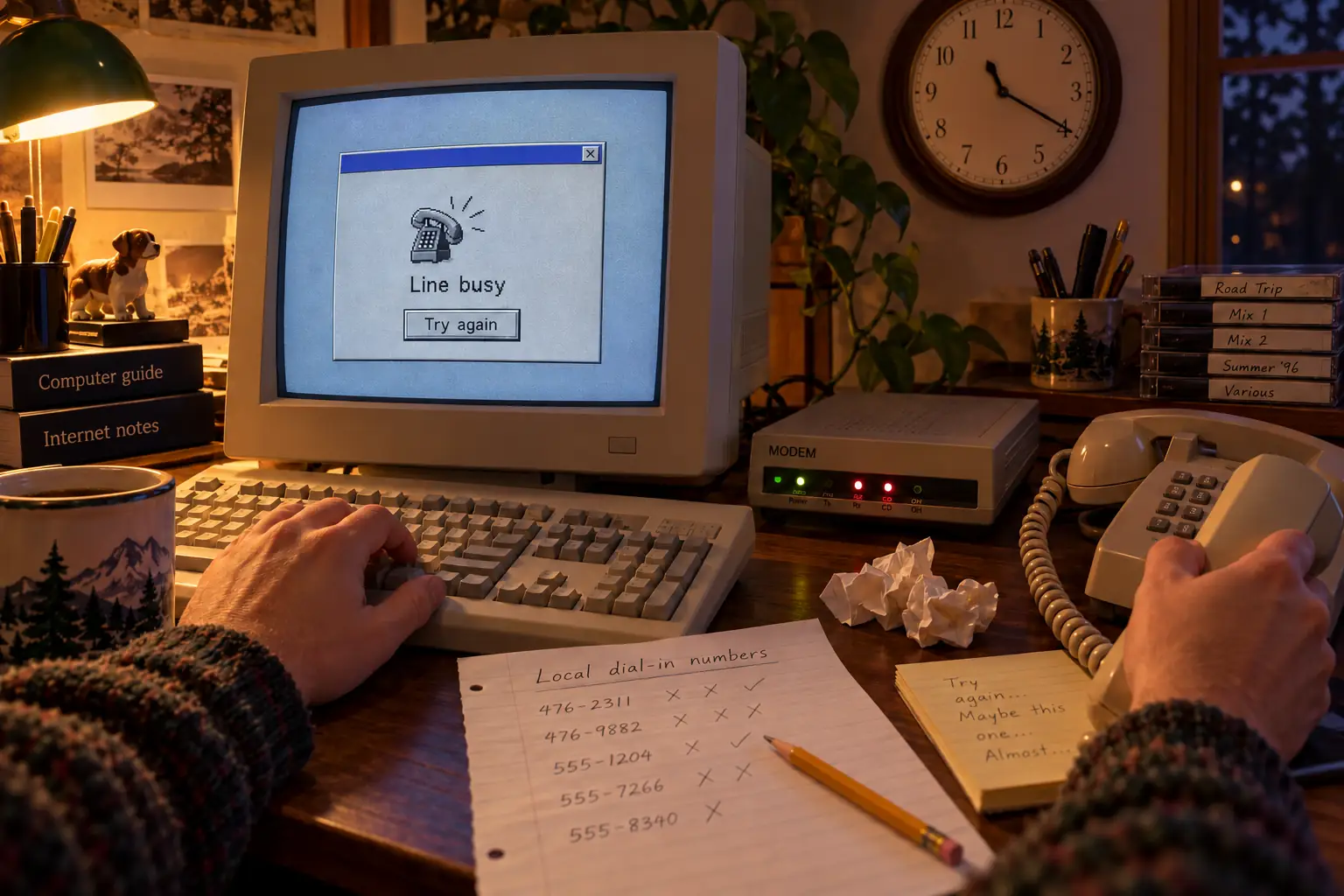
Before the modems could do any of this, a call had to get through. If the ISP had too few available lines or modems for the people trying to connect, the caller might hear the ordinary telephone busy tone. That was not a failed negotiation between two modems. The negotiation had not even begun.
For someone with an email to send, the difference did not help much. You could redial, try a second access number, or come back later. During the busy evening hours, trying again could become its own activity.
Behind the Busy Signal: A Very Real 1997 Problem
In January 1997, Washington state’s Attorney General announced an agreement between America Online and attorneys general from 36 states. Customers had complained that a new flat-rate plan promised unlimited service but left them facing repeated busy signals. Under the agreement, AOL offered relief including refunds or credits and limits on advertising while it worked on capacity.
The state’s announcement is especially revealing because it records a problem that no faster home modem could fix. AOL denied wrongdoing under the settlement. The access problem showed what happened when many more people wanted to be online at once than the service was ready to handle.
This was not a problem at only one company. In April 1997, Wired reported independent dial-up tests of 17 major U.S. services. In the test company’s March measurements, even its best performer had connection failures during the busy evening period. The results were measurements from a particular period and test method, not timeless failure rates for every ISP.
There were also two sorts of crowding. An ISP’s answering equipment might be full. Or the local telephone exchange might struggle with the number and length of calls. A modem could not diagnose the whole situation from the busy tone alone. To the person trying to connect, both meant: not tonight, at least not yet.
The 56K Promise—and the Real Line
By the late 1990s, 56K had become a number worth printing on a modem box. It sounded wonderful next to older 14.4K, 28.8K, and 33.6K connections. But 56K was a best-case headline, not a promise that every call would run at exactly 56,000 bits each second.
The V.90 standard, approved in 1998, described downstream speeds of up to 56,000 bits per second, but upstream speeds of up to 33,600. Downstream meant information coming to the home; upstream meant data going out. That difference made sense for web browsing, where a person often received more information than they sent.
V.90 also depended on a suitable digital connection on the provider’s side and a usable analog path to the customer. Real telephone routes, noise, and equipment could lower the result. Some calls connected at rates well below the biggest number on the carton. Others failed or dropped later.
The handshake screech and line noise were different things. The modem made its test sounds on purpose, even on a good line. Unwanted hiss, crackling, or interference was another matter. Poor wiring and changing line conditions could make data harder to read. A modem might train at a slower speed, try to adjust, or lose its carrier signal altogether. More speed on the package could not repair a bad pair of wires in the wall.
The connection window sometimes displayed a number that looked impressive but described the link between computer and modem, not the true speed over the telephone circuit. The important figure was the modem’s negotiated line rate, and even that was not the same as the rate at which a web page arrived. Server delays and network traffic still mattered.
Legend vs. the Record: 56K Meant 56K Every Time
The legend: Buy a 56K modem and every phone call gives you 56K internet.
The record: V.90 set an up-to downstream limit under suitable conditions. The actual rate could be lower, and sending data used a lower maximum. A successful screech meant the modems had made an agreement, not that they had reached the advertised ceiling.
One Phone Line, Several People
The hardest limit was sometimes not speed. It was ownership of the phone.
In a home with one ordinary voice line, a dial-up call normally kept that line occupied for as long as the computer stayed connected. Someone lifting another handset might hear the data signals. A caller trying to reach the house would meet a busy line, unless call waiting or some other service changed the result.
People worked around this in simple ways. They asked whether anyone needed to make a call. They waited until later in the evening. Some families added a second line for the computer. Others cut a session short because they were expecting news from a relative or a work call. These were common practical choices, though costs and habits differed from home to home.
Call waiting brought another problem. Its alert signal could disturb an active data connection. Some households temporarily disabled it while dialing. In later equipment, an answer appeared: the V.92 standard of 2000 supported faster reconnects on recognized lines and features for putting a modem connection on hold under suitable conditions.
USRobotics promoted Modem on Hold and Quick Connect, but also warned that features depended on phone-company service and the ISP’s support. In other words, the improvement was real, but not something every owner got just by buying a new modem.
That may be the part of dial-up life that a speed chart misses. The computer had to share a resource the entire household already needed. Getting online was a small negotiation with the family before the machines began their own.
When the Minutes Cost Money
The price of a dial-up evening depended heavily on the place. There was no single worldwide dial-up bill.
For many U.S. residential customers, a call to a genuinely local ISP number did not carry a separate charge for each minute. A 2000 UK parliamentary record, for example, discussed unmetered local calling in 85 major U.S. cities. A household might pay its local phone bill and a monthly ISP fee, subject to its actual calling plan. But picking the wrong number, or using a place without flat-rate local calling, could change the arithmetic. Checking whether an ISP access number was really local mattered.
In the UK, the calculation was often more visible. A 1999 statement from the telecom regulator Oftel, preserved by the House of Commons, said most consumers faced two separate costs: the ISP service and the charge to call it. It reported a BT local call price of 3.95 pence per minute at peak times, compared with 1.5 pence in evenings and 1 penny at weekends. Those were period prices, including tax, not today’s rates.
At 1.5 pence a minute, a three-hour evening connection would be £2.70 in call charges alone. At the quoted peak rate, three hours would be £7.11. Those are simple examples from that specific tariff, not typical bills for every British household. But they show why a parent might ask someone to finish a download and get off the line.
In March 2000, BT announced SurfTime options including an evening-and-weekend unmetered plan and a more costly round-the-clock option. The company’s dated announcement also made clear that an ISP could still charge separately. Even the word unmetered needed a close look: it applied to particular plans and times.
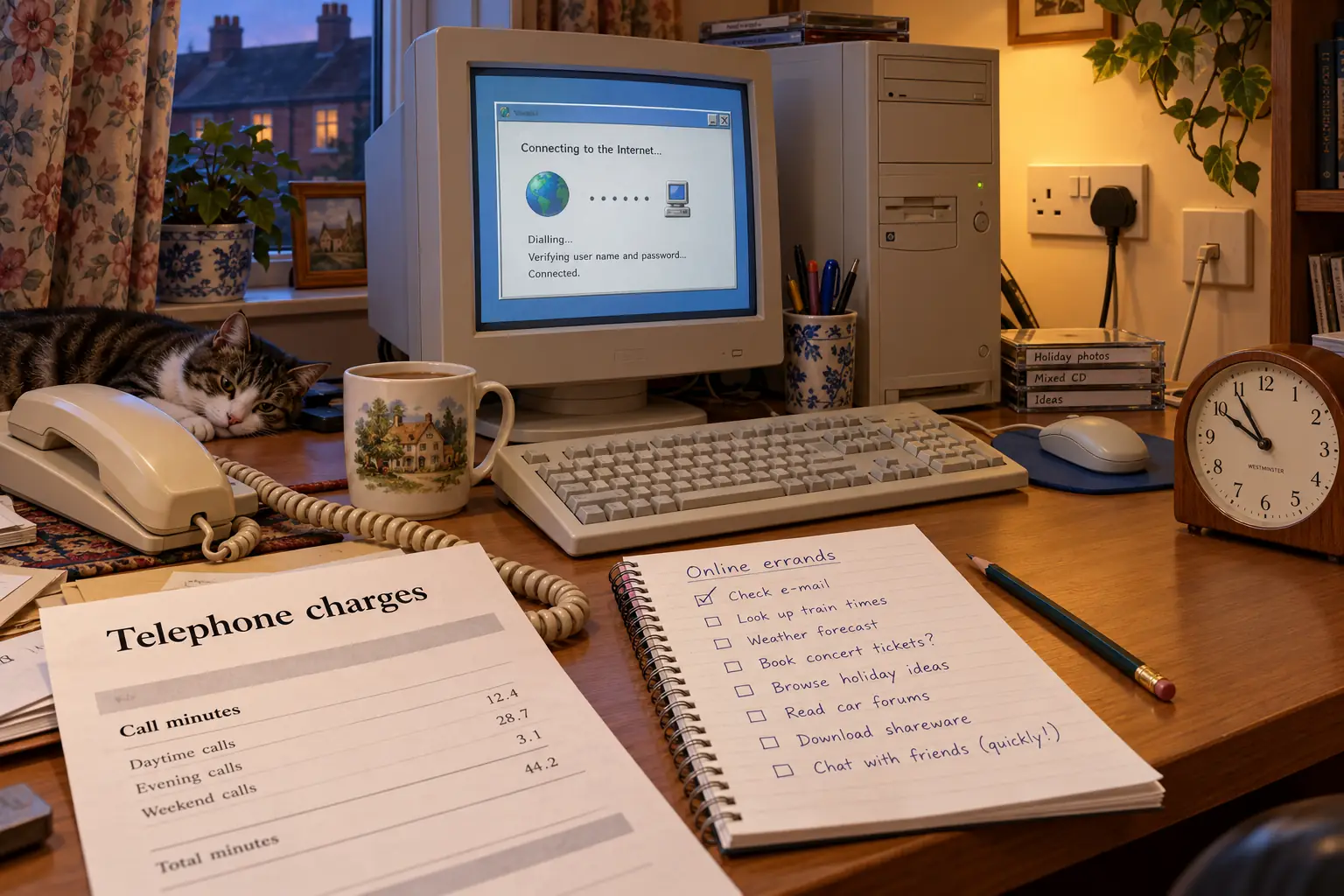
Elsewhere, phone charges, ISP fees, coverage, and access rules varied. Some users planned online sessions around cheaper hours. Some kept a written list of things to look up before dialing. Others downloaded mail, disconnected to read or write replies, and called again to send them. These habits helped manage both time and cost; they were not rules that every user followed.
When the Noise Faded
Cable broadband and digital subscriber line service, usually called DSL, changed both the speed and the household routine. Many broadband connections stayed ready between browsing sessions, without a new voice-phone call for each visit. DSL could use telephone wiring, but suitable setups kept voice calls separate from the data service. Cable used another kind of connection.
The change was gradual. In a 2007 U.S. survey, Pew Research Center reported home broadband service for 47% of American adults. Among people who went online at home, 23% still used dial-up. That was not a world in which everyone had already upgraded.
In December 2012, Pew’s survey still found 3% of Americans using dial-up at home. In a 2009 question to dial-up users, price and availability were among the reasons people said they had not switched. Faster service was not always within reach, or within budget.
The modem sound now survives in recordings, signal studies, old machines, and the memories of people who once recognized its stages without knowing their names. Broadband removed the routine of dialing, waiting, and asking the rest of the household to leave the telephone alone. It did not make communication perfect. It simply moved most of the negotiation out of earshot.
That is why the old screech still has such force. It was not an audio logo, and it was not a machine celebrating a successful login. It was the sound of a fragile agreement: two devices making the best of a line meant for something else. Only after they agreed could the household try to enter the wider world.
Sources and Further Reading
- Oona Räisänen, “The sound of the dialup, pictured” (2012) — a labeled analysis of a real recorded handshake; the interpretation is the author’s, not a universal trace of every modem.
- RFC 4734 (2006) and ITU-T V.8 (2000 edition) — the answer tones and start-up negotiation used by modems.
- ITU-T V.90 (1998) and ITU-T V.92 (2000) — the technical capabilities and limits of late-era dial-up equipment.
- Washington State Attorney General, January 1997 announcement — primary record of complaints and a voluntary AOL agreement; includes the company’s denial of wrongdoing.
- Oftel evidence to the UK House of Commons (1999) and BT SurfTime announcement (2000) — period call tariffs and proposed pricing plans.
- Pew Research Center, Home Broadband Adoption 2007 — measured U.S. transition from dial-up to broadband.