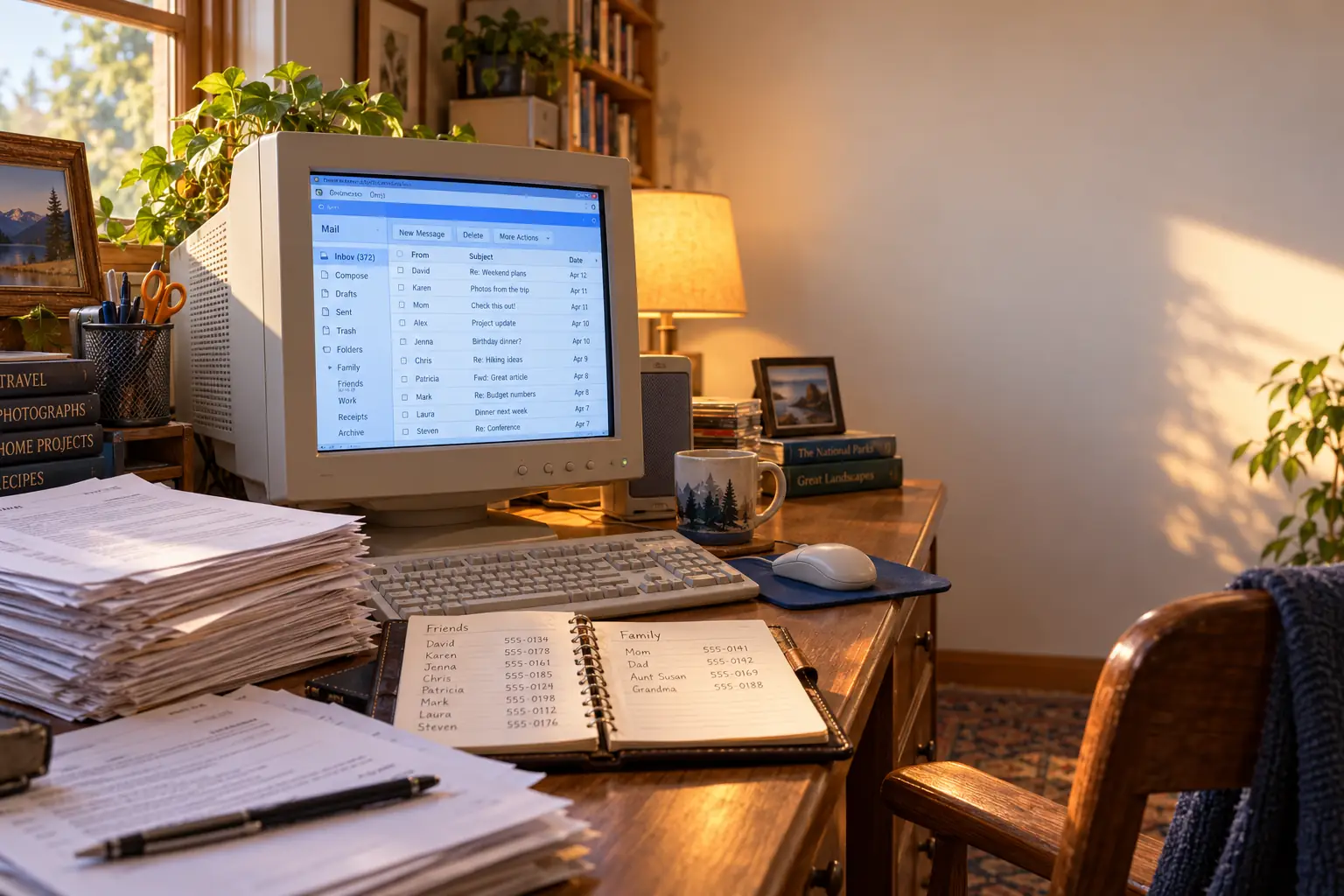
On April 1, 2004, Google announced a free email account with 1,000 megabytes of storage. It was such a huge offer that some people thought it was an April Fools’ Day joke.
They had good reason to wonder. A typical free Hotmail account had about 2 megabytes. Yahoo Mail accounts commonly had 4 or 6 megabytes, depending on the account. Google was offering hundreds of times as much space for nothing.
But the real surprise was not just the number. Gmail asked people to change a habit they had learned the hard way: stop treating an inbox like a tiny closet that had to be cleaned every week.
There was a catch. Most people could not sign up. And another catch arrived almost at once: to pay for the free service, Google planned to place ads based on the words in people’s email.
That mix of freedom, scarcity, and unease made Gmail’s debut one of the strangest chapters in everyday internet history.
Life Inside a Tiny Mailbox
Webmail was not new in 2004. Hotmail and Yahoo Mail already let people read messages through a browser, often from a computer at school, at work, or at a friend’s house. That was a real gift if your normal email lived on one home PC.
What felt old was the storage limit. Each saved message took up part of a very small allowance. An attachment could make the problem worse. People deleted old jokes, newsletters, and sometimes useful messages just to make space for the next one.
Think of a mailbox with a few family photos, a long message from a friend, and a work document attached. It did not take a mountain of mail to start thinking about what could be thrown away. This is a simple example of the problem, not a claim about one particular person’s inbox.
Paid upgrades offered more room. In April 2004, the Los Angeles Times reported that the largest paid storage plans from Hotmail and Yahoo were about 100 megabytes, with prices around $50 to $60 a year. Amounts and free quotas differed by service and account, but the gap was plain.
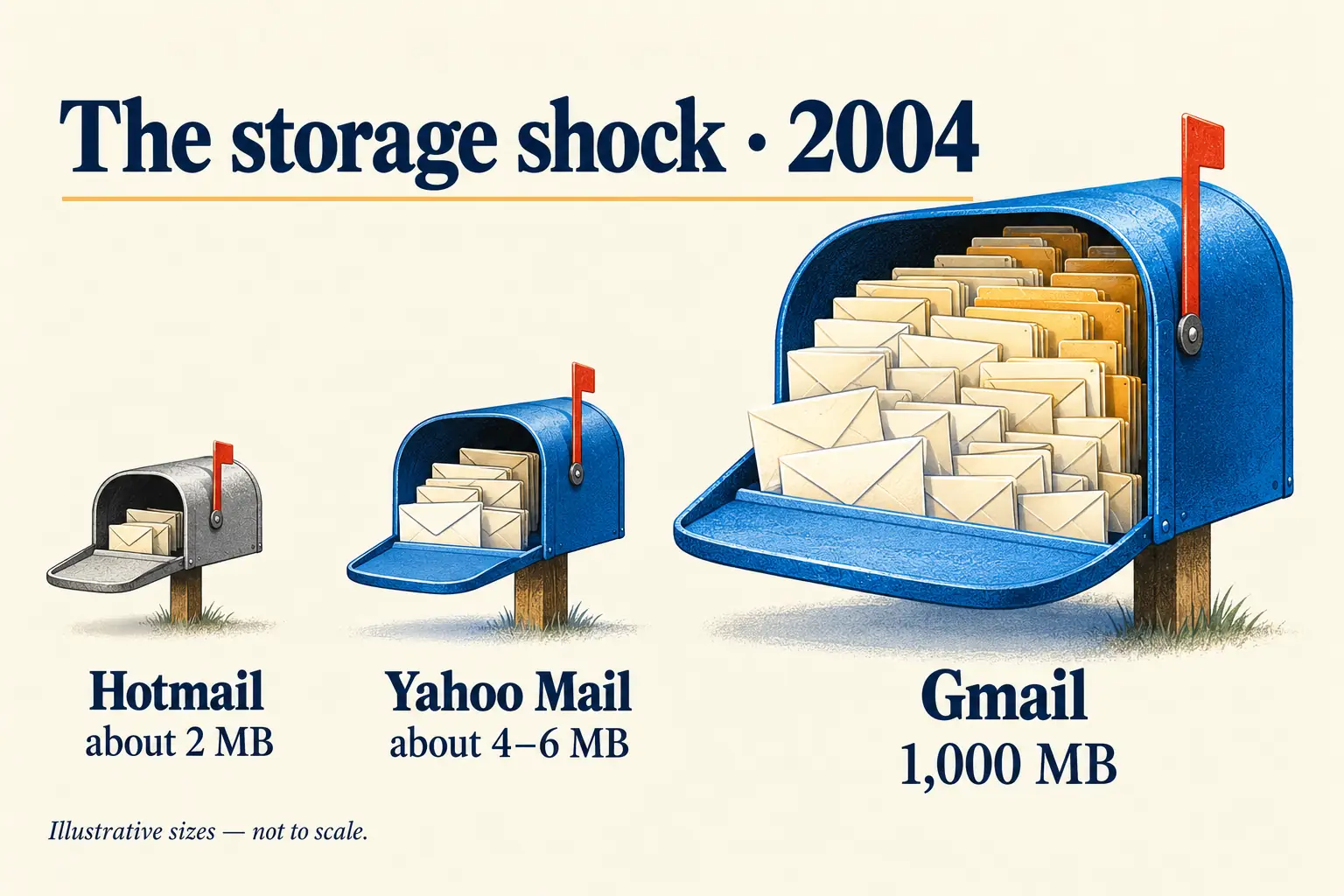
Then Google said: here is a gigabyte. In Google’s launch language, that meant 1,000 megabytes. Against 2 megabytes of Hotmail storage, the offer looked 500 times bigger. Compared with a 4-megabyte Yahoo account, it looked 250 times bigger.
One gigabyte was not infinite. It only seemed that way to someone trained to delete messages to keep an account working.
The Engineer Who Hated His Own Email
Behind Gmail was Google engineer Paul Buchheit. His problem was not that email had failed to catch on. It was that email had become too useful and too messy.
In an October 2005 account written by Buchheit, he described messages buried out of sight, conversations split apart, spam, and mail trapped on one machine.
One detail is especially good. Buchheit recalled cases in which four people sent the same answer to a group because they had not noticed the other replies. That is not just an engineering problem. It is an everyday office problem: more mail, more work, and somehow less shared understanding.
Behind the Scenes: Four People, One Answer
In his 2005 first-person account, Buchheit said tangled reply chains helped drive Gmail’s design. The team spoke with users and watched how they handled mail before trying to build a better system. It was not only a race to offer the largest number on a storage meter.
Buchheit and his colleagues did not invent webmail, searchable messages, or the idea of grouping related mail. Their achievement was to bring large storage, strong search, conversations, spam filtering, and a more responsive browser interface together in a product many people could use.
Years later, Buchheit told the Associated Press that the project had taken about three years and had carried the code name Caribou, a joke drawn from the Dilbert comic strip. The name is a later recollection from a participant, not a detail the 2004 sign-up page explained.
A Gigabyte Was an Invitation to Stop Deleting
Gmail’s opening promise was simple: keep your mail, then find it when you need it. That changed the meaning of a large inbox.
In a small mailbox, old messages were a problem to solve. In Gmail, an old message could be a record worth keeping: a phone number, a travel plan, a school note, or the answer to a question you had asked six months earlier.
Instead of making users build perfect folders, Gmail put search at the center. Remember a name or a strange word from a message? Search for it. This was Google bringing its best-known skill into a private inbox.
Gmail also offered labels, which could organize messages without requiring a single fixed folder for each one. Archiving moved mail out of the crowded inbox while keeping it available to search. The idea was not that nobody should ever delete an email. It was that deletion no longer had to be the first response to a full mailbox.
The Conversation View Trick
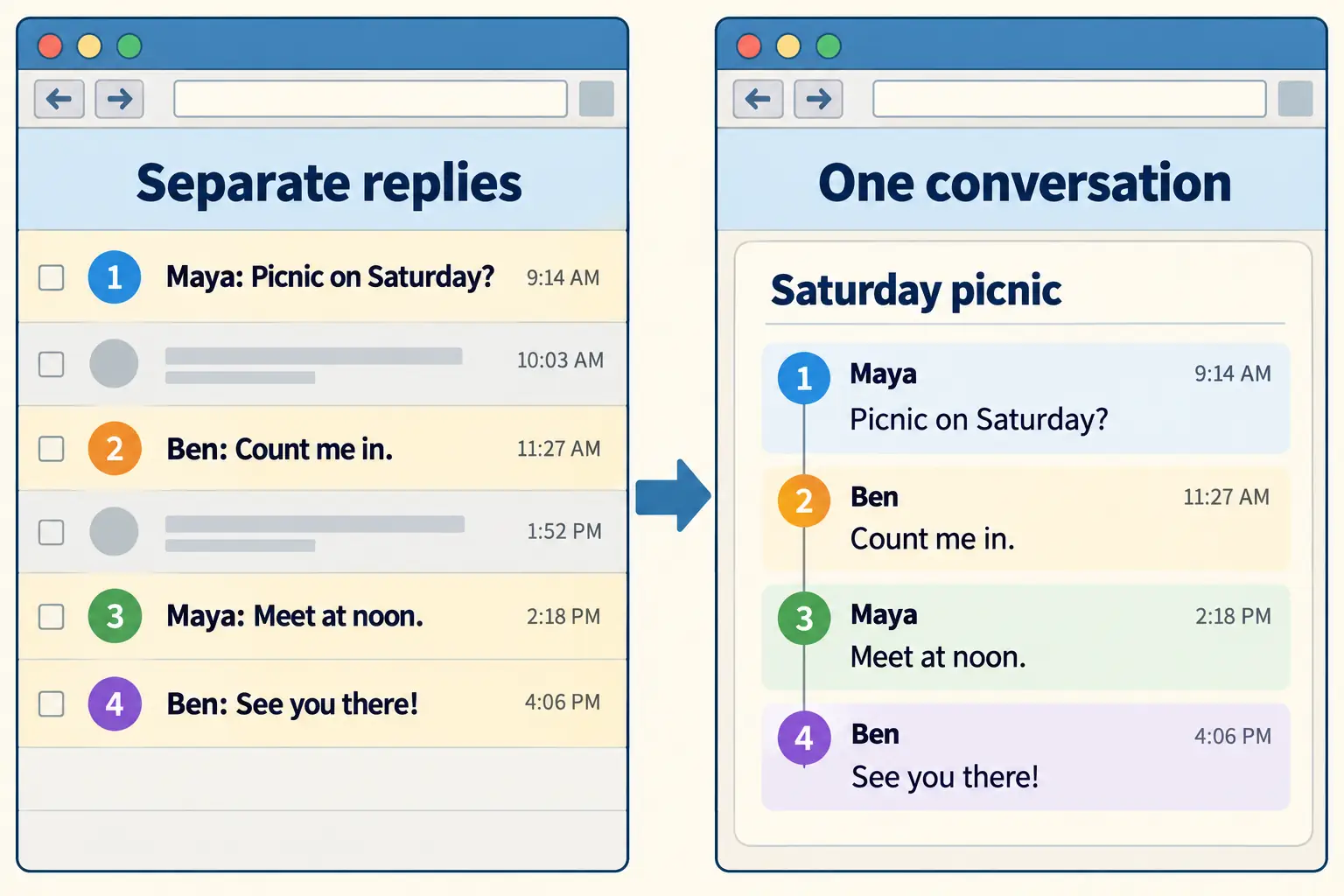
Gmail gathered related replies into a single conversation. Instead of hunting through separate messages to remember who said what, you could open the thread and read the exchange together.
That helped with the sort of mix-up Buchheit described. It was especially useful when friends made plans or a group tried to settle a decision over many replies.
It was not perfect. People used to individual messages sometimes found conversation view confusing. Google eventually made it possible to turn conversation view off in 2010. A useful idea can still be a matter of taste.
A Web Page That Behaved More Like a Program
Before Gmail, many webmail pages made people wait while the whole page refreshed after a small action. Gmail used a mix of HTML and JavaScript to update parts of the screen without starting over each time.
That method later became widely known as AJAX. Gmail did not invent it. But Gmail helped show that a complex, lively application could work inside a browser, not only as a program installed on a PC.
For users on faster internet connections, mail felt quicker to sort and open. But there was a trade-off. A more complex page could take longer to load over a slow dial-up connection. In a 2011 Wired retrospective, Gmail product manager Keith Coleman described that early choice as a bet on broadband becoming more common.
And Gmail did not provide the connection itself. You still needed internet access, a browser, and an account. A free gigabyte was not a free modem line.
When an Invitation Became a Prize
Google made the announcement on April Fools’ Day, and the service was real. But for most people, it was also out of reach.
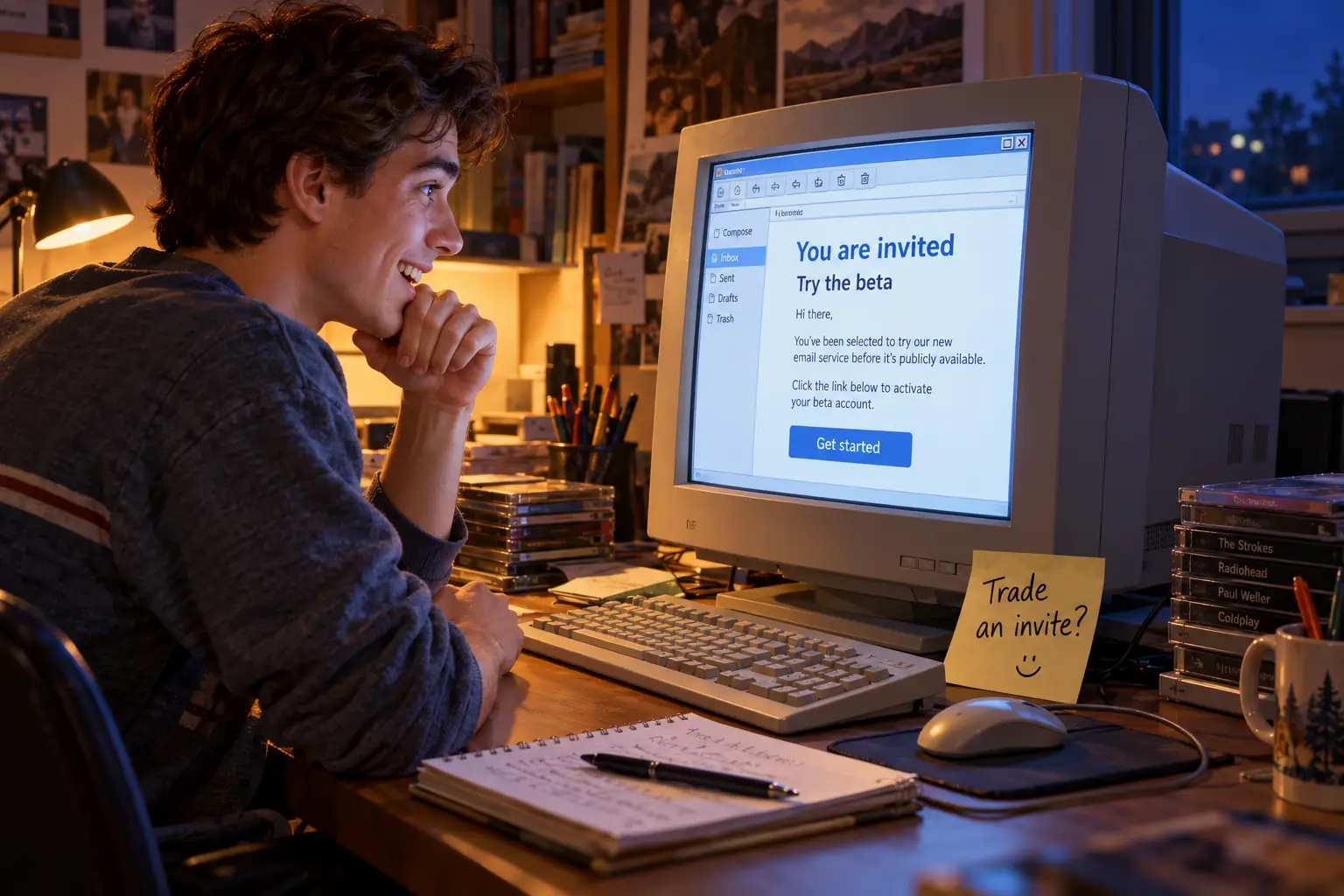
The first release went to a small group of testers. Early users could invite others, and those invitations did not flow evenly. A friend with an unused invite suddenly held a strange sort of online favor.
According to Buchheit’s later account to the Associated Press, Gmail began with about 300 older machines and room for only around 10,000 users. That is his recollection of the early system’s limits, and it helps explain why Google did not simply open the doors to everyone on day one.
Scarcity soon did what scarcity often does: it created a market. People asked on message boards, offered trades, and sold invitations. The excitement was about trying the service, but also about being able to claim a short new @gmail.com address before others did.
The oddest part was how quickly that market moved. On May 20, 2004, Wired reported offers of money, fudge, and other unlikely trades on a site called Gmail Swap. On June 10, Wired reported that some completed eBay invitation auctions had fallen from around $100 early in the week to under $20 as more invitations appeared.
An invitation to a free email service could briefly cost more than a year’s paid email upgrade. Then a flood of invites could make that little prize much less rare almost overnight.
Fun Fact: The First Big Giveaway Was Hard to Get
Gmail’s large, free mailbox helped make the service famous. Yet for its first years, a person who wanted an account often needed someone else to invite them. Storage was generous; access was not.
The Other Price of Free
The biggest complaint about Gmail was not its waiting list. It was what Google planned to do with messages after they arrived.
In 2004, Google’s business plan included showing ads chosen by automated analysis of email content. Google said this matching was done by computers rather than by employees sitting and reading private mail. Even so, the system would examine the words inside messages, including mail sent by people who had never agreed to use Gmail themselves.
Privacy advocates were alarmed. On April 6, 2004, the World Privacy Forum and 30 other groups called for Gmail to be suspended until Google addressed their concerns. Their open letter also raised questions about how long data would be kept and how it could be shared.
The debate was real and had more than one side. Gmail users could welcome a free, searchable archive. Someone writing to a Gmail user could still ask why a message meant for a friend was being checked for advertising. Google argued that automated processing and relevant text ads made the service practical. Critics argued that convenience did not settle the question of consent.
Legend vs. the Record: Were People Reading Everyone’s Mail?
The simple story: Gmail launched by having people read private email to choose ads.
The record: The 2004 concern was automated content analysis for targeted advertising, not evidence that Google staff manually read every message. Automation did not make the privacy objection disappear. The argument was about what a provider should be allowed to do with correspondence.
This part of the story changed. In June 2017, Google said it would stop using consumer Gmail content to personalize ads. Gmail still needed automated processing for tasks such as search, spam filtering, and safety. More recent optional settings can affect how connected Google services use shared information, so the rules of 2004 must not be mistaken for a complete guide to privacy in 2026.
That early controversy matters because it asked a question that outlived the original ads: what does a company receive in return when it gives people a place to keep so much of their lives?
Hotmail and Yahoo Did Not Stand Still
It would be wrong to write this as a story in which Gmail arrived and the other companies simply gave up. They were large services with millions of users, familiar addresses, and their own strengths.
But Gmail made small storage limits look old very quickly. In June 2004, Yahoo expanded free accounts to 100 megabytes, up from 4 megabytes for many users and 6 for some older accounts. That month, Microsoft announced plans for 250 megabytes of free Hotmail storage. The changes were not all rolled out to every market on the same day.
A June 15 Wired report tied Yahoo’s expansion to the Gmail challenge. The Australian Broadcasting Corporation reported Microsoft’s response later that month. In only a few months, the meaning of a reasonable free mailbox had shifted.
Storage was only one part of the rivalry. Search, spam protection, speed, access from different machines, and how messages were grouped all mattered. Users also had to think about the trouble of telling everyone a new address.
Gmail’s original design helped people leave as well as arrive. In his 2005 account, Buchheit highlighted email forwarding and POP downloading, which let people retrieve messages in other programs. Not everyone wanted to live inside a browser, even if the browser had become more useful.
When the Gigabyte Stopped Looking Big
Gmail did not go straight from its April 2004 test to a public account for everyone. Google kept adding capacity and invitations. On April 1, 2005, the Gmail team announced another gigabyte and more growth.
The invitation era ended on February 14, 2007, when Google opened sign-ups worldwide. The familiar beta label lasted longer. Gmail officially lost it on July 7, 2009, along with several other Google applications. Google’s announcement said businesses wanted software that did not sound unfinished.
As of October 2026, Gmail is still operating. A standard free Google Account includes up to 15 gigabytes of storage shared across Gmail, Google Drive, and Google Photos, according to Google’s storage guide. That is more than Gmail’s original allowance, but it is not endless, and it is no longer reserved for email alone.
That is the gentle joke in the title. The gigabyte did not last forever. Neither did the waiting list. What endured was the expectation that an email service should let us keep useful messages, find them quickly, and follow a conversation without searching through a pile of separate replies.
The number that looked impossible in 2004 has become small. The habit it helped break is still worth remembering: for a while, opening email was less about asking What must I delete? and more about asking What can I find?
Sources and Further Reading
- Paul Buchheit’s 2005 account — the creator describes why he wanted different email and what Gmail tried to solve.
- Los Angeles Times, April 1, 2004 — contemporary launch reporting, competing storage plans, and Google’s ad model.
- Associated Press, 2024 retrospective — interviews and later recollections about Caribou, early capacity, and the invitation era.
- Wired, June 10, 2004 — period reporting on invitation sales and the sudden fall in prices.
- Privacy groups’ April 2004 letter — the original objections to message scanning and data retention.
- Wired on Yahoo’s June 2004 response — evidence of how storage competition changed almost at once.
- Google’s 2007 open sign-up notice and 2009 beta announcement — two separate milestones.
- Google’s 2017 privacy announcement — the later decision to end email-content-based ad personalization.