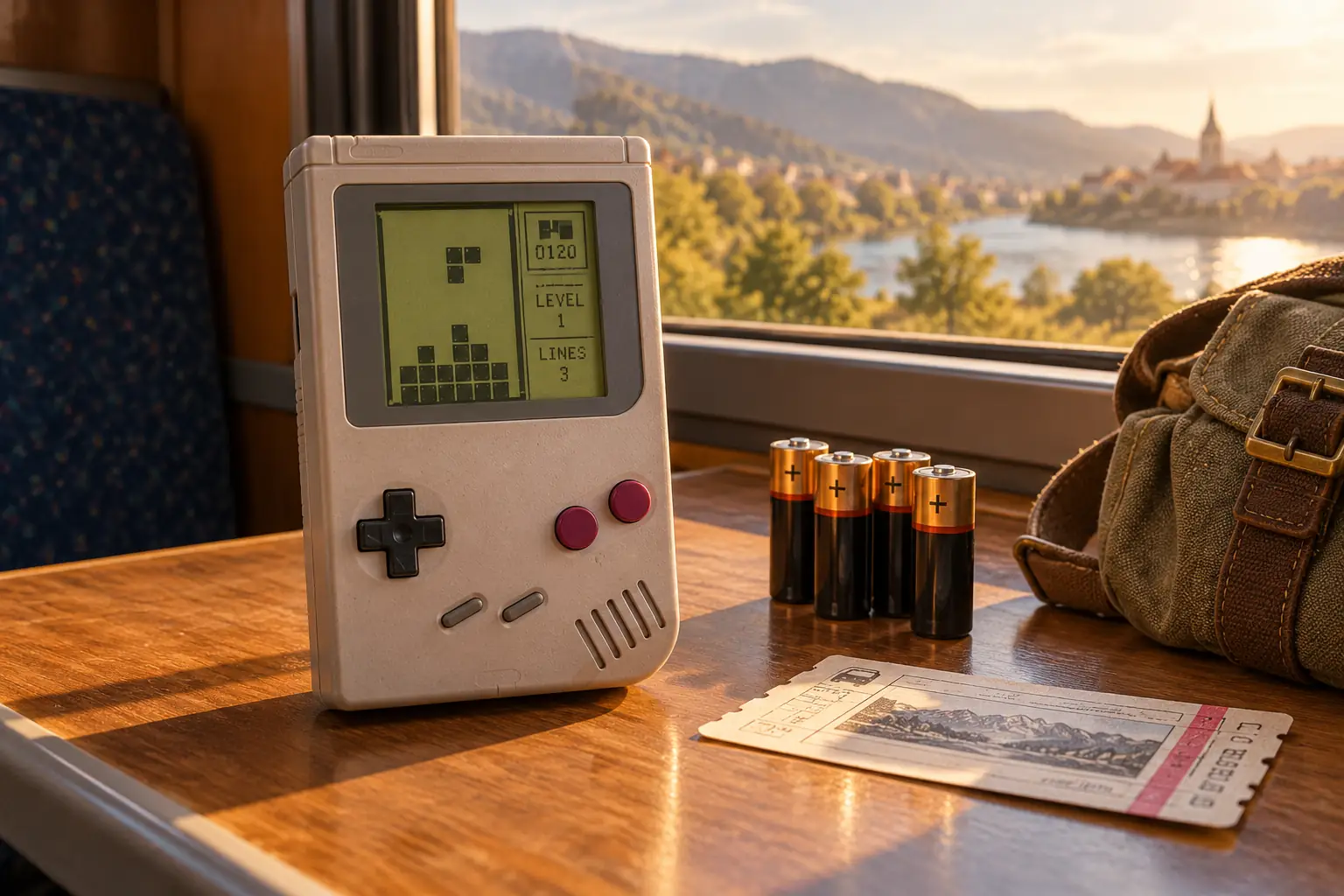
When Nintendo’s Game Boy went on sale in Japan on April 21, 1989, Tetris was not one of its four launch games. That sounds odd now. The falling blocks became so closely tied to the little gray machine that it can be hard to remember a Game Boy without them.
But the Japanese opening lineup had another surprise: Yakuman, a mahjong game. Nintendo was selling a handheld that could play Mario, baseball, a brick-breaking game, or a traditional table game, just by changing a cartridge. The machine did not need to win a contest for the brightest screen. It needed to be worth carrying.
Its display was small, greenish, and difficult to see in poor light. Four AA batteries went into the back. Yet those choices helped make one of the most successful machines in video game history. The clever part was not simply doing less. It was deciding what not to spend power and money on so that the games could travel farther.
The gray machine you could take anywhere
The original Game Boy, model DMG-01, was a thick, upright block of plastic. It stood about 14.8 cm tall and weighed roughly 300 grams with its batteries fitted. A cartridge slid into the back. The front had a familiar cross-shaped direction pad, A and B buttons, and Start and Select. There was a tiny speaker below the screen, plus a headphone socket for private play.
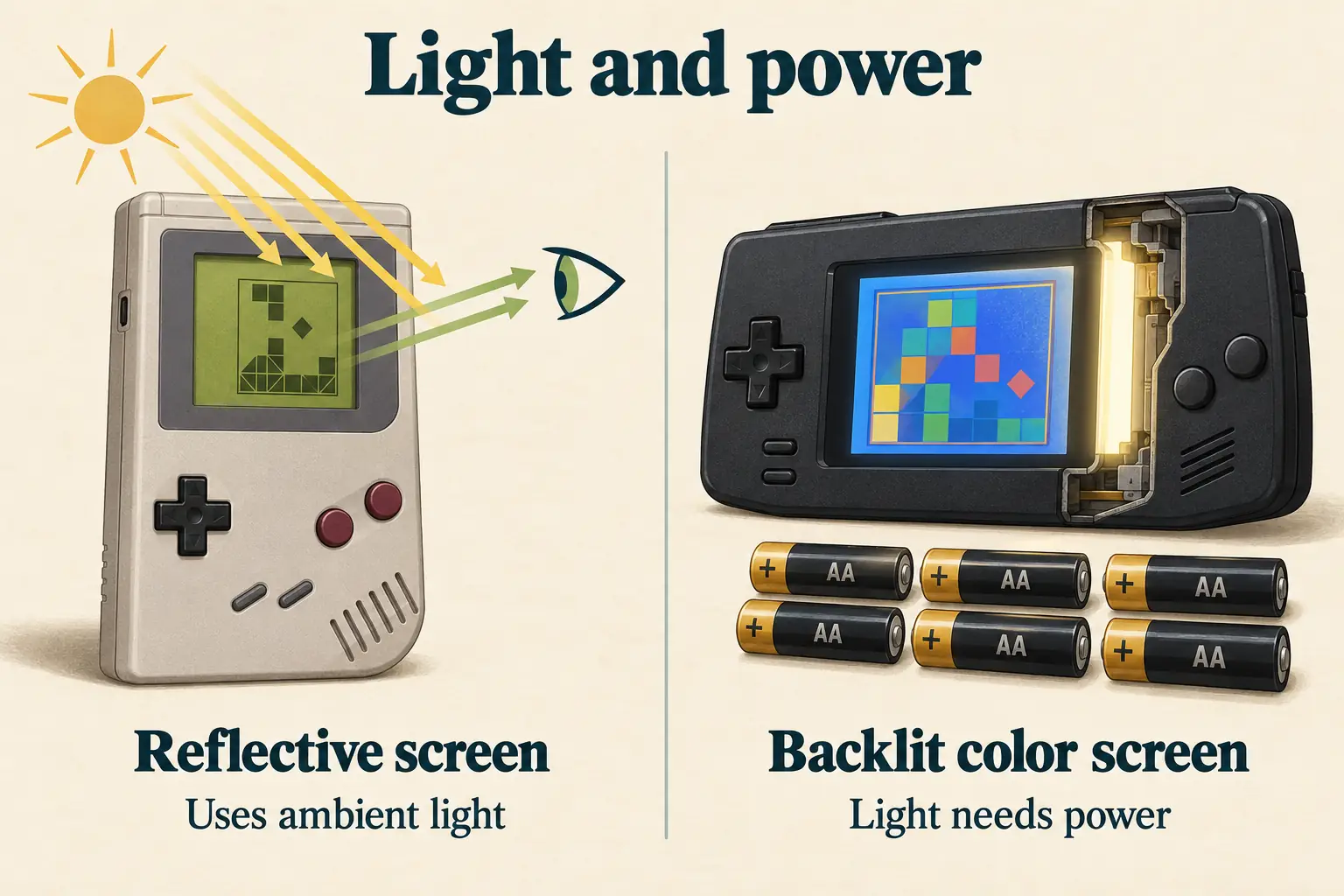
The display was a reflective liquid-crystal screen. It used light from the room or outdoors instead of shining a lamp from behind the image. Its resolution was 160 by 144 pixels, with four shades rather than full color. Those numbers look tiny today. On a bus in 1989, they were enough to dodge a Goomba or place a falling block.
A wheel on the side adjusted the screen’s contrast. If the viewing angle was wrong, the picture could seem washed out or nearly black. A separate volume wheel let you turn the cheerful sounds down before somebody nearby gave you a look.
More important, the Game Boy held four ordinary AA batteries. No television was needed. No power lead had to reach a wall socket. Once you owned a cartridge, the game worked without a network, a login, or an installation. That independence was a large part of its appeal.
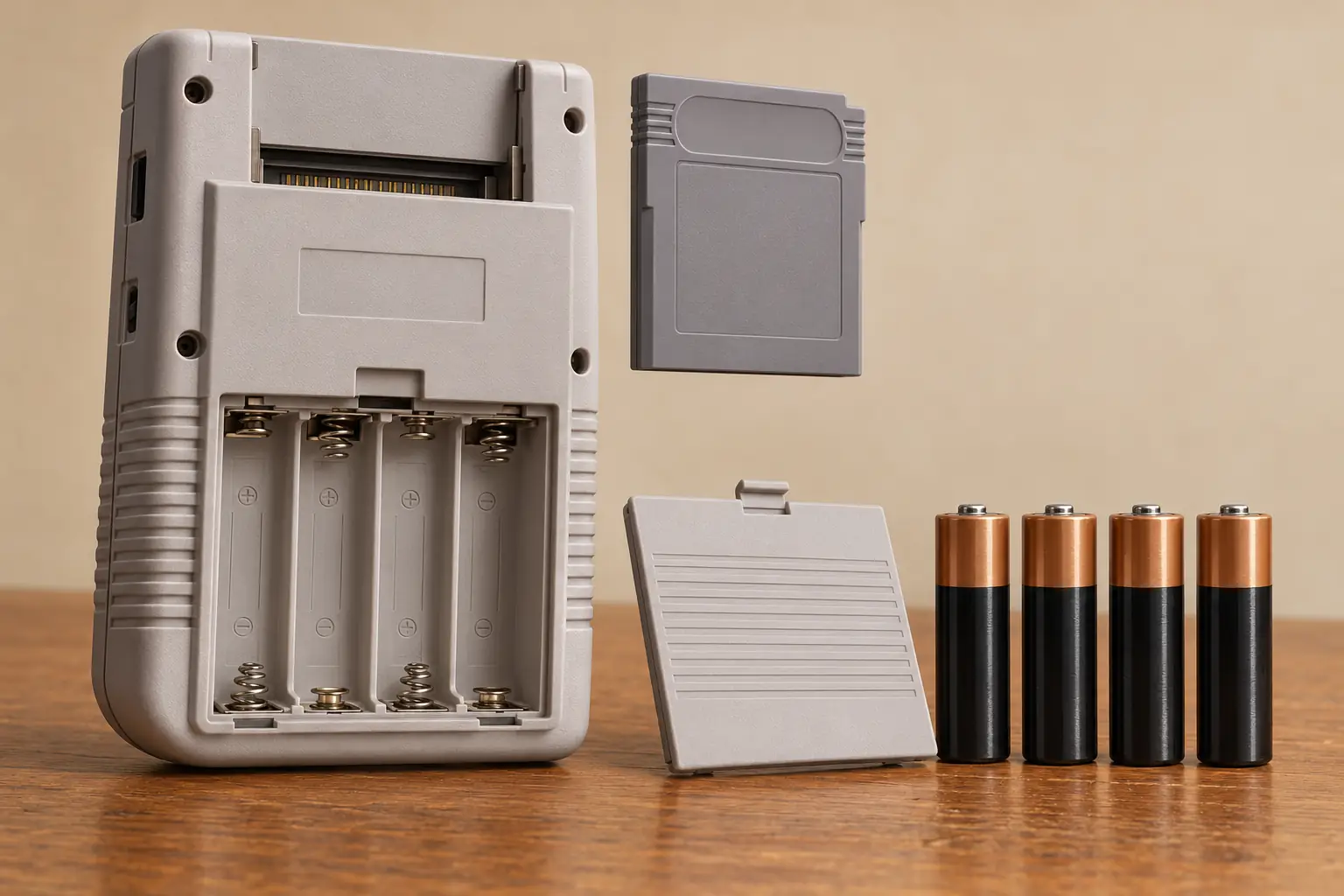
Nintendo’s own published battery estimates require a little care. Its Game Boy hardware history gives about 15 hours for the original model. A separate Nintendo support table says up to 30 hours. These are different official figures, not two measurements from the same test. Battery type, sound level, use and test conditions matter. It is safer to say that the Game Boy could offer many hours of play on four AAs than to promise every owner one exact number.
Why its designers refused to chase color
Gunpei Yokoi, who led the Nintendo team associated with the Game Boy, had already helped make the company’s Game & Watch line of electronic handheld games. Those small devices could be carried easily, but each was built around its own game. Want a different game? You bought another device.
The Game Boy changed that bargain. One machine could accept many cartridges. In an August 1996 conversation with game creator Kenji Eno, Yokoi said his aim had not been to make a portable version of the home Famicom. He wanted to move from a device with one built-in game to one device with many games. It was a different way of thinking about portability.
Yokoi also explained why the screen was monochrome. A color display was possible, but it would use more power and could be harder to view in bright light. He thought that a good game did not need color to be gripping. A board game can be exciting even when every piece is just black or white.
Behind the Scenes: A color rival did not scare Yokoi
In a 1997 interview with Yukihito Morikawa, Yokoi recalled hearing that a rival portable machine had appeared. He said he first wanted to know whether its screen was color or monochrome. When told it was color, he felt reassured. That is Yokoi’s later recollection, not a transcript of a meeting in 1989. Still, it shows how firmly he believed the screen choice suited the product.
That decision would have been much less useful without games made for the small display. Strong outlines, clear movement and readable shapes mattered more than tiny detail. Tetris was almost a demonstration of the idea: the player needed to tell seven block shapes apart, turn them, and make them fit. A rainbow was not required.
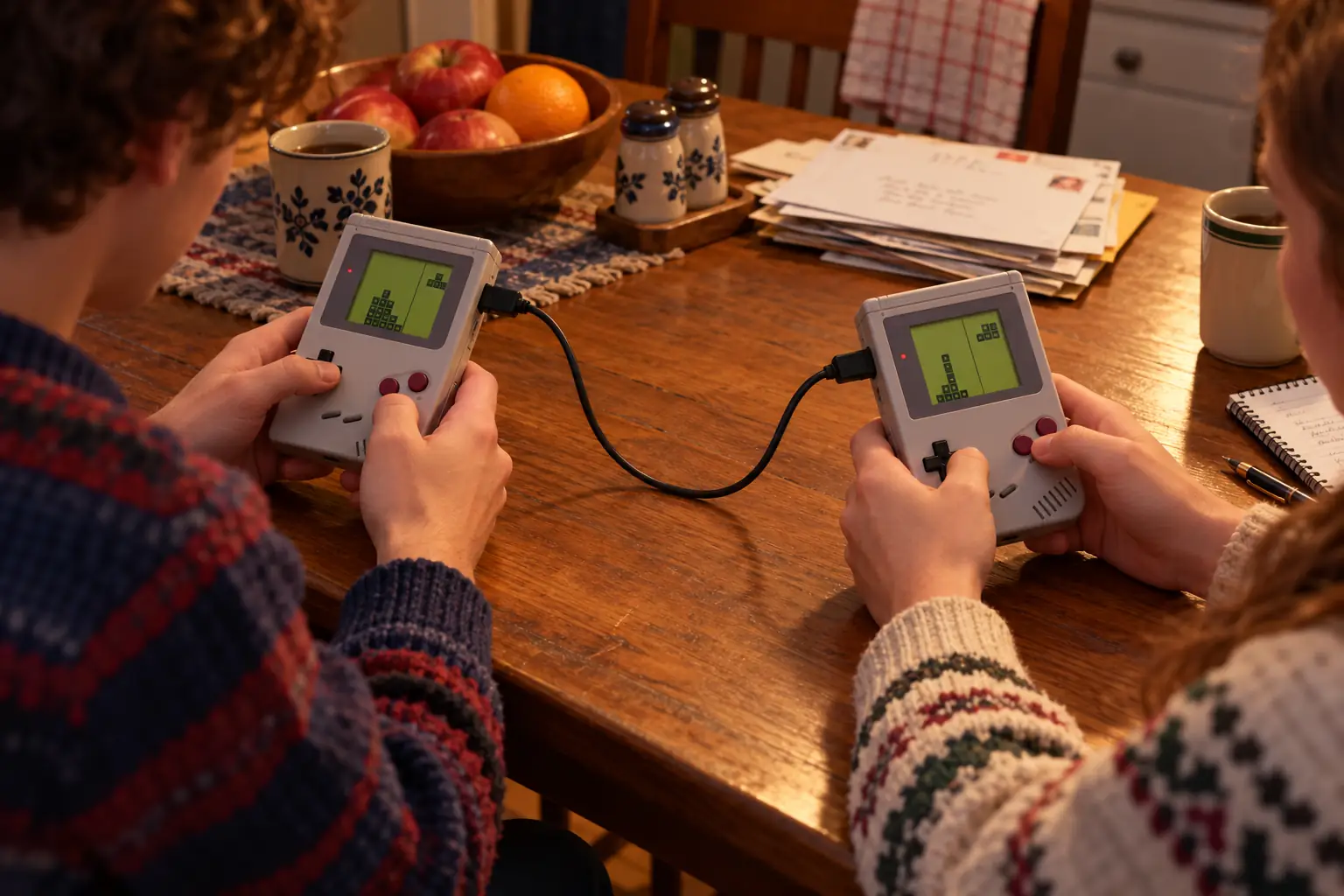
The team did not ignore everything but price. The Game Boy included a link port, which let compatible games exchange information through a cable. It also provided stereo sound through headphones, even though the built-in speaker was mono. Nintendo spent its limited room and power where players might notice a real benefit.
Japan: four launch games, then Tetris
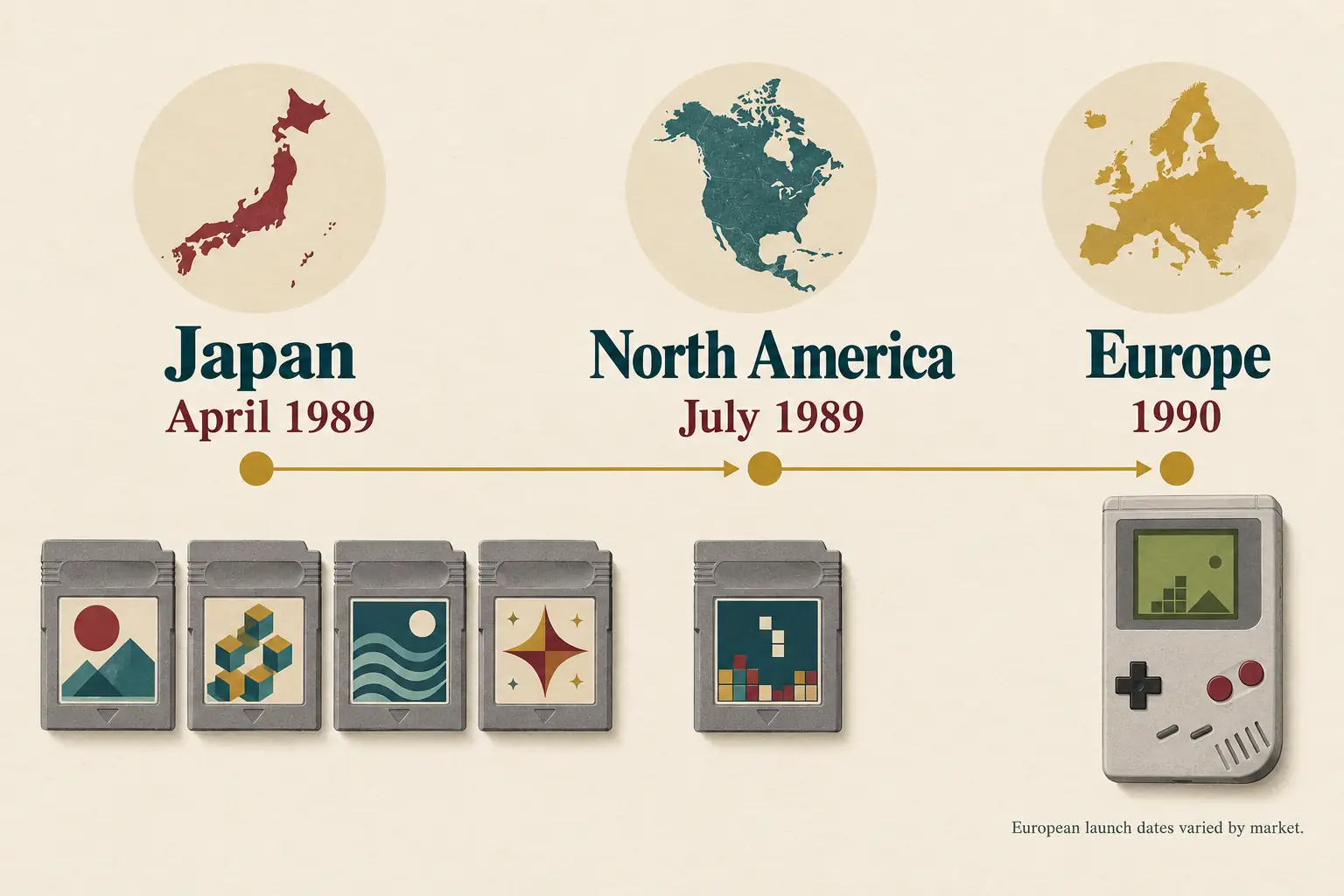
Japan received the Game Boy first, on April 21, 1989. Its reported launch price was ¥12,500. Nintendo’s own Japanese historical timeline identifies exactly four games released alongside the machine: Super Mario Land, Alleyway, Baseball, and Yakuman.
They made an interesting small collection. Super Mario Land carried Nintendo’s best-known hero into a new setting. Alleyway let a paddle bat a ball around a field of bricks. Baseball offered a familiar sport. Yakuman brought mahjong to a portable screen and could be played with a second machine through the link cable.
That last title is worth remembering. It did not become a famous Western pack-in, and mahjong was not a standard part of the North American launch lineup. Japan’s four games show that Nintendo did not view its new handheld as only a child’s miniature console.
Tetris arrived in Japan on June 14, 1989, not on the April hardware launch day. It turned short breaks into a perfect setting for play. Finish a line. Try again. Perhaps the train has arrived. Perhaps not—one more game.
America, Europe and Australia got a different arrival
The North American launch is commonly dated July 31, 1989. Here the story looked different. The Game Boy was sold with Tetris, a link cable and headphones. The U.S. launch price was $89.95. The software promoted around the opening included Super Mario Land, Alleyway, Baseball, and Tennis, alongside the bundled puzzle game. The precise first retail date of every separately sold cartridge is not as firmly documented as the hardware date, so those titles are best treated as the early U.S. lineup rather than an unqualified one-day release list.
That bundle helped explain the machine to adults who did not care much about Mario. Tetris was easy to understand by watching for a moment. Its difficulty grew naturally as the blocks fell faster. It made sense on a short ride, during a lunch break, or while waiting for someone who had said they would be ready in five minutes.
The American packaging choice also gave the link cable a job. Two people with compatible games and two consoles could compete without sharing one television. The cable was a physical reminder that portable play did not have to mean solitary play.
Europe followed in 1990, not in the original Japanese launch year. September 28, 1990 is a commonly cataloged date for the UK/European release of the Game Boy versions of Tetris and Super Mario Land. Nintendo’s European company history confirms 1990 for the system. It is better not to pretend that every European country, shop and software title arrived on a single uniform day.
Australia also saw its first Game Boy in 1990. There is a revealing piece of evidence in the National Film and Sound Archive of Australia’s collection: a 1990 Nintendo television commercial with skateboards, basketball and BMX-style energy. The archive notes how strongly the ad spoke to teenage boys, even though the system’s wider audience later included many girls and women. A portable computer game could be sold as street-cool youth culture, even when its most famous software was falling geometry.
What the battery bargain cost
None of this means the display was wonderful. The original Game Boy had no built-in screen light. Play in a dim room and you needed to move toward a lamp. Fast-moving objects could leave a blurry trail. The screen could be hard to read at the wrong angle. Long sessions were not always kind to the eyes.
Its rivals showed what Nintendo had left out. Atari’s Lynx appeared in 1989 with color graphics. Sega released the Game Gear in Japan in October 1990, with a backlit color LCD. That light made a large difference when the room was dark.
But the batteries paid for it. In Sega’s own account of Game Gear development, the company describes the hard work of reducing power use. Its six AA batteries gave roughly three to four hours of play. Compare that with Nintendo’s published figure of about 15 hours for an original Game Boy under its historical specifications, and the practical choice becomes clear. The figures are manufacturer estimates from different sources, not a controlled head-to-head test, but the gap was real enough to shape daily use.
A child buying spare batteries with pocket money could notice the difference. So could an adult packing for a trip. Color was lovely if you could keep feeding it power. A screen you could use for a long train ride was lovely in a different way.
Legend vs. the Record: Did the Game Boy simply have the longest battery life?
The easy story: Game Boy won because its batteries always lasted 30 or 35 hours.
The better story: Nintendo published different life estimates, and real use varied. More important, the modest display was part of a wider plan: affordable hardware, usable controls, cartridges, games that fitted the screen, and an audience beyond people chasing the newest graphics.
Games gave the hardware a long second life
The machine survived because developers kept finding things worth doing on it. The library did not stop with puzzle games and short arcade sessions. Kirby’s Dream Land made a friendly adventure easy to pick up. The Legend of Zelda: Link’s Awakening, released in 1993, showed that a small screen could hold a world you wanted to return to.
Then came a twist no one buying the gray 1989 model could have planned for. Pokémon Red and Pokémon Green launched in Japan in February 1996. The North American Red and Blue versions followed in September 1998, according to The Pokémon Company’s history.
The link cable suddenly mattered in another way. It was not only a way to beat a friend at Tetris. It let players trade creatures and compete, making what was inside one small machine valuable to somebody holding another. The simplest social network in the room might have been a wire stretched between two children.
The success was no longer tied to one original case design. Nintendo sold colored-shell versions of the old model in the mid-1990s. The smaller Game Boy Pocket arrived in 1996. The Game Boy Color came in 1998, finally bringing color to the family. These are different products and years, not features quietly added to the 1989 machine.
Nintendo’s official lifetime sales table lists 118.69 million Game Boy-family systems. That figure combines the Game Boy line, including Game Boy Color; it is not the number of original gray DMG-01 consoles sold. The distinction matters when a number becomes part of a legend.
What remains of the original Game Boy
The original Game Boy is no longer a current retail console, but the hardware can still be played if it is in working order. Its cartridges are physical objects, and so are its weak points: dirty contacts, leaking batteries, scratched screens and age-worn displays. A secondhand machine deserves a careful inspection, especially around the battery compartment.
There are safer ways to revisit some games without hunting for old electronics. As checked in October 2026, Nintendo offers a selection through Game Boy – Nintendo Classics on Nintendo Switch systems, with an active Nintendo Switch Online membership. The library is a selection, not every cartridge ever made. Availability can change by region and over time.
The funny thing about the Game Boy is how little its basic design tried to impress a person staring at a spec sheet. It was thick. It was gray. It could not light its own screen. But it could play a different game tomorrow, fit into a bag today, and stay awake while a brighter rival ran out of batteries.
That was the four-battery bet. The screen was not the whole point. The freedom to keep playing was.
Sources and further reading
- Nintendo’s Japanese historical timeline — records the four simultaneous Japanese launch cartridges.
- Nintendo technical support and hardware history — original specifications and differing battery-life figures.
- 1996 Yokoi–Eno interview and 1997 Yokoi–Morikawa interview — English translations of first-person reflections on screen and product design.
- Australia’s 1990 Game Boy commercial — National Film and Sound Archive catalog record and audience context.
- Sega’s Game Gear development history — color backlight, six batteries and short operating life.
- Nintendo lifetime hardware sales — combined Game Boy-family sales, not original-unit sales alone.
- Smithsonian Game Boy museum record — preserved physical object and historical context.