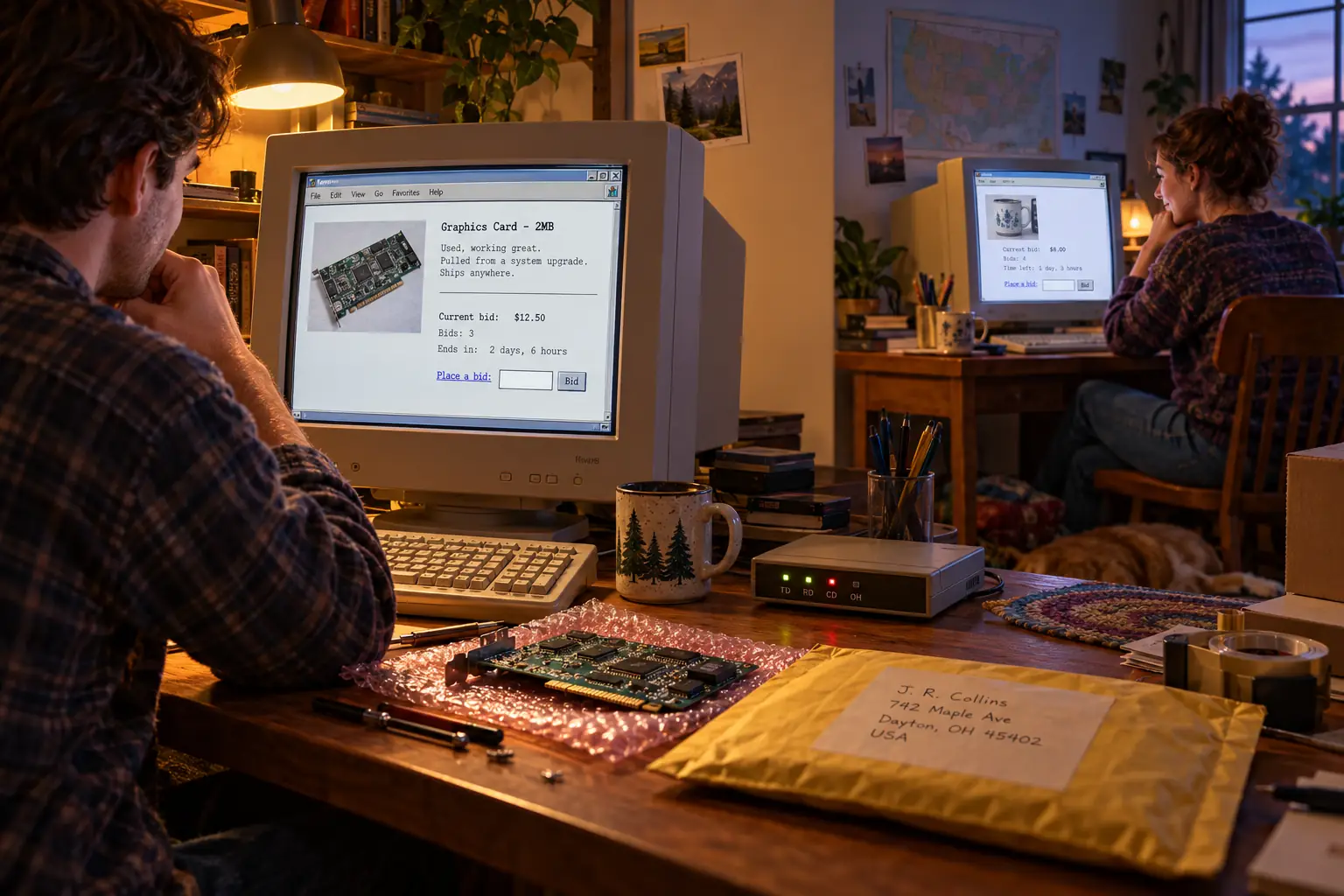
On February 26, 1996, Pierre Omidyar asked the members of his little online auction site to do something unusual: talk about each other in public.
They could praise a good trading partner. They could complain about a bad one. Other buyers and sellers would be able to see what they said.
His site, then called AuctionWeb, had been open for less than six months. In his original letter to members, Omidyar said it had already hosted nearly 10,000 auctions. He also knew the central problem: people were sending money or goods to strangers they had never met.
He called the business an experiment in dealing with strangers online. What followed was not a perfect cure for dishonesty. It was something more interesting: a way for ordinary people to build a public reputation one transaction at a time.
Before the name eBay
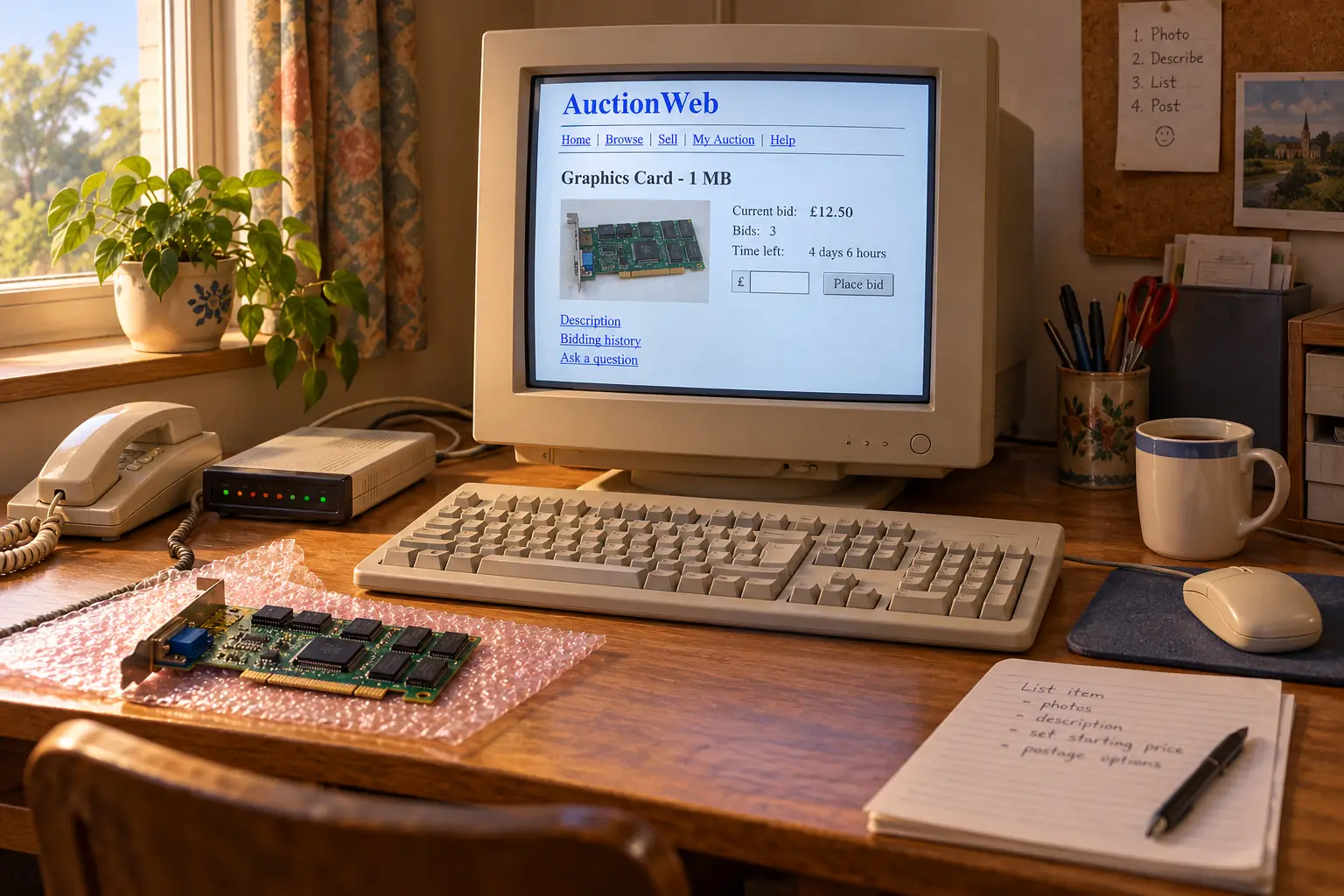
In September 1995, Omidyar, a software developer in California, put an auction service on the web. He had written the code over the Labor Day weekend. It was called AuctionWeb and began as part of his own website, not as the giant shopping brand we know today.
Its idea was plain. A person could describe an item and set a starting price. Other people could place bids. When the auction ended, the seller and highest bidder could arrange a sale.
That might sound ordinary now. In 1995 it felt rather bold. A local classified ad usually meant a phone call and perhaps a meeting. A shop let you look at the goods. An online auction could connect a person in California with someone across a border, but neither side could reach through the screen to inspect the item or shake the other person’s hand.
Nor did AuctionWeb provide the Internet connection. Users needed their own computer, modem or other online access, web browser, and email. Early participants were mostly people already comfortable finding their way around the web. Auctions did not require a sleek app or a room full of corporate buyers.
The service was based in the United States, but its appeal did not stop there. A collector who lived far from the right shop might finally find the exact thing they wanted. A seller could reach more than the people who happened to read one town’s newspaper.
The broken pointer and its buyer
One of the first stories told about AuctionWeb sounds like a joke written after the fact. Omidyar listed a broken laser pointer, clearly described as broken. It sold for $14.83.
The buyer was Mark Fraser, a Canadian. That much is backed by eBay’s later account of meeting him. In 2015, Fraser appeared in a video shown to Omidyar at a company event. He still had the pointer, two decades after buying it.
For years, retellings made the buyer into a mysterious collector of broken laser pointers. Fraser’s later explanation was more practical. He said he had wanted a laser pointer for presentations, found working ones too expensive, and tried to build his own using parts. The faulty pointer offered something he needed. That is his recollection twenty years later, not a surviving purchase receipt or a record of his thoughts in 1995.
It is also the better story. One person saw useless junk. Another saw a possible part for a project. They did not need to live on the same street to find each other.
Still, this early sale should not carry more weight than it can bear. The surviving corporate account confirms a famous purchase from Omidyar; it does not give us a full public record of every AuctionWeb listing or every first transaction made by other members.
Behind the Scenes: Small payments, big idea
Looking back in 2015, Omidyar recalled that early AuctionWeb members sometimes mailed coins taped to index cards to pay site fees. It is a wonderfully physical detail from a business built on web pages. It also reminds us that the Internet could arrange a deal long before the money itself traveled online.
What winning an auction actually meant
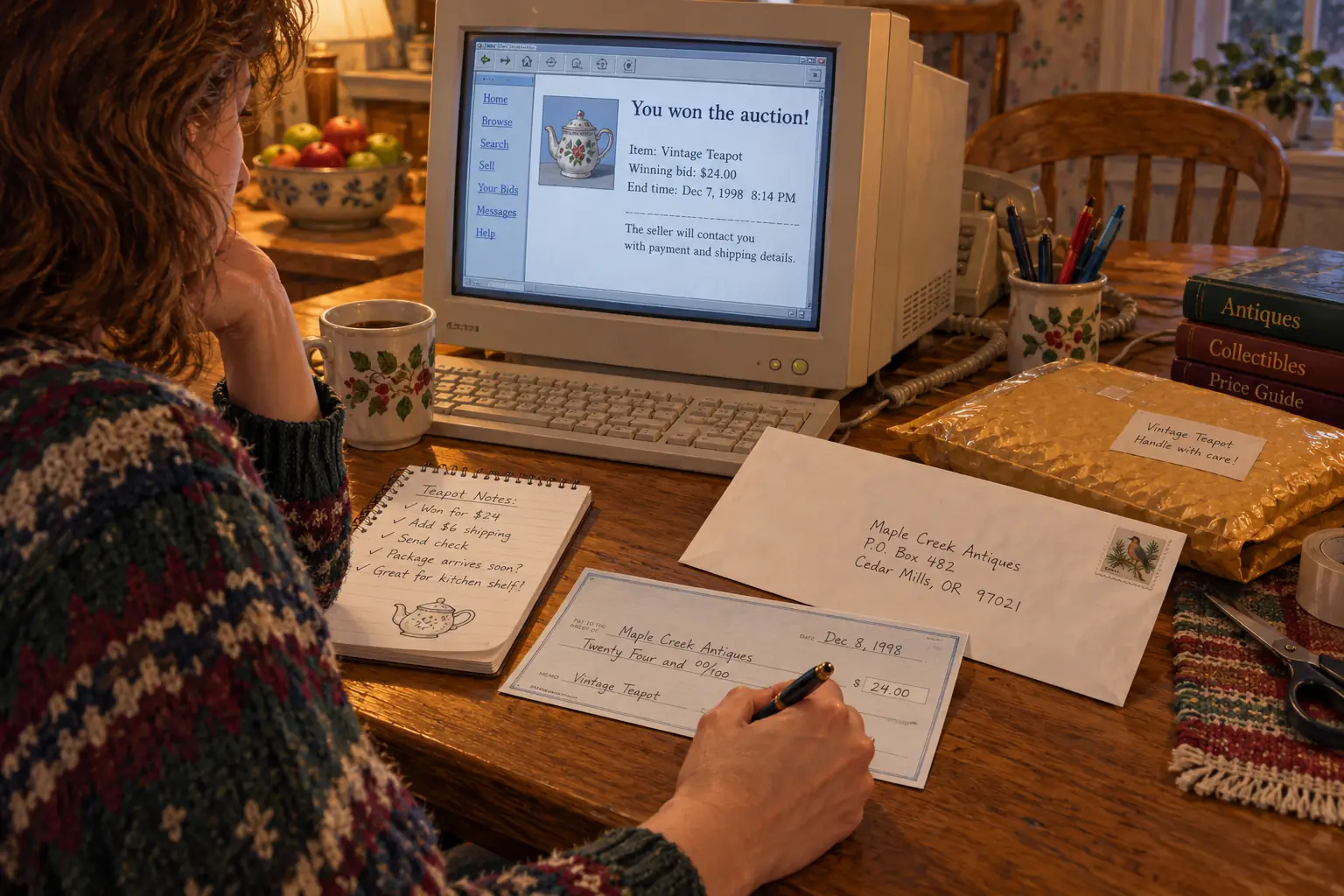
By 1998, eBay had grown into a much larger service. Its August 1998 stock-market filing described what happened after a winning bid. eBay sent notice by email. Then the buyer and seller made their own plans for payment and shipping.
There was an important split in responsibility. eBay provided the listing, bidding system, messages, and reputation pages. It did not normally hold the goods or take possession of the buyer’s payment. It was closer to a meeting place than a shop with a storeroom.
For a buyer, the routine could mean waiting for the auction clock to run out, getting an email, checking the seller’s address, sending a check, and waiting again for a parcel. The seller might wait for the payment to arrive or clear before shipping. Sometimes a credit card was possible. Other deals used cashier’s checks or similar paper payments. Terms varied from seller to seller.
The website could show a bid in seconds. A check and a cardboard box still moved at the speed of the post.
Suppose you won a hard-to-find computer part. The listing said it worked. The price looked fair. But you had not tested it, and the seller might be hundreds of miles away. If the package arrived damaged—or never arrived—who would fix the problem?
That question was bigger than any auction timer. And it explains why a simple public comment could matter almost as much as the item itself.
The feedback experiment: a reputation anyone could read
Omidyar had heard from unhappy users who wanted him to settle their disputes. He did not want to become the judge of every argument. His answer was to make good and bad experiences visible to the community.
His February 1996 message did not pretend everyone was honest. It said most people meant well, some people did not, and members should speak up when they saw either kind of behavior. There was a striking balance in the request: leave complaints, yes, but give praise as well.
The result was the Feedback Forum. It offered a reason to finish a deal properly even when nobody from eBay was watching. You might need your good name for the next sale.
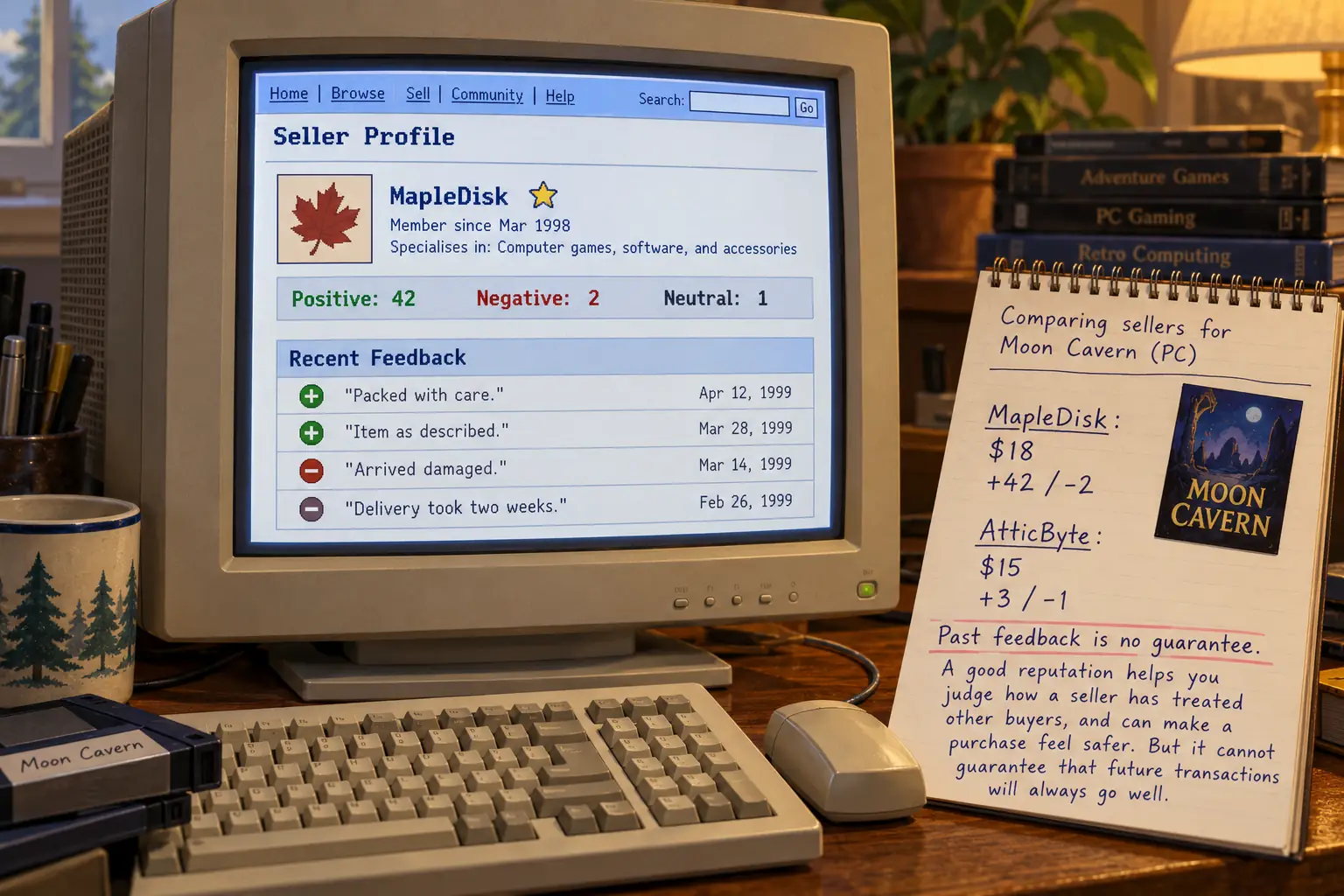
By 1998, eBay’s filing described a more structured version. Registered users had feedback profiles. Comments helped other people decide whether to bid, how to pay, and whether to trust a seller with their money.
The system also turned feedback into a number. Positive comments raised a user’s standing; negative ones lowered it. A small star beside a username could signal a history of activity. It was a kind of public trading record built by the traders themselves.
Think of two sellers offering the same old computer game. One has a long trail of happy buyers. The other has a fresh account and no comments. The first might ask a little more money. The second might still be honest, but the buyer has less to judge.
The site did not have to know which seller was good in advance. Past customers supplied clues. That was clever—and it had consequences.
An original page that still speaks
Omidyar’s dated February 26, 1996 letter survives on eBay’s website. He reported close to 10,000 auctions and only a few dozen complaints. Those were his own figures at the time, not an independent measure of fraud. More important, the letter makes the goal clear: make dealing with unknown people easier by sharing what users learned.
A good score was a clue, not a promise
A number looks precise. Trust is not.
Good feedback could show that earlier transactions went smoothly. It could not prove a seller still had the item, would pack it well, or would tell the truth next time. A new honest seller had little history. A skilled cheat might behave well for a while before doing harm.
eBay knew the system could be abused. Its 1998 filing said one account could change another person’s net feedback score by no more than one point, even after leaving many comments. People also had to be registered for at least five days before posting feedback. Self-praise through other accounts and attacks through false accounts were against the rules.
Those checks tell us something easy to miss: the early community did not run on trust alone. It needed rules against people who tried to fake a good name or damage someone else’s.
There were other risks, too. A seller might bid on their own item through another account to push up the price. Someone could list goods they did not own. A buyer could win and never pay. Public comments could become another way to fight.
eBay built a SafeHarbor program to handle reports of misuse, give dispute guidance, and warn or suspend accounts. It could remove some forbidden listings. Yet its 1998 filing also made clear that the company could not force two people to complete their deal.
The limits were not hidden from regulators. In April 1998, the U.S. Federal Trade Commission warned about online auction sellers who collected payment but failed to deliver. It urged shoppers to verify sellers, ask about returns, and use safer payment methods. That warning concerned online auctions broadly; it was not a finding that the named case was an eBay transaction.
Feedback was valuable because it reduced uncertainty. It never removed uncertainty.
When everybody’s odd little collection found a buyer
At first, a strange spare part or old toy could be enough to make AuctionWeb worth visiting. By 1998, the selection had grown far beyond one enthusiast’s website. eBay’s filing counted more than 846 product categories in June that year, from coins and stamps to books, computers, dolls, and jewelry.
Small, shippable items worked especially well. Buyers could compare a photo and a description without having to inspect a refrigerator or a used car in person. Collectors knew what a rare edition or missing piece meant. Sellers found buyers who understood the difference.
Beanie Babies, the small stuffed toys that became a collecting craze, were an especially visible part of the boom. A particular toy could find a bidder far beyond its local shops. The website was less like one giant store than many small, strange markets sharing an address.
By this stage sellers paid to list items and paid again when they sold. In August 1998, eBay described listing fees of 25 cents to $2 and a sliding sale fee of 5% down to 1.25%, depending on the sale price. Buyers could bid without paying eBay a bidding fee. Those are 1998 terms, not a claim that every fee existed on opening day.
The model gave eBay a share of all those little deals without buying and storing the goods itself. It also gave people with modest collections a way to become regular sellers.
eBay’s published results say the service had about 340,000 registered accounts at the end of 1997 and more than 2.1 million by the end of 1998. The fourth quarter of 1998 alone saw over 13.6 million auctions hosted. Registered accounts were not the same as unique active buyers, but the scale was no longer a weekend hobby.
There was competition. Auction sites and shopping services connected with Yahoo, Excite, and other businesses were chasing the same users. A September 1998 report in Wired described both eBay’s profits and its many potential rivals. A bigger crowd of sellers helped bring in buyers; more buyers drew in sellers. A record of past deals made both sides more willing to return.
That combination—selection, repeat visits, and public reputation—was hard to copy with a new logo alone.
The day trust went offline
There was another kind of trust eBay had to earn: would the site itself stay running?
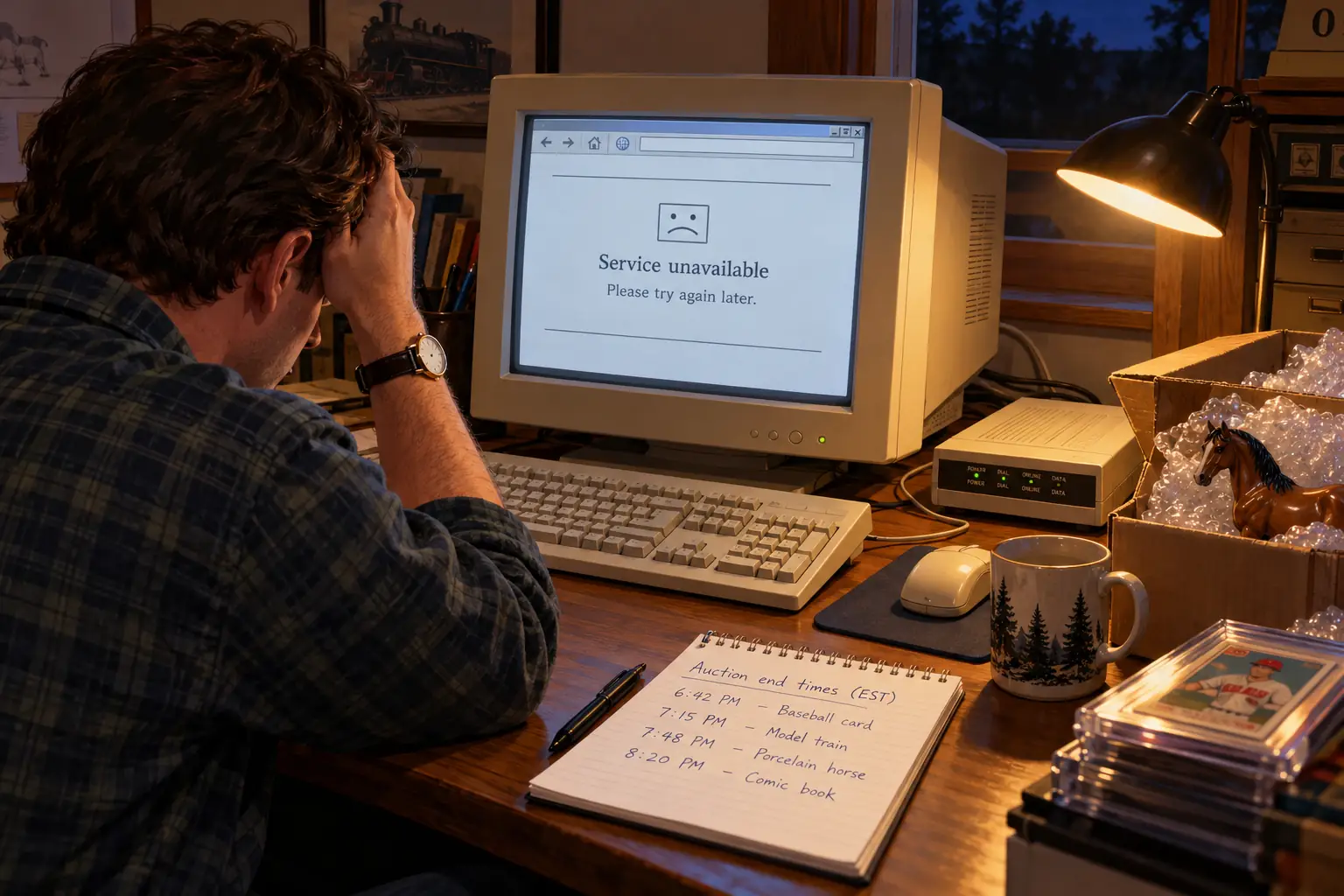
On June 10, 1999, eBay suffered a long outage that stopped people from placing bids. An auction is tied to time. If the site goes dark just before the final minute, a buyer may miss a desired item and a seller may lose a higher offer.
In an open apology dated June 11, Omidyar and CEO Meg Whitman acknowledged how badly the failure hurt users. Contemporary reports put the main disruption at about 22 hours. The company extended affected auctions and issued fee credits.
The outage was a reminder that community spirit could not replace servers, backup systems, and people who knew how to restore them. By then, an online auction was not just a pastime. Some members planned their work and income around its deadlines.
The Pez story and a small date puzzle
Legend vs. the Record: Was it all for Pez?
The legend: Omidyar started eBay because his future wife wanted a place to trade Pez candy dispensers.
The record: The story became famous, but eBay’s own history calls it fabricated. AuctionWeb’s real story rests on the 1995 launch and Omidyar’s aim of an open market. Collecting became central to the site’s success, but the Pez tale is not sound evidence of why it was built.
There is a quieter source puzzle. eBay’s later company timeline places the introduction of seller feedback in the second quarter of 1997. Yet Omidyar’s dated February 1996 letter clearly launches a Feedback Forum. The safe reading is that a public feedback system existed in 1996, while specific features and later labels may have changed. The dated letter is stronger evidence for the original experiment than a short corporate timeline entry.
The change of name is another point to keep straight. AuctionWeb began in 1995. The service became eBay in September 1997. The company had already been incorporated in California in May 1996, and later became a Delaware corporation in April 1998. Those are not four different founding moments.
A little less anonymous, but never risk-free
eBay did not invent selling things to strangers. Classified ads, mail-order clubs, collectors’ shows, and swap meets had done that for years. Nor did it end the risk of being fooled.
What early eBay made unusually visible was the history of a stranger’s dealings. Instead of asking only, “Do I trust this person?” a buyer could also ask, “What happened when other people trusted this person?”
That was a large change in how everyday people used computers. A website was no longer just a place to read a page or exchange messages. It could help two people who had never met settle on a price, send payment, ship a parcel, and report back to the next person.
Many parts of buying online later became easier. Fixed-price shopping, integrated payments, formal buyer protections, and delivery tracking reduced some of the awkward steps. eBay itself continued as a marketplace rather than disappearing with the dot-com years. Yet the old lesson remains useful: a rating can guide a choice, but it cannot replace checking what you are buying and how the deal works.
And somewhere in the history of all those millions of auctions sits a broken laser pointer. Not because it proved people would buy anything, but because it found someone who could see a use for it.
Sources and further reading
- Omidyar’s February 1996 letter — contemporary evidence for the Feedback Forum’s purpose and early self-reported activity.
- eBay’s August 1998 SEC filing — detailed period record of auction steps, seller fees, feedback controls, SafeHarbor, and the limits of eBay’s role.
- Interview and first-buyer account — company reporting from 2015 on Mark Fraser, Omidyar’s recollections, and the original broken pointer.
- eBay’s dated company history — corporate chronology for the 1995 launch, 1997 rename, and Pez myth; compare its feedback date with the 1996 letter.
- FTC’s April 1998 auction warning — period consumer-protection advice and documented risks of online auctions in general.
- eBay’s 1998 year-end results — registered-user counts, auction volume, and business growth.
- 1999 service-outage apology — primary account of the disruption and the company’s response.
- Wired’s September 1998 report — contemporary view of competitors, profits, and the excitement around person-to-person auctions.