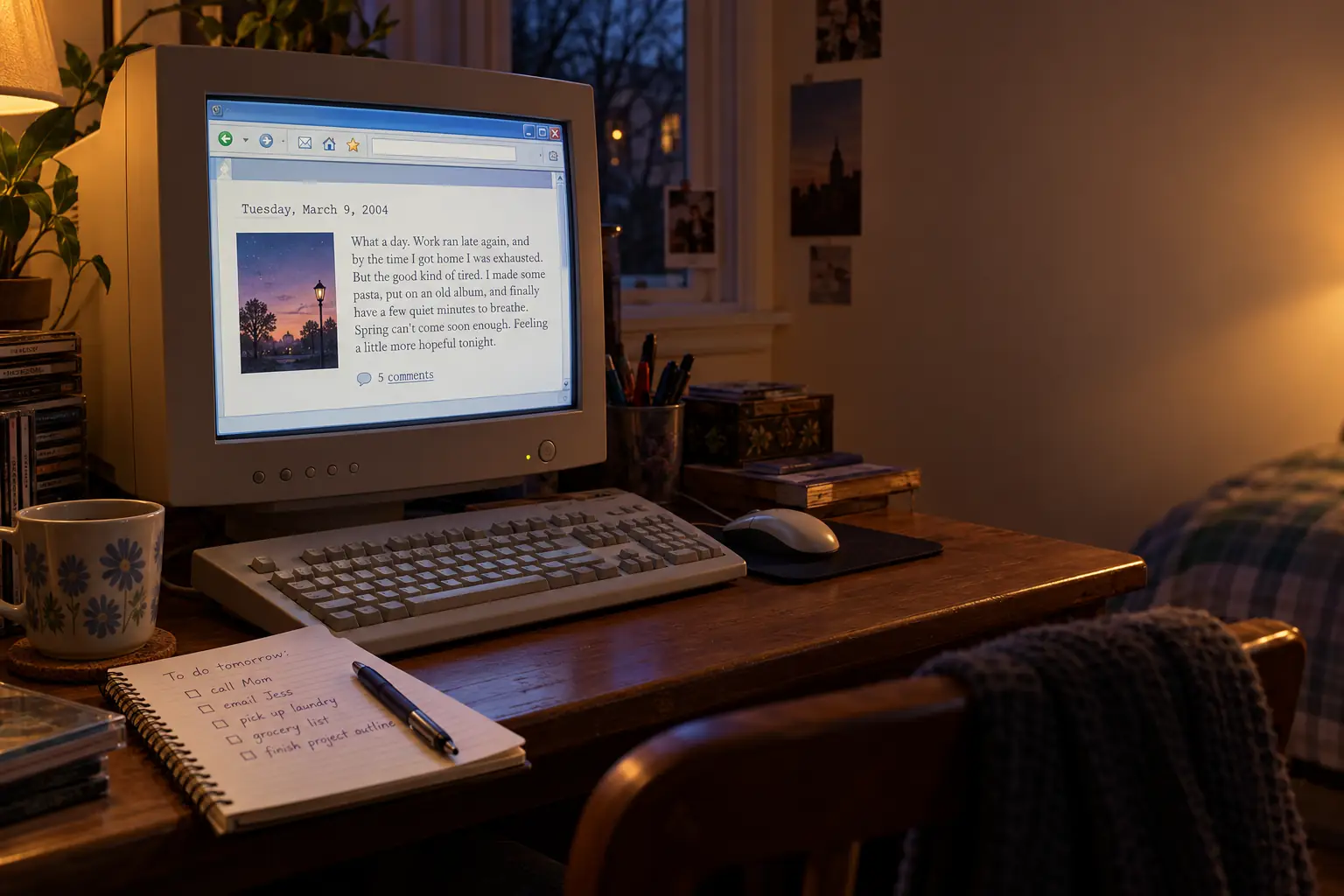
One of the features that made LiveJournal feel like a private place started with a very public mistake: somebody’s parents could read the party stories.
That is how founder Brad Fitzpatrick explained it in a September 2005 interview with the San Francisco Chronicle. His friends were posting accounts of nights out, and their parents were finding them. Users asked for a way to let friends read a post without showing it to everyone else. The result was the familiar friends-only entry.
The need sounds small. It was anything but. Once people could choose their audience, a journal could become more than a public web page. It could be the place where a group stayed close between classes, jobs, moves, and late-night phone calls.
Blogger offered another kind of freedom. It made putting words on the open web so easy that a person could publish a thought without building a website first. It was less like passing a diary around a circle and more like opening your own front door.
Both services began in 1999. By 2004, they had helped turn a simple act—writing down what happened today—into a new way to keep friendships alive.
Two beginnings in 1999, two ideas about a journal
Brad Fitzpatrick started LiveJournal while studying computer science at the University of Washington. He wanted an easier way to update a personal website and let people back home know what he was doing. His early posts were not meant to be great literature. One update might be about a drink; another might say he was doing laundry.
Friends wanted the same tool. Rather than keep installing and tending copies for them, he made a service that ran from his own server. More people arrived. By Fitzpatrick’s later account, the service quickly grew past the circle of people he knew by name.
The technical idea was simple: log in, type, and let the site keep your entries in date order. The social idea became much bigger. What if the people who read your updates could also form the shape of your online world?
Blogger grew from a very different accident. Evan Williams and Meg Hourihan founded Pyra Labs to work on web software. A November 2000 report in The New Yorker described how Williams and colleague Paul Bausch built a weblog tool on the side. They launched it while Hourihan was away. Before long, the side project was more interesting than the original business.
Blogger went live on August 23, 1999, according to the service’s own anniversary account. Its gift was a simpler path from thought to published page. You did not need to write HTML, upload a file by hand, or understand how a web server worked.
Neither site invented online diaries, and neither was the first way to make a weblog. Personal websites, online journals, forums, and mailing lists were already there. What these two services did was make regular writing less like website maintenance and more like a habit.
Behind the Scenes: The side project that took over
In the 2000 New Yorker visit to Pyra Labs, the founders were still working out what Blogger could become. It had begun as a tool built for their own use, not the product on which their first business plan rested. This matters because early blogging was not handed down as a finished social-media strategy. Its makers were discovering what people wanted by watching people write.
What using them felt like in 2004
You first needed a computer and an internet connection. For many households that still meant a shared family PC, a browser, and a phone-line connection or early broadband subscription. A free journal account did not pay for the line or the minutes you spent online.
Then you signed up, picked a user name, and learned where the posting box lived. You could type a small report on your day, write for an hour, or paste in a long complaint that probably seemed brilliant at one in the morning. A timestamp would place it above yesterday’s thoughts.
A typical update might announce an exam result, a new job, a breakup, the death of a pet, or a new favorite band. There was no requirement that the topic be newsworthy. The fact that it mattered to you was often enough.
Then came the part that made the whole routine social: checking whether anyone had answered. A thoughtful comment from one person could matter more than a hundred silent visits. Sometimes there were no comments at all, and the empty space told its own story.
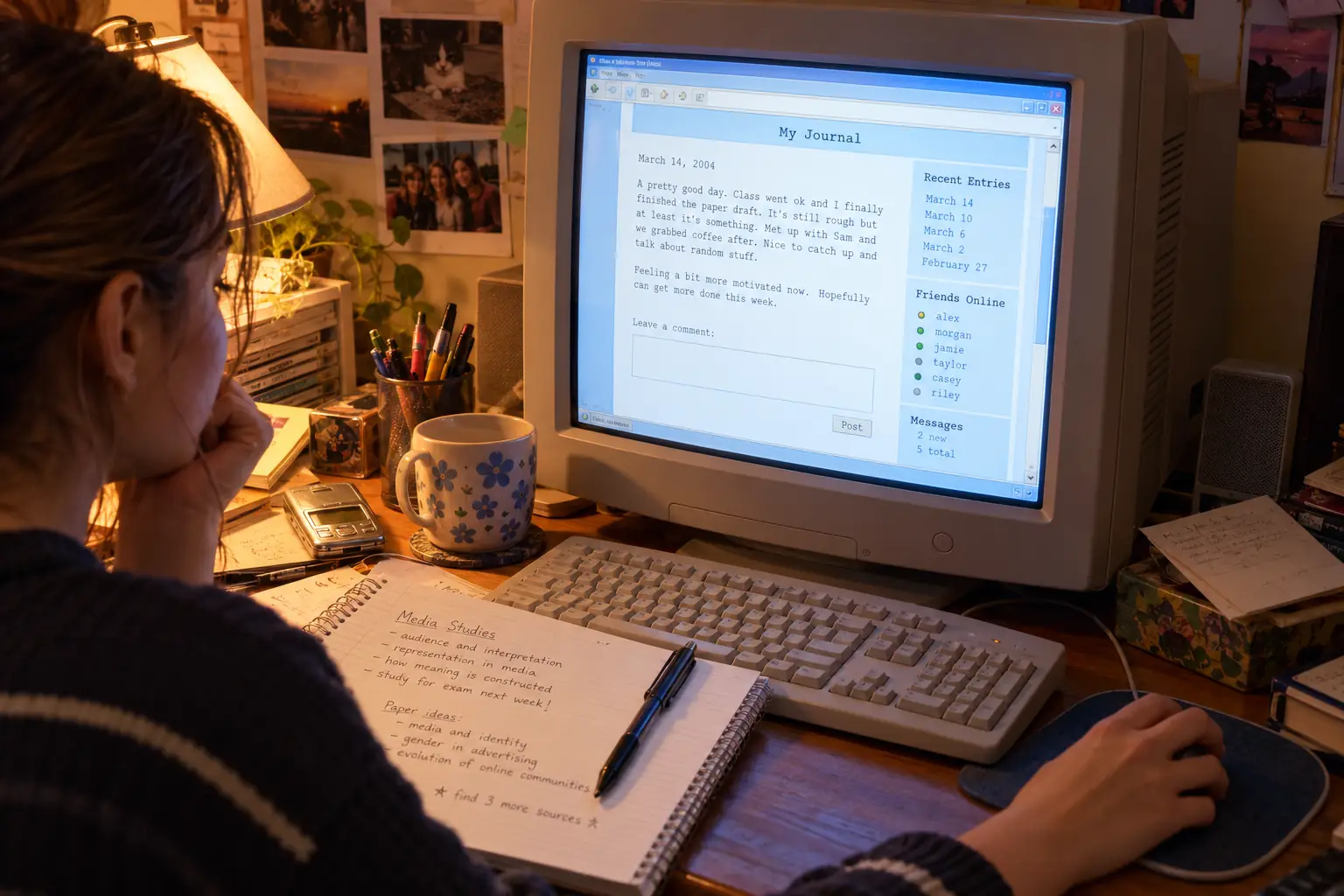
Both services let people write from outside the home as well. A student could post from a campus lab. A traveler could find a computer with a browser. It was a quiet change from keeping a diary in a drawer. Your words were waiting on a server, wherever you found a connection.
There was work involved, too. People adjusted templates, added links to friends’ sites, chose tiny user pictures, and sometimes fought with a stubborn layout. Blogging was easier than hand-coding a whole site, but it was not always effortless.
LiveJournal was a room full of familiar faces
The clever thing about LiveJournal was not just the blank page where you wrote. It was the page where you read other people.
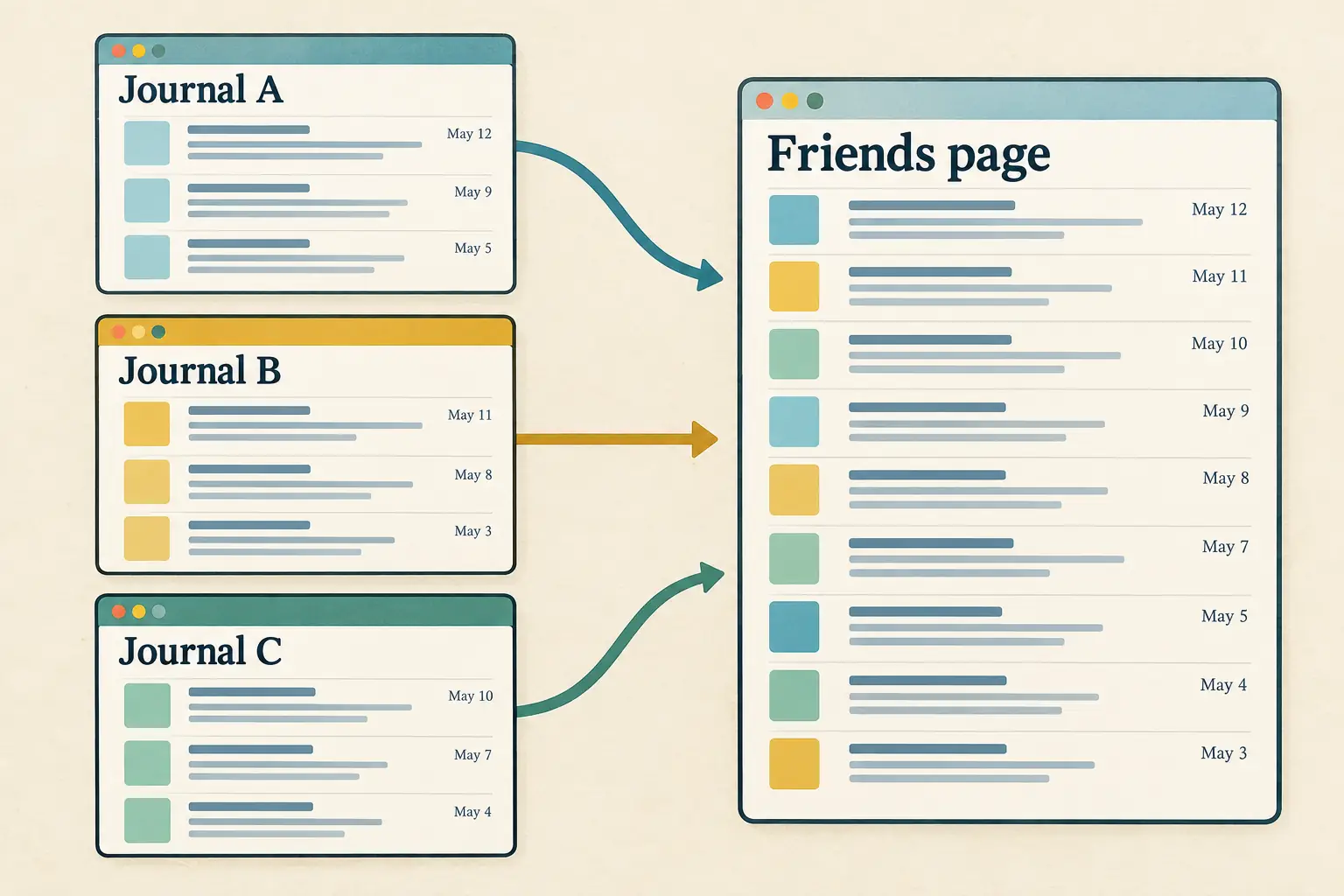
Adding another journal to your friends list put its updates in a shared reading stream, usually with the newest entry first. Instead of visiting ten homepages, you could check one page and see who had news. Long before today’s giant social feeds, that was a useful piece of friendship infrastructure.
The word friend carried several jobs. It could mean somebody whose writing you followed. It could mean someone you trusted with entries that strangers could not read. It could also mean an actual friend from school or work. Those meanings overlapped but were not always the same.
Communities added another layer. People gathered around fandoms, writing, hobbies, cities, and shared problems. An individual diary could lead to a discussion with strangers who later became familiar names. LiveJournal was especially important to some fan communities, though the experience differed across countries and groups.
This network was not one big chat room. Entries could be long and thoughtful. Comments could grow into a conversation over hours or days. A small group could know each other’s lives in surprising detail without meeting in person very often.
The platform also had money and hardware to worry about. Fitzpatrick said that rising traffic pushed him to ask users for help funding more servers. Paid accounts then offered extra features. For part of 2001–2003, new free users needed an invitation code from an existing member; that rule ended in December 2003. For some people, getting a code was a welcome into an existing group. It was also a practical limit on rapid growth, not proof that all members were close friends.
Blogger gave you a front door to the web
Blogger’s main promise was different. It helped you run a website that could be read by anybody who had the address. You could name the blog, choose a look, and write posts without becoming your own web technician.
Some people used a free Blogspot address. Others used Blogger’s publishing tools with their own hosting arrangements. The distinction mattered: Blogger was a tool for publishing, while Blogspot provided a home for many of the pages made with it.
A Blogger page might be a public notebook, a family update letter, a diary, a travel log, or a place to discuss politics, knitting, books, or code. Links in the sidebar could form an informal neighborhood of other blogs. Readers arrived through search results, recommendations, and links from other writers.
That did not mean Blogger lacked friendship. Plenty of conversations grew in and around Blogger sites. But its structure did not make a LiveJournal-style friends feed the center of every account. A Blogger writer often thought first about my site; a LiveJournal regular might think first about my people. Those were tendencies, not firm tribes.
There is a vital date to remember here. At the time of Google’s May 10, 2004 redesign, built-in comments were listed as a new Blogger feature. So a story set in 2001 should not casually show the familiar later comment box as though it came with the service from day one. Writers had used outside comment tools and other ways of responding before that.
The same redesign brought author profiles, fresh templates, and posting by email. A phone or personal digital assistant that could send email could now be part of the publishing path. There was still a service, a connection, and some setup behind the magic, but the distance between a thought and a post was getting shorter.
A locked post was not the same as a secret
The biggest technical difference between the two services was how they helped writers think about readers.
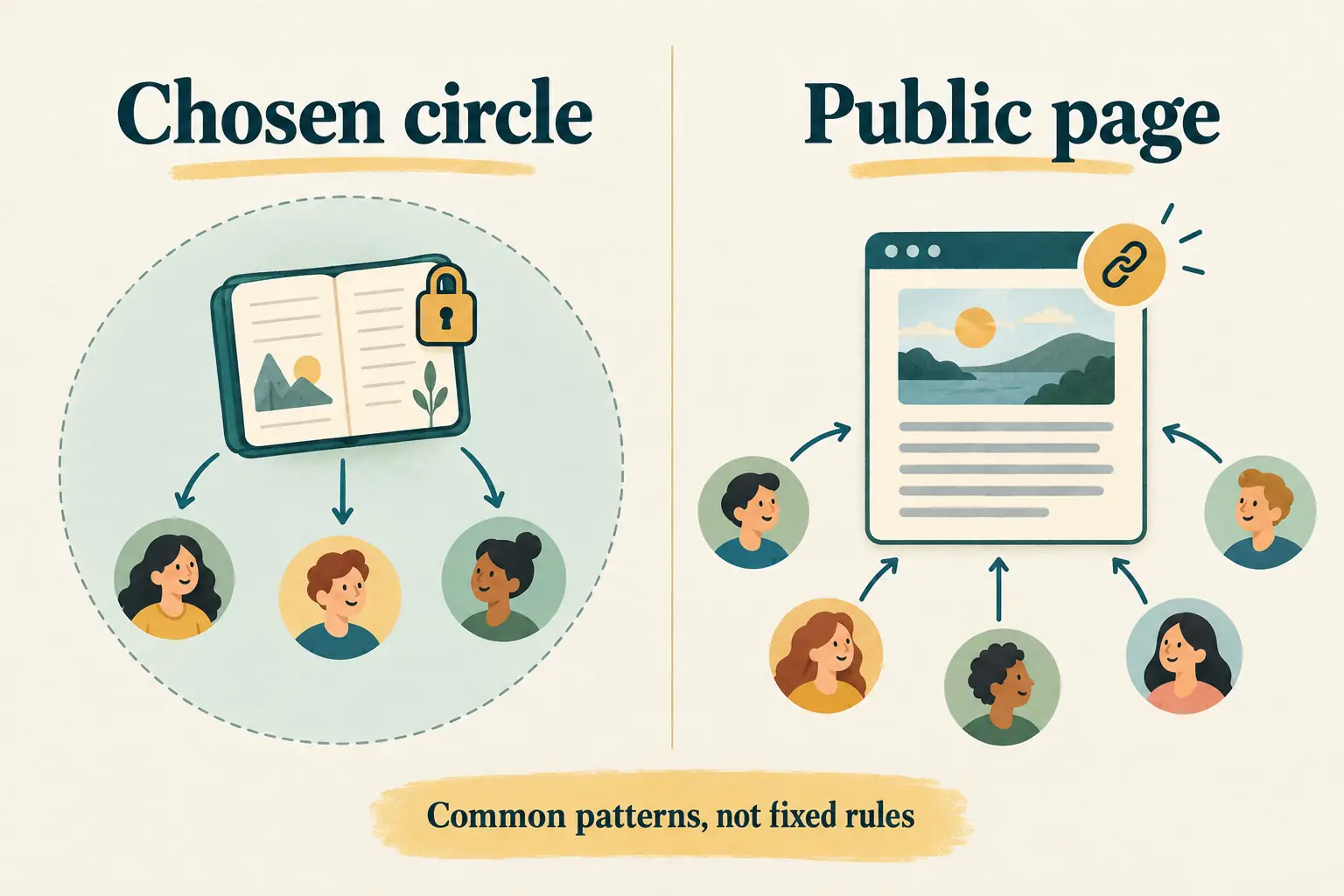
LiveJournal let authors set access for individual entries. A public post was open to anyone. A friends-only post could be read by accounts the author had marked as friends. More selective friend groups could narrow the audience further, while a private entry was for the writer alone.
That control came with a human problem. Following someone did not automatically make that person trust you with their locked posts. A writer could put you on a friends list for reading while refusing to share private entries. Removing someone could feel like more than a setting change.
Researcher Lori Kendall documented these tensions in a 2007 First Monday study based on earlier fieldwork and interviews. Participants often called their page a diary but also knew they were writing for an audience. They sometimes held back precisely because they knew who might read. Kendall also warned that her interviewed group was not a statistical picture of the whole service.
Blogger worked more like a public site during its early years. It did not launch with LiveJournal’s post-by-post friends-locking scheme. In August 2006, Google announced a new Blogger beta that included controls over who could read a blog. That was a later addition, and it generally dealt with access to the blog rather than an intimate circle chosen separately for each diary entry.
These rules should not be confused with real secrecy. A trusted reader could repeat a story, copy text, or show a screen to someone else. And a public entry could be indexed, linked, or saved long after its writer had changed their mind.
Legend vs. the Record: Were these simply public diaries?
The easy version: Everybody wrote private feelings and put them on the open internet.
The better version: Some posts were public, some were restricted, and many were written with a very specific audience in mind. LiveJournal supplied detailed controls for entries. Blogger later supplied reader controls for whole blogs. Privacy depended on the setting, the date, and the people who had access.
Writing about friends could change a friendship
There was something odd about knowing people through their journals. You might see a classmate for five minutes at lunch, then read six paragraphs about their bad day that night. You might learn of a new romance, a family illness, or a move before a person told you face to face.
That could be kind and comforting. A quiet person could explain something carefully without having to find the right words in a crowded room. Friends in different cities could remain part of the same daily conversation.
But ordinary misunderstandings were easier to keep in writing. A vague complaint might feel clearly aimed at one person. Somebody left out of a friends-only post might discover the exclusion. Even the absence of a reply could hurt.
In a 2024 account of his own online youth, writer Kyle Chayka recalled finding a friend’s LiveJournal entry that criticized him by name. It is one person’s memory, not a claim that this happened to everyone. Still, the scene captures a risk that came with making ordinary friendship visible in text: you could suddenly read what someone thought of you when they were not speaking to you.
These were not merely platforms for people hoping to become famous writers. For many users, the posts were closer to letters sent to a whole circle at once. The reward was not reach. It was hearing from someone who mattered.
Remember the refresh?
A familiar early-blog routine was posting an update, visiting friends’ pages, and checking back for a comment later. That description is a general period practice, not a claim about one documented household. Before push alerts became normal, keeping up often meant going to the page yourself.
Then the little writing tools became businesses
Neither service stayed a small project.
Pyra Labs had a rough trip through the dot-com crash. Staff were laid off, and Evan Williams kept Blogger running through a difficult period. By February 2003, Google bought Pyra. The purchase was an early sign that easy publishing mattered even to the company people mostly knew for search. The contemporary acquisition report makes clear that Blogger had a substantial registered base, but registrations should not be treated as a count of active writers.
Google’s 2004 improvements made Blogger easier to use and easier to reply to. Further changes in 2006 added labels, layout tools, and reader-access controls. The product kept its central idea: a person should be able to publish a website without building the whole machine behind it.
LiveJournal went through different ownership changes. Six Apart bought it in January 2005. In December 2007, Six Apart announced a sale to Moscow-based SUP, which had already been involved with LiveJournal’s Russian-language market. A dated Six Apart announcement confirms the change. The site’s life had never been limited to one American college circle; it had become a place for communities in several countries, with a major Russian audience.
Ownership mattered because the host set the rules. Moderation, advertising, account options, and the place where information was held could change without a writer moving to a new journal. Over time, some members left because their friends had moved; others objected to platform decisions or wanted more control.
The later Russian context raised especially serious questions. According to Freedom House’s 2017 report, LiveJournal moved servers to Russia in late 2016 and revised its terms afterward in ways that raised censorship and privacy concerns. That is a separate issue from the harmless awkwardness of an early friends list. An online diary was always held by a real organization, under real rules.
Can you still visit your old corner of the web?
As checked on October 24, 2026, both LiveJournal and Blogger still have public service websites. Blogger continues to offer blog creation; LiveJournal still offers account access and communities. Neither should be treated as a frozen 2004 museum. Features, terms, moderation, and access can change.
Old journals may still be readable if their owners left them public and the posts remain available. Others may have been restricted, deleted, moved, or lost to broken links. If you find your own writing, consider saving an offline copy before you make changes. Check any current export options and privacy rules on the service itself, rather than trusting instructions written many years ago.
There are also newer homes for long-form personal writing, from self-hosted websites to modern blogging services and newsletters. None recreates the exact social world of a particular group of old friends. Software can provide a comment box, but it cannot bring back the people who once filled it.
The small things were the point
LiveJournal and Blogger were never the same kind of place. One put the friends page and careful audience choices close to the heart of the experience. The other made publishing a personal corner of the web feel possible for almost anyone with a connection.
Both let people spend serious time writing about things that might never appear in a newspaper: a long shift at work, a new kitten, an awkward dinner, a band heard for the first time, a message from someone far away.
Those entries could be silly, vain, tender, angry, or dull. They were also evidence of people paying attention to one another. Much of the writing was not intended to impress strangers. It was a way to say, without making a phone call: here is what happened to me, and I hope you are still there.
Sources and further reading
- Neva Chonin, San Francisco Chronicle, September 27, 2005 — Brad Fitzpatrick’s account of LiveJournal’s early life, friends-only posting, and server costs.
- Rebecca Mead, The New Yorker, November 6, 2000 — firsthand reporting inside Pyra Labs during Blogger’s early years.
- Blogger’s August 2006 archive — its stated August 23, 1999 launch anniversary and early philosophy.
- Google press announcement, May 10, 2004 — the Blogger redesign and addition of built-in comments, profiles, and email posting.
- Blogger team, August 14, 2006 — introduction of new reader controls, labels, and layout tools in beta.
- Lori Kendall, First Monday, 2007 — research on identity, selective sharing, and friendships on LiveJournal; interview sample limitations explained.
- Six Apart’s December 2007 sale announcement — contemporary company record of the LiveJournal ownership change (Japanese).
- Freedom House, Freedom on the Net 2017 — LiveJournal server relocation and later Russian legal context.
- Kyle Chayka, The New Yorker, January 13, 2024 — clearly identified personal recollections of LiveJournal and the early social web.