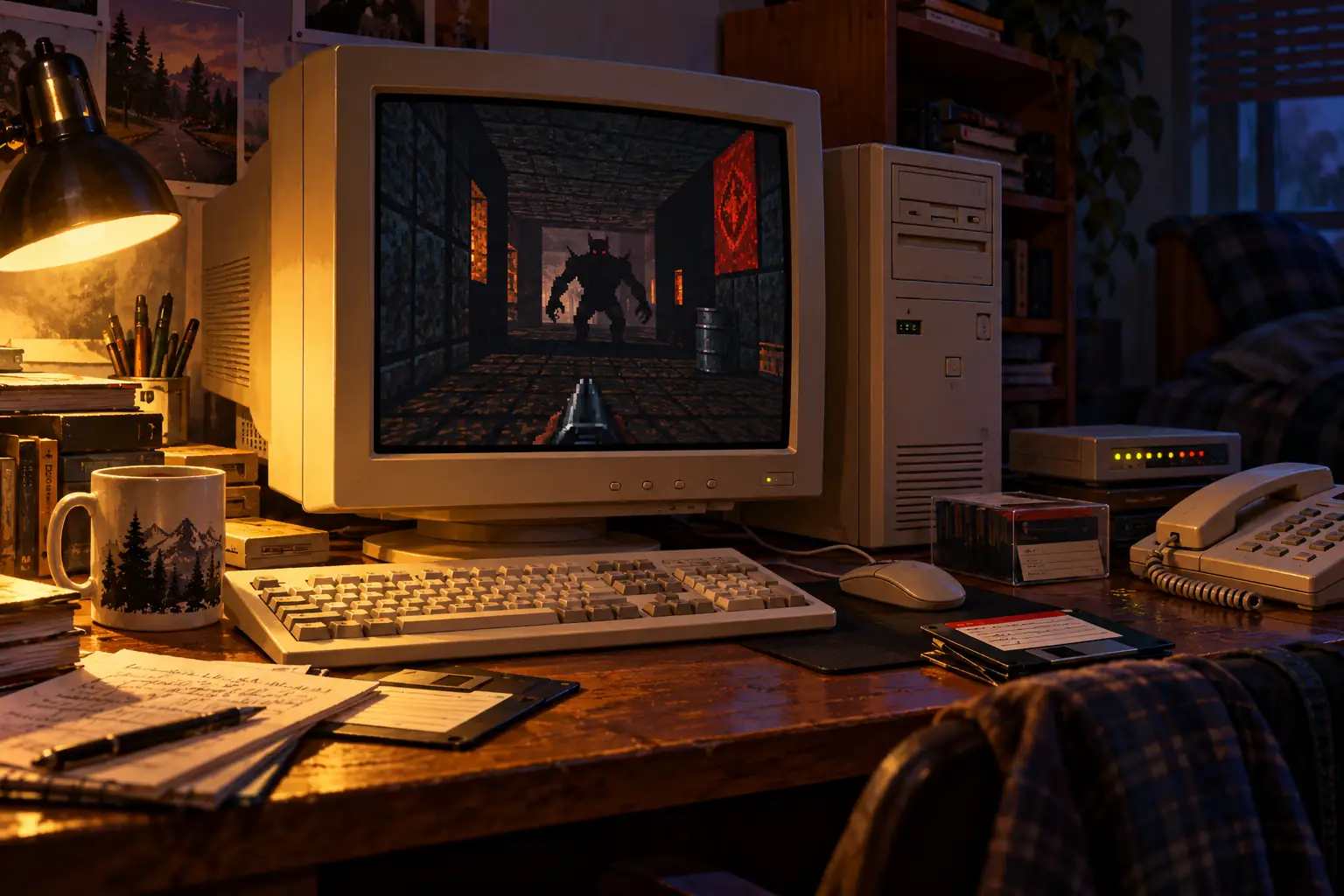
On December 10, 1993, id Software faced an unusual launch problem. People were so eager to get Doom that they crowded the computer meant to receive the game file. The company had trouble putting its own release online.
John Romero later told the story of repeated upload attempts. A contemporary British review, recalled in Richard Moss’s Shareware Heroes, described fans filling online spaces with demands for the game. Before many people had played a single level, they were already helping to make its release a spectacle.
No shop had to sell them a boxed copy first. The opening episode was free to copy and pass along. That choice turned players, computer clubs, online services and even rival disk sellers into part of Doom‘s distribution network.
But free access alone does not explain what happened next. To understand how Doom traveled, we have to follow three things: a small ZIP file, the people who played it together, and the new levels that players began making for one another.
Why id gave away the first episode
Doom was not id Software’s first shareware game. Commander Keen and Wolfenstein 3D had already shown the company how well the model could work. Give people enough of a game to enjoy. If they wanted the rest, they could pay for it.
That mattered in an era when getting a new PC game into shops took money, packaging, shipping and help from a publisher. Shareware offered another route. The game itself could find customers before a boxed product found shelf space.
For Doom, id made the first episode, Knee-Deep in the Dead, available as shareware. It held eight main levels and a secret ninth level. Buyers of the registered game got the other two episodes, The Shores of Hell and Inferno, along with weapons missing from the free edition.
The mail-order version cost $40 in the United States, according to the period Official DOOM FAQ. The free episode was not a timed trial that shut down after ten minutes. It was a substantial game that could make a player want more.
Id also changed who collected the money. The team had worked with the shareware publisher Apogee, but decided to handle Doom‘s registered sales itself. Historian Richard Moss describes that move in his account of Doom’s business plan. In plain terms, id kept its direct customer relationship and the revenue from full-game orders.
Behind the Scenes: Sell our free game, keep the money
Here is the strange part. Romero later recalled that id contacted companies already selling shareware disks and invited them to package the first episode of Doom. He said those sellers could charge up to nine dollars and keep the proceeds.
That sounds backward until you see the aim. A disk seller made money from the copy in the shop. Id hoped to make money when the new player ordered the full game. It was a way to recruit distributors without paying them an advertising fee.
This is Romero’s later account, published in Moss’s Shareware Heroes, not a surviving contract with every disk seller. Even with that limit, it reveals how deliberately id wanted the free episode to move.
The upload that nearly defeated itself
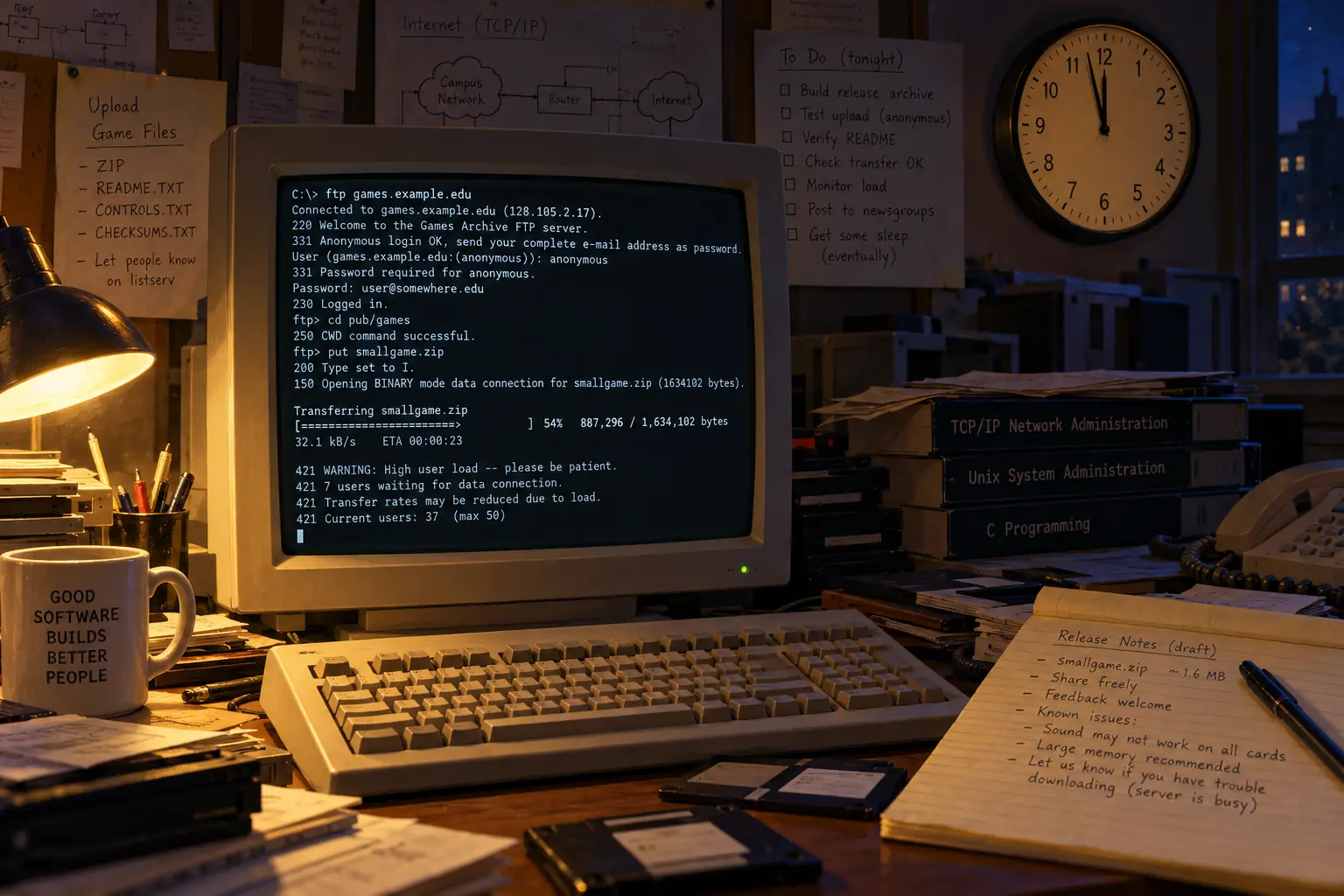
The first public shareware release, version 1.0, arrived on December 10, 1993. The initial package was called DOOM1_0.ZIP. Its destination was an FTP server at the University of Wisconsin–Parkside, part of the university network used for sharing computer files.
FTP stood for File Transfer Protocol. You connected to another computer, found a file in its directory and copied it to your own machine. There was no modern game-store page, large download button or automatic installer.
By Romero’s account at the 2011 Game Developers Conference, the crowd waiting for the upload forced three attempts before the transfer succeeded. It is one of the few software launches in which the audience reportedly got in the way of delivering the product it wanted.
That difficult first upload should not be confused with every later release of the game. Version 1.1 followed on December 16. The February 1994 version 1.2 added direct modem play and other changes. As the FAQ makes clear, there were more revisions through 1994. Someone who says they played the “original Doom shareware” might mean one of several versions.
The surprise is not that a single server could struggle. Servers struggled often in those days. The surprise is what happened after people finally had the ZIP file: id no longer had to carry the whole load.
FTP, BBSes and floppy disks
One successful download could turn into many new copies. A player might pass the ZIP file to a friend, upload it to another FTP site, place it on a bulletin board system or copy the unpacked game onto disks. The copy might cross a city before it crossed an ocean.
A BBS, or bulletin board system, was a computer people called using a modem and a telephone line. It offered messages and files to download. A local BBS operator could make Doom available to callers who had never used a university FTP account.
That was not instant. The shareware download was roughly two megabytes. At a slow 2,400-bit-per-second connection, the transfer alone could take around two hours in ideal conditions, and longer in practice. A busy or noisy phone line could turn a promising evening into a failed download. Faster modems helped, but cost and access varied widely.
The period FAQ is a small history lesson by itself. It listed FTP sites in the United States, Britain, Finland, Canada and South Africa. It also listed the Software Creations BBS, with separate telephone numbers for different modem speeds. The list shows an active international copying network by the time that edition of the FAQ circulated; it does not prove that every country received Doom on launch night.
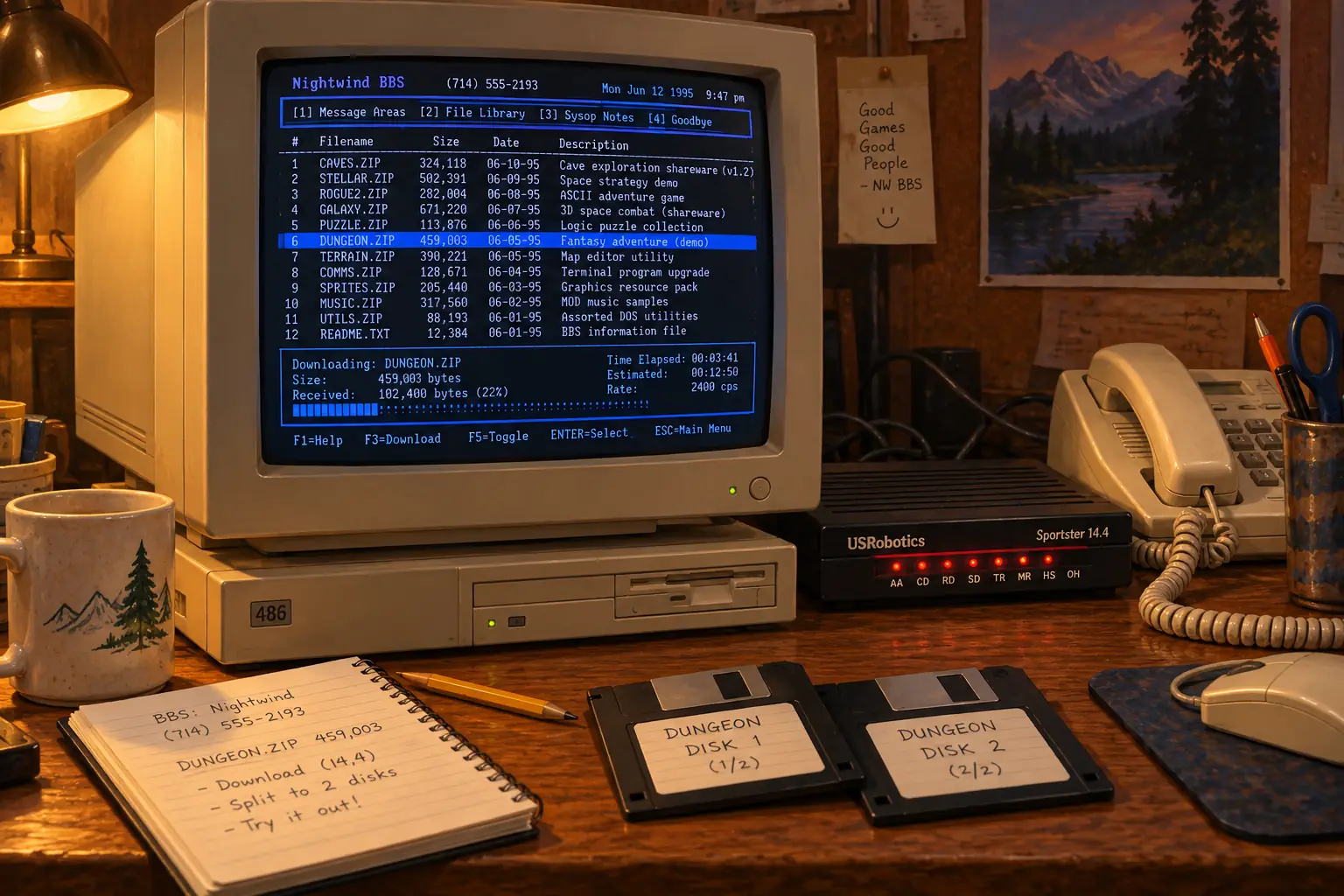
Disks mattered just as much as cables. People who did not have a modem might buy a shareware disk, trade disks with a friend or try a copy found through a computer club. Shareware sellers could put the same game in different wrappers. What looked like several competing products in a shop might lead to the same first episode.
There was an important limit. Shareware did not mean the entire game was free. The permission to share applied to the designated shareware package, not to making unauthorized copies of the paid episodes. The split was the business model.
Why the free game was worth keeping
If Doom had been dull, the clever distribution plan would have delivered disappointment very efficiently. It was not dull.
Wolfenstein 3D had made first-person action feel fast on a PC. Doom added rooms of different heights, angled walls, stairs, pools of light and passages that sank into darkness. John Carmack’s graphics engine made those spaces move quickly enough to feel alive. John Romero and Sandy Petersen helped shape the levels. Adrian Carmack and Kevin Cloud made its ugly, unforgettable art; Bobby Prince supplied music and sound.
The player did not need to understand the engine. You turned a corner, heard a monster, found a shotgun and learned that a dark room might be hiding something awful. Exploration and danger were woven together. The free episode delivered that experience, not merely a menu of features.
Not everyone liked the result. The violence and horror made it a poor fit for some homes, while the British magazine Edge questioned whether there was enough to do beyond fighting. As Moss notes in his account of the period reviews, most game magazines were far more excited than skeptical. Doom could be both technically impressive and a game someone simply did not want to play.
But it also made demands of the machine. The period FAQ specified an IBM-compatible computer with at least a 386SX processor, 4 MB of RAM, VGA graphics and DOS. A 486 was a better bet for speed. On some PCs, getting enough free memory meant changing startup settings before the game would run.
The usual tools were a keyboard and often a mouse. Players with the right sound card heard far more than the basic PC speaker could offer. The result could be thrilling on a powerful home PC and choppy on an older office machine. The distribution was easy to copy; the experience was not equally easy to run.
Remember the setup screen?
A DOS game was not always a double-click affair. A typical player might choose a sound card, test controls, make room on a hard drive and then launch the game from a command prompt. These are documented period tasks, not a claim about one particular player’s evening.
Deathmatch gave it a second life
There was another reason a copy of Doom became useful to someone who had already finished the episode. They could play it with other people.
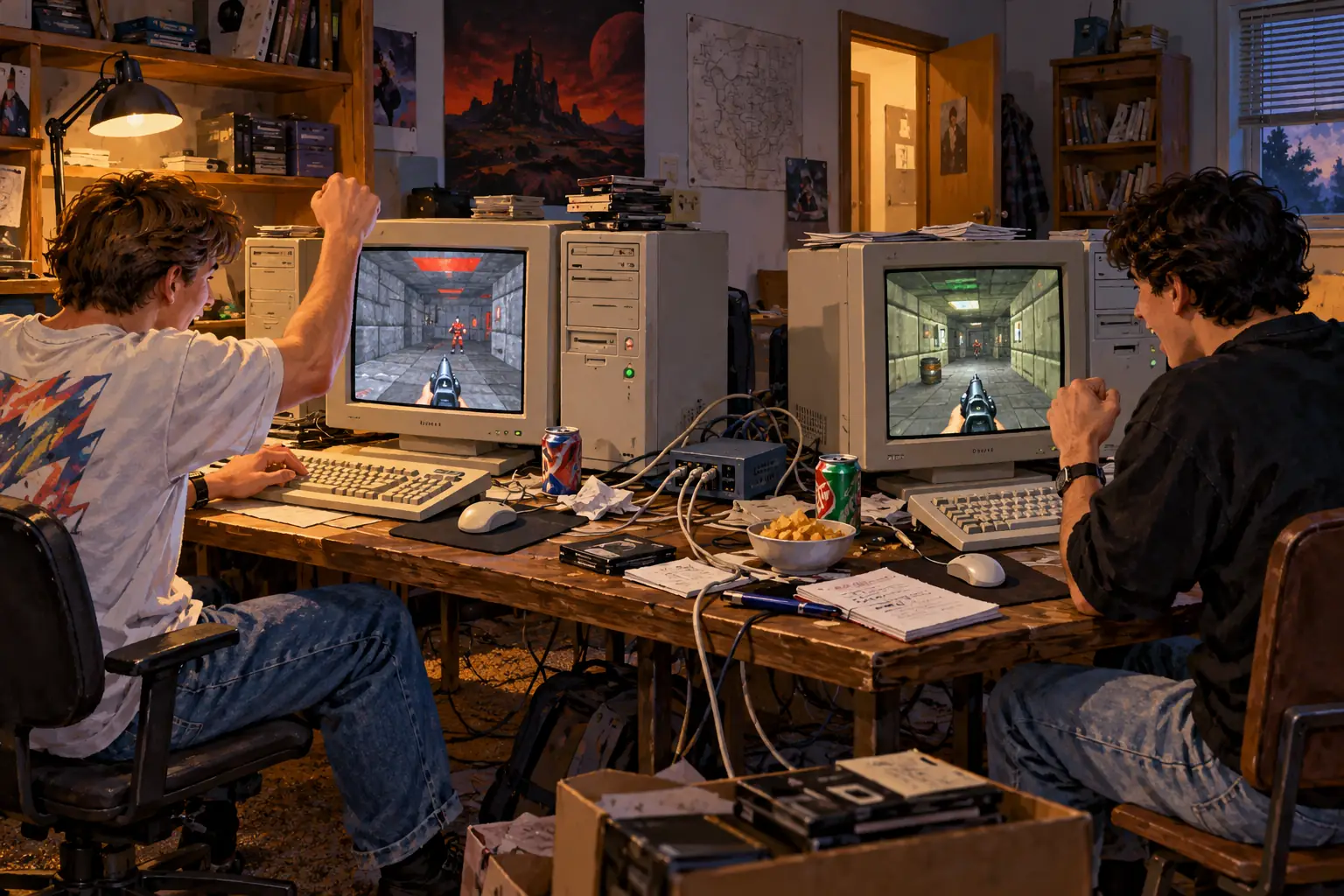
At launch, Doom supported local network games for up to four players. A group could fight monsters together, or hunt one another in the mode id called deathmatch. The word became part of gaming language, but the feeling was easier to explain: the monster on the other side of the door might now be your friend from the next desk.
For a network game, PCs generally had to be connected on a compatible local network using the IPX protocol common in offices and schools. This was not the same as joining today’s worldwide matchmaking service. Direct two-player modem support arrived in a later update, with version 1.2 in February 1994.
Multiplayer also gave Doom a reason to spread through workplaces and campuses. A copy on one machine was good. Copies on several linked machines meant a match. The game could fill a room with cheers, complaints and urgent arguments about who picked up the rocket launcher.
There were costs. Multiplayer traffic could burden shared networks, and people were not always meant to be playing games at work. Later histories describe organizations dealing with unwanted Doom traffic. Such reports should not be stretched into a claim that every office banned it.
Multiplayer was not invented by Doom, and Doom did not offer modern online matchmaking. Its great contribution here was to put a fast, easy-to-understand fight into a game that people already had strong reasons to copy.
WAD files let players make more
Then came the people who did not just want to play the levels. They wanted to build some.
Doom kept much of its game material—maps, pictures and sounds—in WAD files. The program that ran the game was separate from much of the content it displayed. That division gave skilled fans something they could study and change without rewriting the game engine.
By April 1994, Matt Fell had produced his Unofficial DOOM Specs, circulated by FAQ editor Hank Leukart. The document laid out the structure of maps and other data. It was a real community effort, not an official software-development kit from id. The FAQ itself said id had chosen not to release its own formal specifications at that point.
People could exchange new maps as comparatively small add-on files. That gave existing players fresh places to explore and new places to fight. It also gave them something else to post on FTP sites and BBSes long after the first episode’s release.
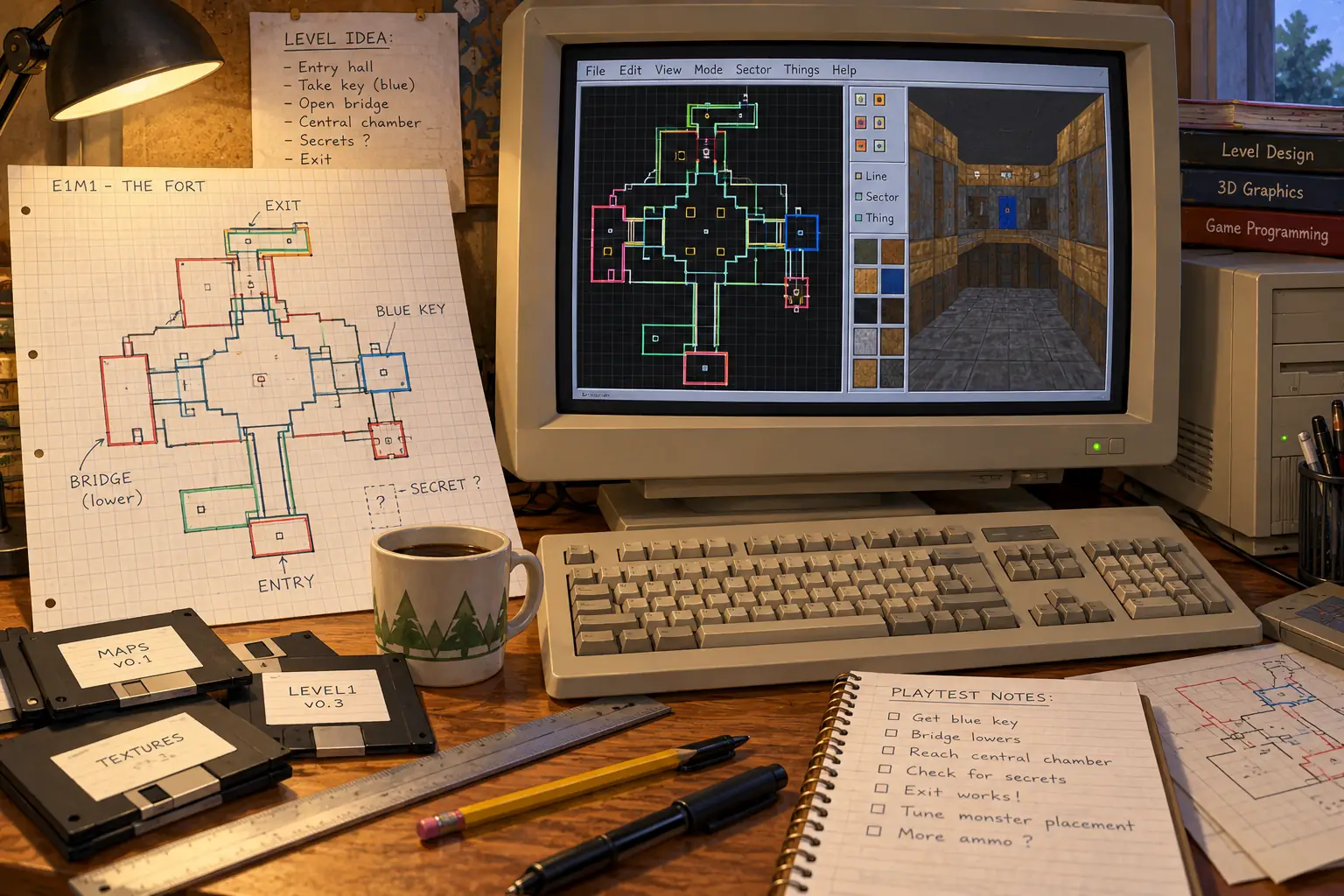
This openness had limits. Id’s period documentation discouraged making new levels for the shareware edition because that could reduce the reason to buy the registered game. Fans still had plenty to do with the paid game. The full history of their tools and WAD creations deserves its own story; for the shareware story, the key point is that player-made content helped keep Doom in circulation.
Legend vs. the Record: Was Doom open source in 1993?
No. The shareware episode could be copied under its rules, and fans could make certain kinds of add-ons. That did not mean id had released the program’s source code. Id published Doom’s engine source in December 1997, at first under a restricted noncommercial license; it was later made available under the GNU General Public License. Even today, game data and program source are not the same thing.
How many copies were really out there?
It is tempting to end this story with one giant number. That is also where the evidence becomes slippery.
A familiar claim says Doom reached about ten million PCs by 1995. Other figures are larger. In a May 2026 investigation, PC Gamer revisited accounts that id president Jay Wilbur had spoken of at least 15 million computers in 1995 and 20 million shareware downloads in 1996. It also examined later memories of a Microsoft study said to show Doom on more PCs than Windows.
Those figures do not all measure the same thing. A download was not necessarily a new player. One copy could be downloaded, copied to disks and installed on several machines. Some people bought registered copies. Others tried the free episode and stopped. We do not have a reliable worldwide count that neatly sorts them out.
The safer conclusion is also the important one: by the middle of the 1990s, Doom had reached an extraordinary number of computers, many of them outside the normal boxed-game sales record. The exact total is less certain than the path it took.
The game did not stop in 1993
Id soon used a more familiar retail route for Doom II, released in 1994, without offering a matching free first episode. The original game later appeared in a retail form as The Ultimate Doom in 1995, with a fourth episode. Doom had become a name people would buy, not just try.
Still, the old habits survived. Players kept trading maps, talking about tricks and building tools. The December 1997 source-code release opened another chapter, helping programmers keep the engine running on newer systems. That was a separate milestone from the 1993 shareware launch, but it built on the same taste for passing useful things along.
As of October 2026, there is also a straightforward official way to revisit the games. Bethesda’s 2024 DOOM + DOOM II release combines updated versions for modern platforms, with online multiplayer and support for community mods. The publisher also explains how PC owners can access older versions. That is a safer starting point than assuming any random copy of an old executable is trustworthy.
The best part of Doom‘s first journey may be its simple chain of favors. Someone made room for a file on a university server. Someone else copied it to a BBS. Another person put it on a floppy disk. A friend connected a second PC. A hobbyist drew a new map.
Id made a game people wanted to share, then made sharing part of the plan. The free episode got Doom into homes, offices and schools. The players gave it reasons to stay.
Sources and further reading
- The Official DOOM FAQ — period reference for release revisions, episode contents, system needs, FTP mirrors, BBS numbers and the $40 mail-order price.
- Richard Moss, Shareware Heroes excerpt (2022) — history of id’s sales plan and John Romero’s later recollections of shareware disk distribution.
- GameSpot’s GDC 2011 report — Romero and Tom Hall’s retrospective, including repeated attempts to upload the first release.
- John Carmack interviewed by Wired (2013) — creator account of Doom’s graphics and the game industry’s early development choices.
- id Software shareware README, version 1.8 (1995 copy) — setup, modem and network instructions, and id’s warning against new levels for the shareware edition. This document describes a later version, not the exact December 1993 package.
- Matt Fell, Unofficial DOOM Specs (April 1994) — contemporary evidence for early community work on WAD formats.
- PC Gamer’s 2026 installation-count investigation — why the large and often repeated Doom estimates cannot be treated as a verified census.
- Bethesda’s DOOM + DOOM II release notes (2024) — official modern availability and features.