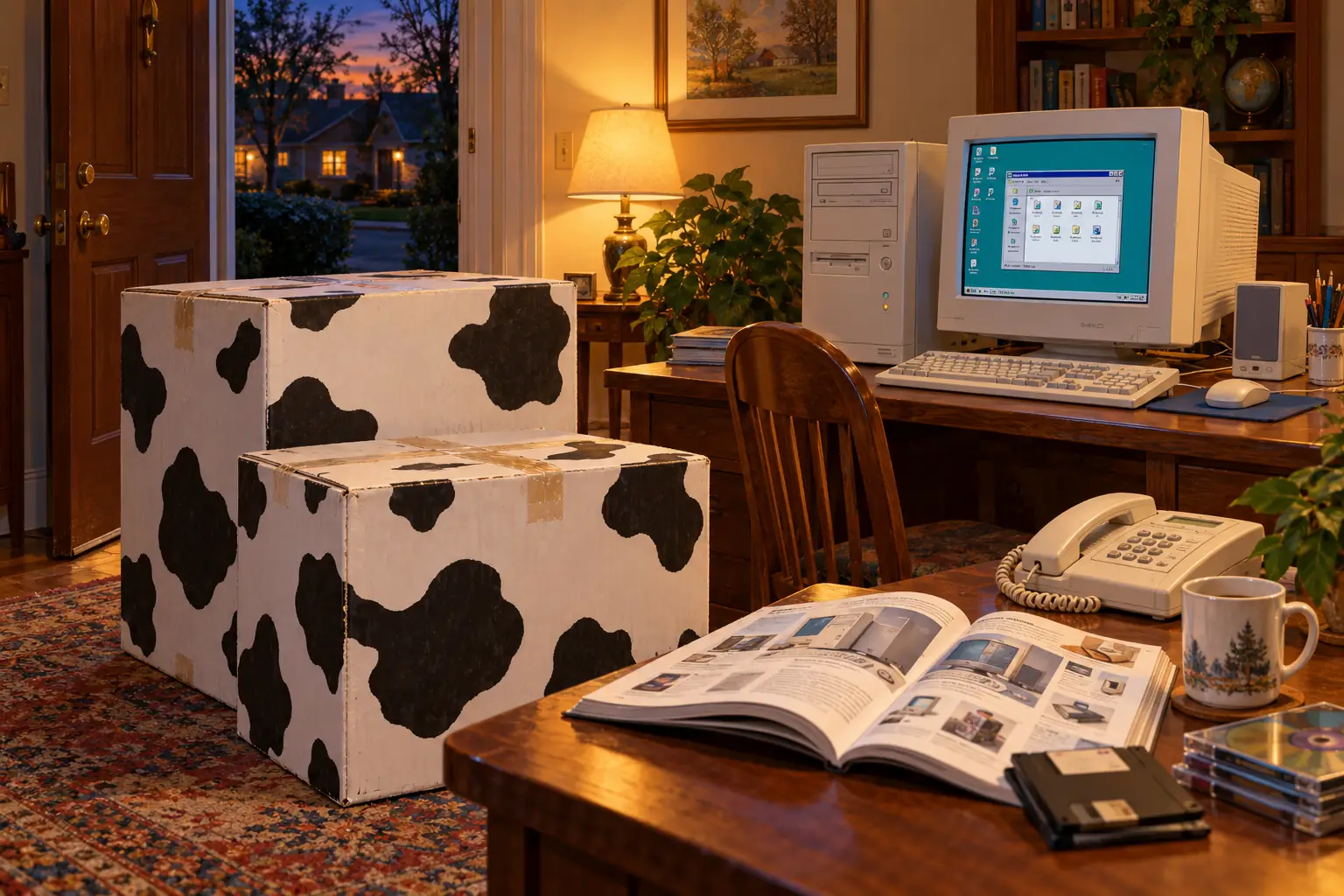
In 2004, a federal appeals court was asked to decide a remarkable question: could a cow-shaped toy made for computer monitors violate Gateway’s rights to its black-and-white spots?
Yes, the cow spots had become that valuable. What began as a playful way to sell personal computers was now part of a legal fight. The court upheld an order protecting Gateway’s distinctive trade dress against the disputed toy.
The packaging was easy to laugh at. But for millions of people who saw Gateway ads, considered buying by phone, or waited for a new PC to arrive, the spots meant something practical. Here was a company asking you to trust a voice at the other end of a telephone line with a large part of your savings.
How did a business born on an Iowa cattle farm make that work? And how did its famous boxes outlast the company that made them famous?
From farm to phone line
Gateway’s story starts in 1985, not in California’s Silicon Valley, but near Sioux City, Iowa. Ted Waitt and Mike Hammond set up a small business in a farmhouse tied to the Waitt family’s cattle operation. Their first market was not new family PCs. They sold add-ons and software to owners of Texas Instruments computers.
That was a smart place to start. Some Texas Instruments machines did not work with the growing world of IBM-compatible PC products. Their owners still needed parts and programs, even when many shops had lost interest in selling them.
Waitt had worked in a computer store. He had seen the gap between expensive machines and cheap ones that did too little. He also saw that a helpful salesperson could explain a computer without standing beside it. A magazine ad and a telephone could do the work of a showroom.
The founding money was small. In a 1995 Wired interview, Waitt described using a $10,000 certificate of deposit belonging to his grandmother as security for financing. This was not the usual story of a venture firm pouring millions into a young technology business.
By the late 1980s, Gateway was selling IBM-compatible PCs. It grew into a build-to-order business: take the order, agree on the parts, assemble the machine, then ship it. In 1990 the company moved its growing operation to North Sioux City, South Dakota, just across the state line.
The location gave Gateway a story that its rivals could not easily copy. A computer company in cattle country? That sounded odd. It also sounded more human than another anonymous beige box.
Why the cow spots worked
The company’s black-and-white Holstein pattern tied its new business to its old surroundings. It appeared in advertising, on shipping cartons, and eventually in stores. There was no technical benefit to the pattern. A cow-spotted box did not make the processor faster. It made the brand hard to miss.
A 2004 appeals-court opinion sets out an unusually clear history. Gateway was using cows and spots in national advertising by 1988. The pattern had become a company symbol by 1991. Gateway registered a cow-spot design for computers and related products in 1992.
Those dates matter. The cow image did not arrive as a last-minute joke after Gateway became famous. It grew alongside the mail-order business, turning into something customers could recognize at once.
Behind the Scenes: The ads starred the people selling the PCs
When reporter Charles Platt visited Gateway in 1995, he found an advertising operation with a taste for costumes and jokes. Ted Waitt had designed early ads himself, and the later campaigns still used Gateway workers as models. Platt described ads with Waitt playing Robin Hood and a poker player in an Old West saloon.
The humor had a job. A person reading a computer magazine could see a recognizable company personality instead of only rows of specifications. That did not prove its PCs were better, but it gave a distant mail-order firm a face.
In ordinary computer marketing, the cardboard box was something to throw out. Gateway made its box a second advertisement. A spotted carton on a porch or in an office could tell a neighbor which computer had arrived before anyone opened it.
Buying a PC from an ad
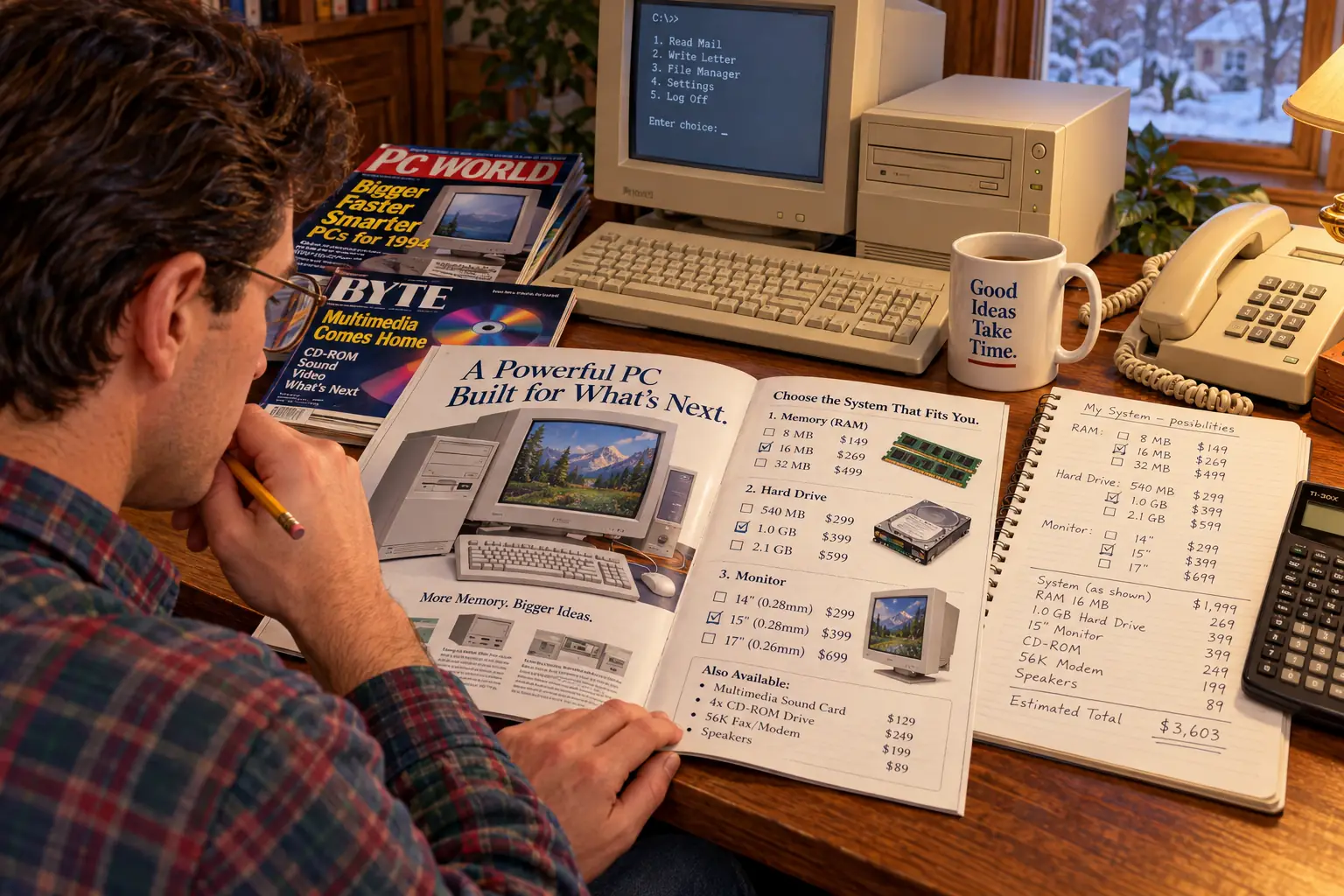
To buy a Gateway in the early and mid-1990s, you could read its large magazine advertisements or a printed catalog, call a sales number and talk through the choices. There was no need to carry a PC home from a local shop. There was also no chance to lift the keyboard or hear the fan before paying.
The choice of parts was serious business. A little more memory could make Windows run better. A larger hard disk could hold more games and programs. A CD-ROM drive, modem, sound card or better monitor could change what the machine was useful for. Every extra had a price.
One surviving customer record gives this process real weight. In a 2010 account, former buyer Greg Edwards reproduced an order summary he had kept from early 1996. He recalled choosing a package from a catalog, ordering by phone, and receiving a written specification from the sales representative.
His P5-120 Family System had a 120 MHz Pentium processor, 16 MB of memory, a 1.2 GB hard disk, a 6-speed CD-ROM drive, a modem and Windows 95. The price was $2,499 for the system. With his add-on, sales tax and $95 shipping charge, the record showed a total of $2,845.02 in 1996 dollars.
That was a great deal of money for a household. It could also buy a whole new set of activities: homework, word processing, spreadsheets, photo and multimedia discs, games, and a way onto the dial-up internet. The software bundle on Edwards’s order even included Microsoft Bob, a reminder that not every bright new idea aged well.
The invoice is one person’s purchase, not a standard price for every Gateway. But it captures something a list of company sales figures cannot: buying a PC meant balancing wants, budget and trust, line by line.
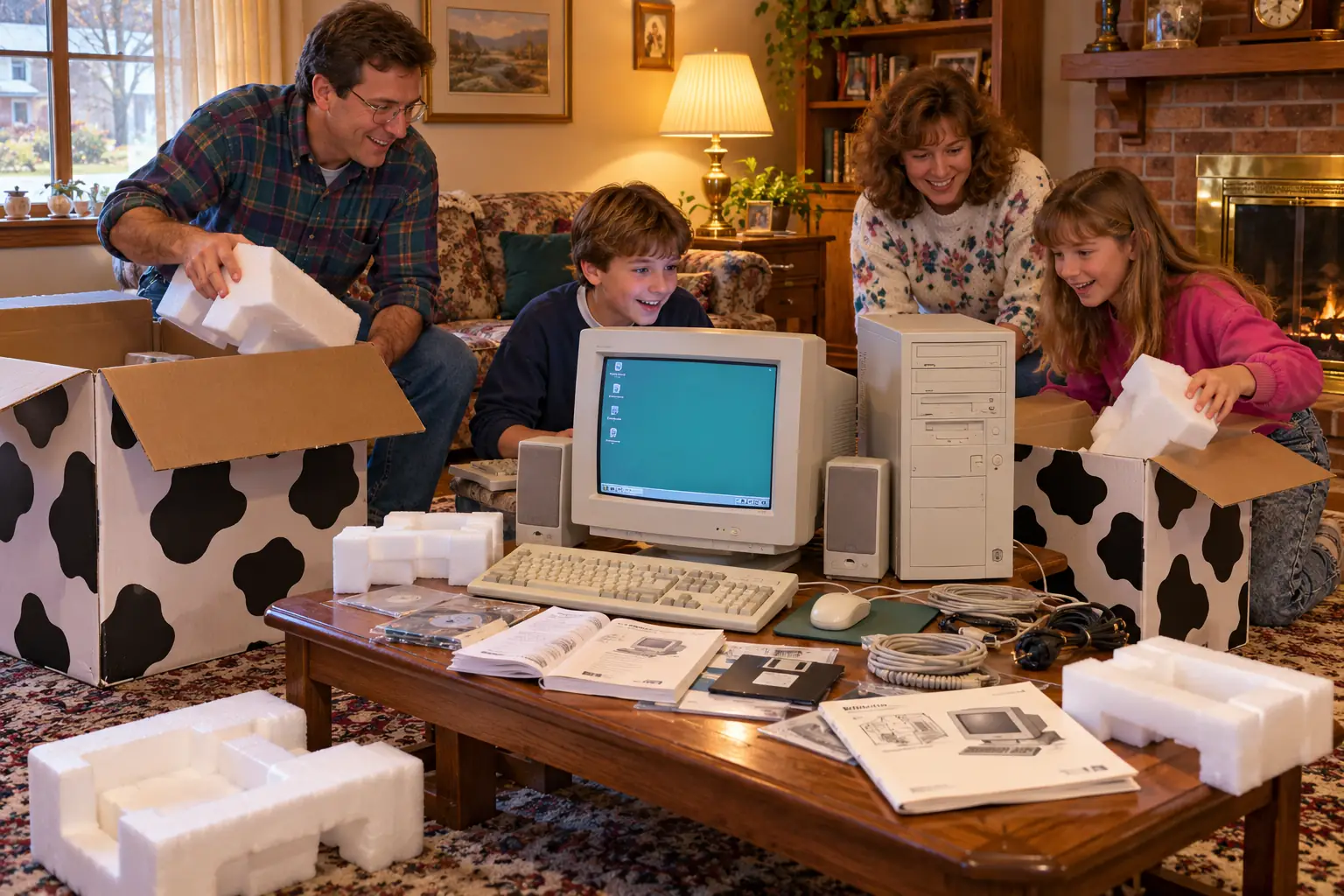
Delivery began another job: making the computer work. A desktop order could mean a system unit, heavy CRT monitor, keyboard, mouse, speakers, cables and paper instructions. Once it was on the desk, someone had to connect it all, start Windows and learn the unfamiliar messages on the screen.
The company had saved on the cost of a traditional retail shop. Some of the work that a store might do before or after a sale had moved to the customer and the telephone support staff.
The service promise and its limits
Gateway marketed help as part of the bargain. It promoted phone support, warranties and return rights. That message mattered because an expensive computer ordered from far away could feel like a gamble.
Then came the hard part: thousands of new owners who needed help at once.
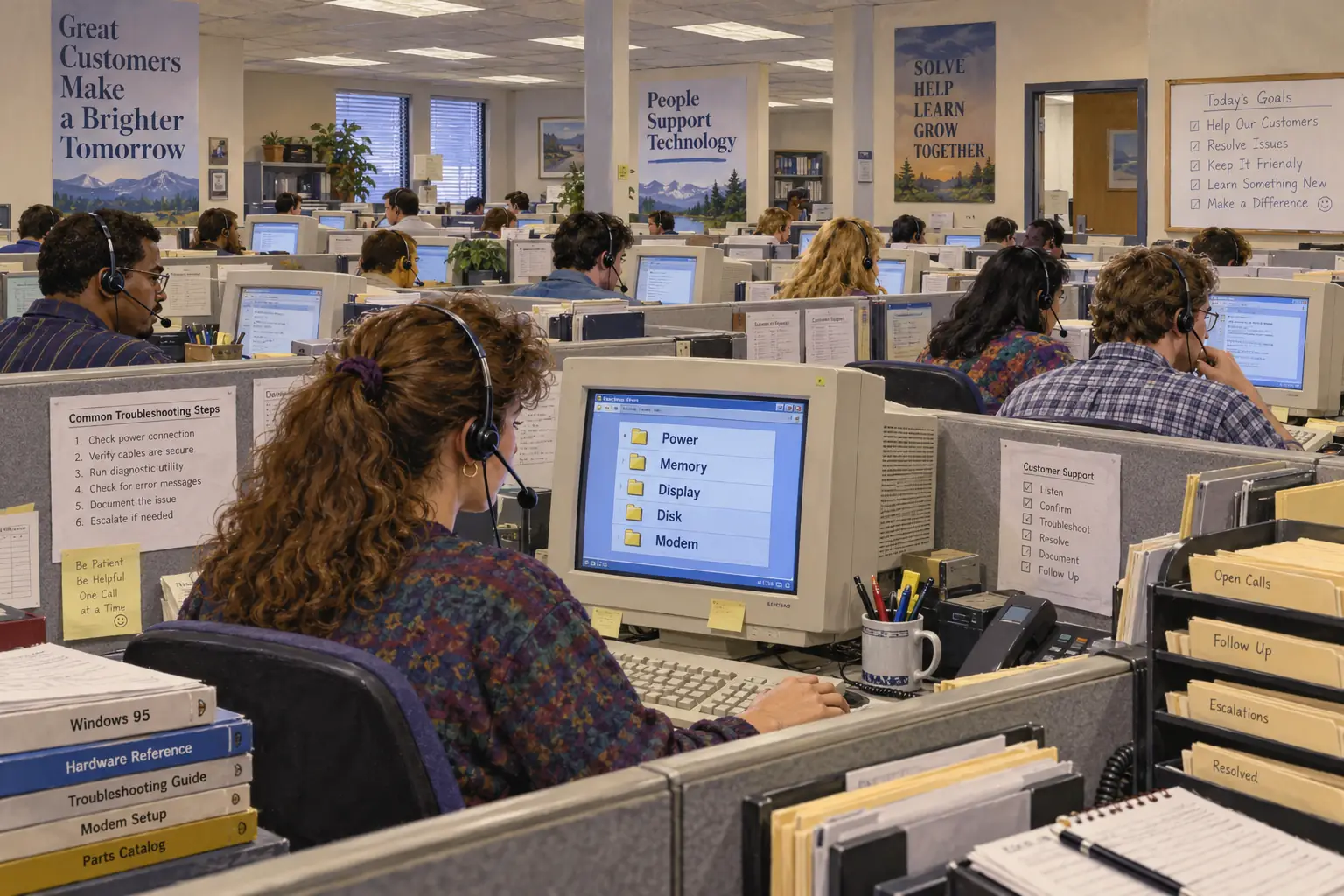
During the 1995 Wired factory visit, Gateway managers acknowledged support problems. The article reported complaints about busy lines and delays. At the time, the company had more than a thousand people handling different kinds of telephone assistance across three U.S. locations. One employee told the reporter she dealt with roughly 100 to 120 calls a day.
The article also described a practical support system. Staff could look up common faults on their screens and follow suggested steps. For a caller whose CD-ROM drive would not work, that could help. For a buyer who had already called three times, it might feel less friendly than the magazine ad.
There was a more serious gap between some promises and practice. In 1998, the Federal Trade Commission announced a settlement over Gateway’s advertising of full refunds and free on-site service. The FTC said some customers were not refunded their original shipping costs, and that on-site visits were offered only after Gateway first decided a customer could not fix a problem by phone.
Gateway agreed to pay about $290,000 and to change the way it described these offers. The agreement was for settlement purposes and was not an admission of a law violation. The FTC entered its final consent order in January 1999.
Legend vs. the Record: Was Gateway service always wonderful—or always terrible?
Neither claim survives a fair look. Gateway made major investments in support and won devoted customers. Contemporary reporting also found real delays, and the FTC challenged parts of its sales promises. One happy owner or one failed repair cannot describe every customer experience.
That is the other side of Gateway’s friendly image. The cow spots helped customers recognize a brand. They could not answer a busy phone.
When Gateway opened stores
Gateway eventually met a problem that advertising could not solve. Some people simply would not spend thousands on a computer without trying one first.
Starting in 1996, Gateway opened Gateway Country stores. They gave people a place to see the machines, use the software and ask questions. But these were not ordinary shops with boxed computers stacked at the checkout.
In a February 2000 report, Gateway spokesman Greg Lund said the stores held no systems for sale from stock. The company still built a PC after the customer ordered it and sent it to their home or office. Stores could also offer training and service.
It was a clever bridge between two worlds: try it in person, then get the custom-built computer delivered. It also meant rent, staff, buildings and a growing burden of costs that the original farmhouse mail-order operation had avoided.
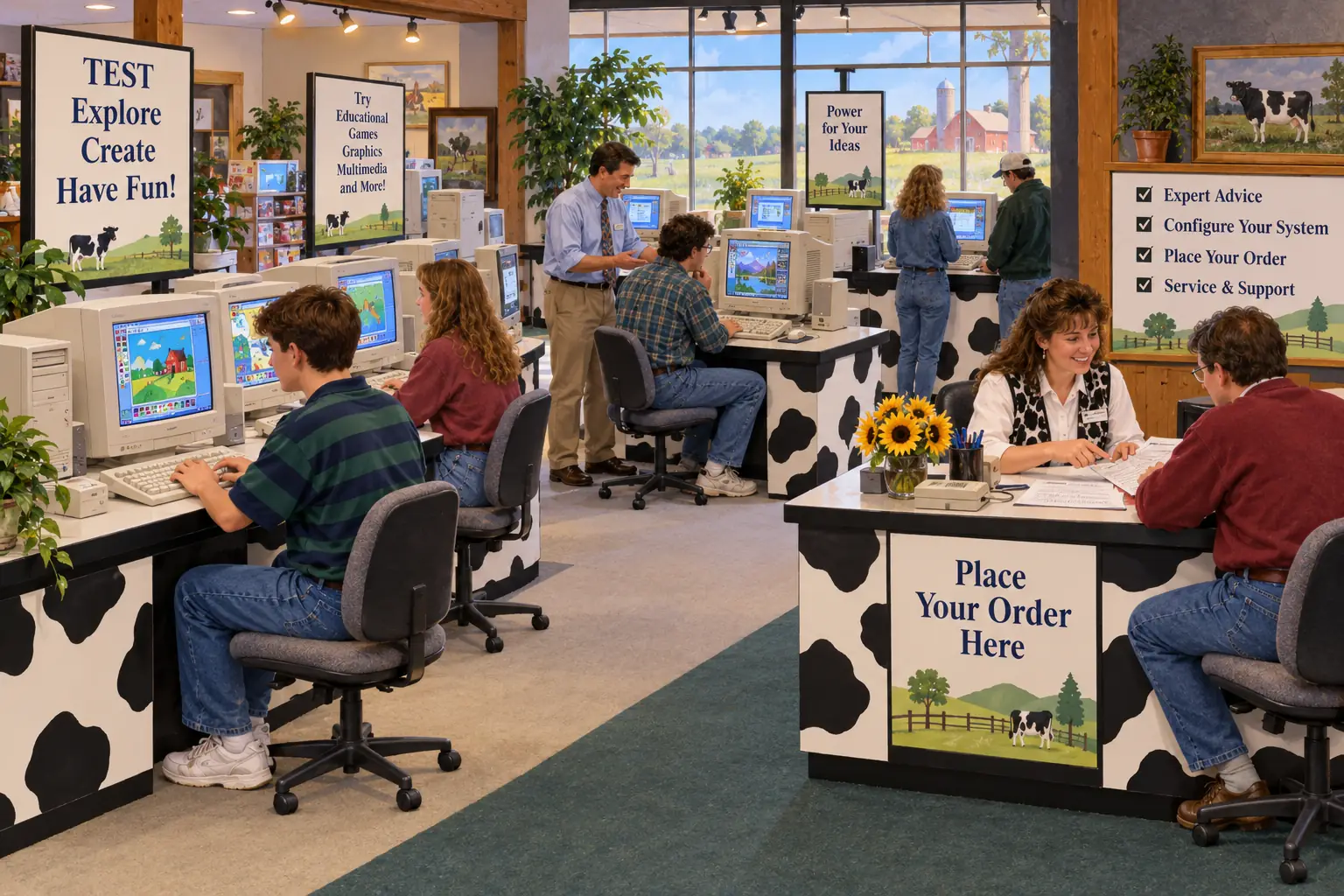
Gateway’s success was real. It went public in 1993, reached the Fortune 500, and grew into a major PC company. A University of Nebraska–Lincoln reference records revenue of about $6.3 billion in 1997. The firm had expanded well beyond its original American market, with operations in other countries.
Growth also changed what Gateway had to manage. It was no longer just a direct seller with a cheeky ad team. It had factories, support centers, overseas operations, new product lines and stores to run.
How the business changed
PCs were becoming more common and more alike. Rivals could buy many of the same processors, memory chips and disk drives. Dell competed hard in direct sales. Big retailers gave other brands wide reach. The early excitement of a family buying its first PC could not by itself keep prices or profits high.
Gateway tried to adapt. It pushed further into consumer electronics and retail experiences, while struggling with the costs of stores and a much larger operation. By 2002 it was even trying to soften its farm image. In a contemporary Washington Post report carried by the Los Angeles Times, Waitt described the shift as a move away from the prairie identity.
The next change was not subtle. Gateway completed its purchase of low-cost PC seller eMachines in March 2004. In its SEC filing, Gateway put the transaction’s total purchase price at about $262 million. eMachines brought experience selling through major retailers, a different path from Gateway’s old direct-order model.
Then, on April 1, 2004, Gateway announced it would close all 188 remaining company-operated stores on April 9. The release said about 2,500 retail jobs would go. Direct phone and web orders would continue, but the company planned wider distribution through other retailers.
What Went Wrong?
Cost and complexity: Gateway’s company-run stores made it easier to try a PC, but also added overhead. Closing them saved money while removing a part of the buyer experience it had spent years building.
A tougher PC market: Hardware became harder to distinguish, and price pressure grew. A memorable package could not protect a profit margin.
A changing sales model: Gateway moved toward third-party retailers. Its 2006 annual report says Best Buy alone made up about 39% of total revenue that year. That dependence was far from the old image of a company taking each customer’s order directly.
These were linked pressures, not one neat mistake that explains every year of decline.
In August 2007, Taiwan-based Acer announced an agreement to buy Gateway at a total equity value of roughly $710 million. Acer completed the acquisition that October. The independent Gateway company that had grown from a farm business was now part of a much larger computer group.
That is not the same as every Gateway machine disappearing overnight. It is the end of one business story, followed by another life for the name.
What remains of Gateway?
Gateway’s brand survived its independence. In September 2020, a new line of Gateway laptops and tablets appeared through Walmart. The Walmart announcement made a point of bringing back the famous cow pattern on packaging.
By October 2025, a Gateway support notice directed buyers to Sam’s Club as its authorized retail partner. Gateway’s support site also says Acer owns the brand and that a licensee handles sales, warranties and support. Retail arrangements and product availability may change; the name on a modern laptop does not mean it was made by the 1990s Gateway company.
And the old PCs? They are vintage machines now. Some survive in collections, homes and workshops, along with keyboards, restore discs and battered manuals. Using one today calls for age-appropriate care; a computer built for an old version of Windows should not be treated as a safe modern internet PC.
For former owners, the most powerful reminder may not be the computer’s processor speed. It may be the day the delivery arrived. A giant patterned carton was sitting by the door. Inside was a machine someone had chosen from columns of numbers in a catalog, paid for after a phone conversation, and hoped would last for years.
Those spots sold more than a box. They turned an unseen seller into a name people knew. The lesson of Gateway 2000 is that a clever promise can make a company famous—but keeping the promise, as the business grows and the market changes, is the harder job.
Sources and further reading
- Gateway v. Companion Products (2004) — appeals-court record of early cow-spot advertising, trademark history and the dispute over a cow-shaped computer accessory.
- Charles Platt, Wired (1995) — firsthand factory reporting, the advertising team, phone sales, support staff and Ted Waitt’s recollections.
- Sioux City Public Museum collection — local museum account of Gateway’s origins and early computers.
- Greg Edwards’s 1996 order record — one buyer’s surviving specification, charges and later personal recollections.
- FTC Gateway 2000 case file — formal case history and the 1999 consent order; the settlement did not establish an admission of liability.
- Encyclopedia of the Great Plains — company growth, geography and the farm-rooted brand.
- Gateway 2006 Form 10-K — retail reliance, eMachines integration and business risks.
- Acer–Gateway announcement (2007) — acquisition terms and the stated strategy at the time of the deal.
- Acer company milestones — confirmation that the Gateway merger was completed in 2007.
- Gateway brand and Acer — modern licensing and support relationship, checked October 2026.