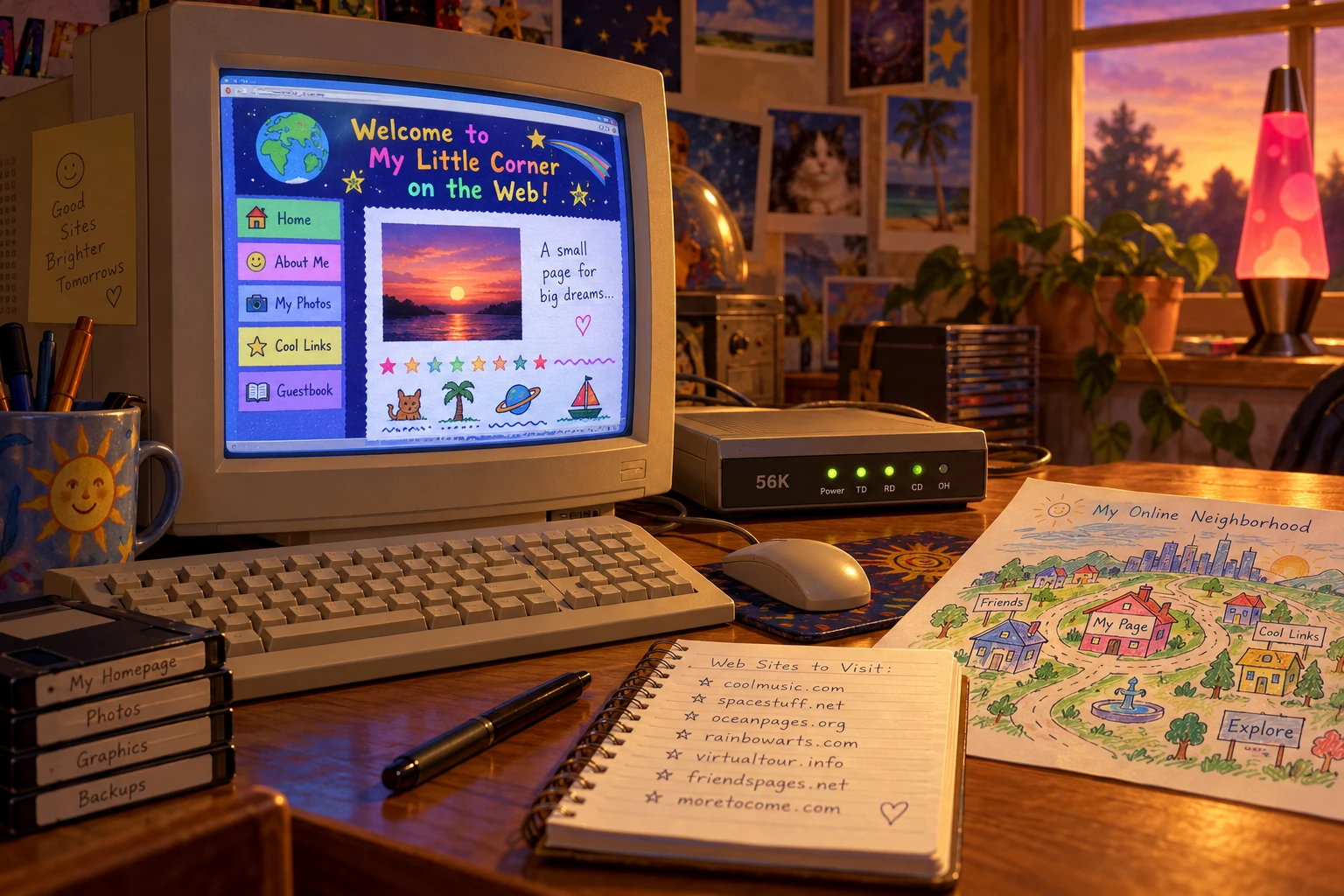
On May 15, 1995, David Bohnett invited 15 friends and colleagues to try a new way to make a homepage. His promise was bold: they could put a personal page on the World Wide Web in less than ten minutes.
This was not yet the glittering GeoCities many people remember. Bohnett’s young company was still called Beverly Hills Internet. And the earliest pages were often rather plain. Some shared the same cartoon, the same little signs, even the same line about links to other websites.
Years later, web artist and researcher Olia Lialina spotted that odd pattern in saved pages. It was not proof that dozens of strangers had the same taste. They had been using the same page-making template. Lialina documented both the old page code and Bohnett’s later recollection of the tool in her study of early GeoCities pages.
There is something lovely about that small discovery. A few choices made for beginners in 1995 became part of the look of the early web. Soon people were choosing their own colors, putting their names above their favorite bands, and leaving invitations for strangers to write back.
That was GeoCities at its best: not just a place to look at other people’s pages, but a place where you could make one of your own.
From Street Cameras to Online Neighborhoods
GeoCities began in Southern California in 1994, before it had that name. Bohnett and co-founder John Rezner were trying to work out what the young web could become. Many early websites belonged to universities, companies, or people who knew how to run a server. Creating your own page was possible, but hardly as simple as writing a letter.
Their first idea had a local flavor. Beverly Hills Internet used cameras showing real places around Los Angeles. One was tied to the glamorous shopping world of Beverly Hills; another drew on the Hollywood scene. The cameras suggested a larger idea. What if people could live near others who liked the same things, even if they were thousands of miles apart?
The Computer History Museum’s account of GeoCities, built in part around a program with Bohnett, traces this move from cameras to personal pages. It also explains why the community idea mattered to Bohnett: he wanted people to take part in the web, not merely watch it.
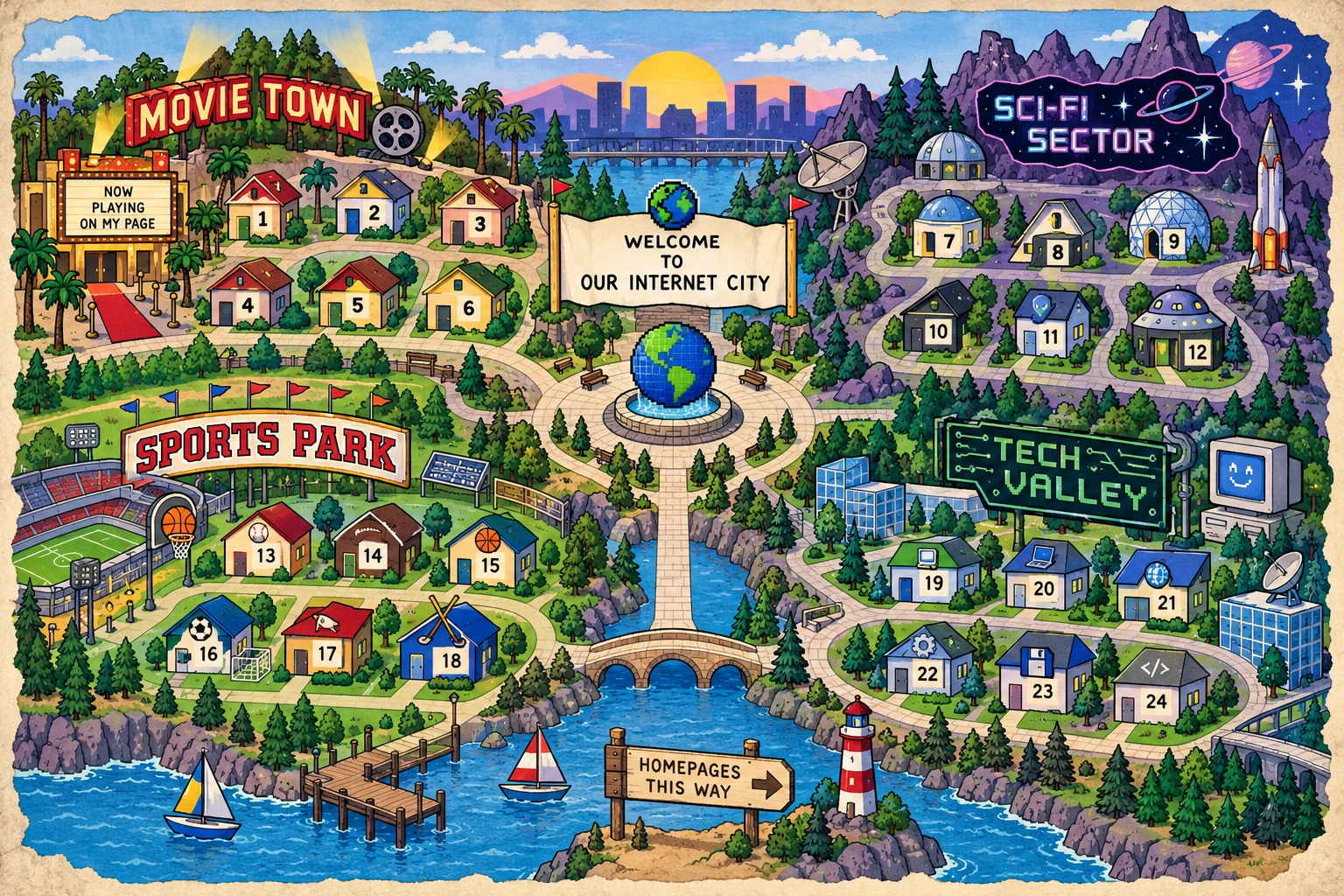
In 1995, the company began opening themed places for personal homepages. They were called neighborhoods, and their names borrowed from real streets and cities. Hollywood suited movies and celebrities. Colosseum was for sports. WallStreet was for business. WestHollywood welcomed gay and lesbian subjects. Soon there were places such as SiliconValley for computing and Tokyo for interests that included Japanese popular culture.
These were not geographic limits. Someone in another country could still choose a neighborhood about science fiction or music. Your topic mattered more than your mailing address. The service grew out of Beverly Hills Internet’s 1994 work, and the GeoCities name arrived during 1995. The original 1994 venture and its later free-page service should not be treated as the same launch day.
How Did You Claim a GeoCities Homestead?
First, you needed a way onto the internet: a computer, browser, and an internet connection. For many home users, that meant a telephone modem, an internet provider, and a phone line that could not be used for a normal call at the same time. GeoCities offered web hosting, not the connection itself.
Once online, a new member signed up for a GeoCities account, chose a neighborhood, and took a numbered address within it. The company called its members homesteaders and their little sites homesteads. The words made web space feel more like somewhere you could settle.
An early address could look like geocities.com/Area51/1234. As places filled up, GeoCities added smaller districts called suburbs, making longer addresses such as geocities.com/Area51/Shire/5872. The latter address belonged to a real page later examined by researchers. Neighborhoods and suburbs helped readers guess what kind of site they might find before opening it.
The site gave members a small amount of disk space for their files. In its early years, an often-cited free allowance was just 2 megabytes. The amount changed over time, as did plans and features. Two megabytes sounds tiny now, but text files are light. A plain page and a few small GIF images could fit. Large photos, music, and long file collections were another matter.
It cost nothing to claim the basic page, but it did not make every part of the experience free. Members still paid whatever their internet access cost. Uploading a picture over a slow modem was not much fun, and changing providers or computers could make editing awkward.
Fun Fact: Your URL Was Part of the Story
Those four-digit addresses were more than a filing system. They let people talk about living on the same virtual street. Later, when a neighborhood filled its numbered lots, GeoCities made more room by adding suburbs. A fan-made neighborhood directory still records many of these old names and addresses.
A Homepage You Could Change Yourself
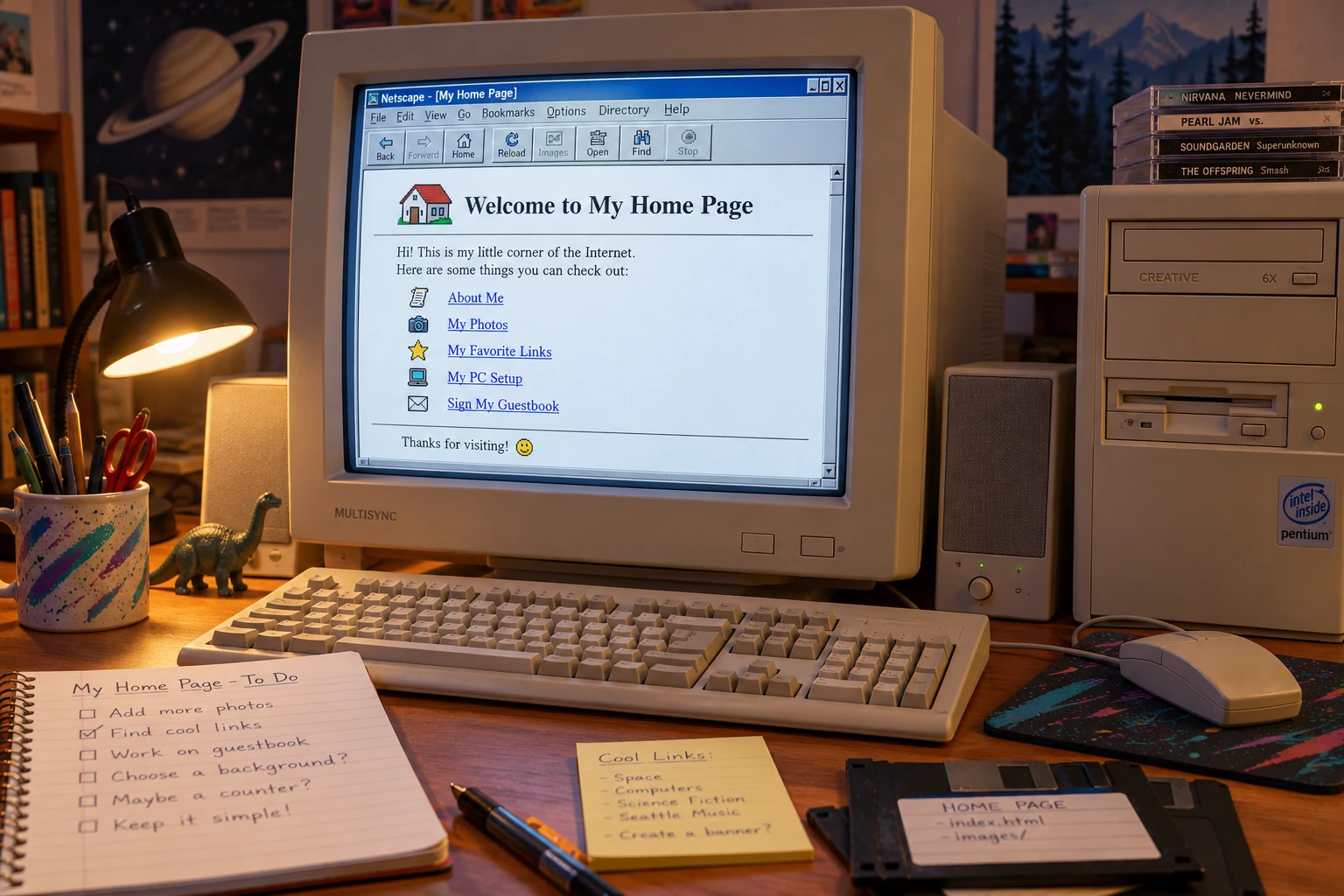
The important step came after signup: getting words onto the page. GeoCities did not ask every new member to learn HTML first. Early users could fill in fields, pick images and separators, and edit a sample layout in the browser. HTML—the simple code that tells a browser how to show a page—remained there underneath. More confident members could edit that code directly.
We know something unusually specific about the first tool. Lialina found the mark of BHI’s Home Page Generator in saved page files. In a conversation she reported having with Bohnett in 2019, he described a sample page with editable text boxes and menus for small pictures, dividing lines, and bullet symbols. The original builder interface itself has not survived in full.
So if you see a few near-identical 1995 pages with the same cheerful cartoon, do not assume everyone chose it. Some of those choices may have come from the starter page. A person could still replace them, or leave them alone and write the part that mattered: the introduction, the hobby, the pictures, and the links.
Behind the Scenes: The Default That Became a Style
One early image collection held hundreds of flags and a handful of other small graphics. Bohnett later told Lialina he had gathered images while browsing the web, looking for things beginners might want. Lialina also found the template’s link section repeated on early pages. A little menu meant to make page-building easier had left a mark on the culture of the web. That is her documented finding, not a claim that every GeoCities site used the template.
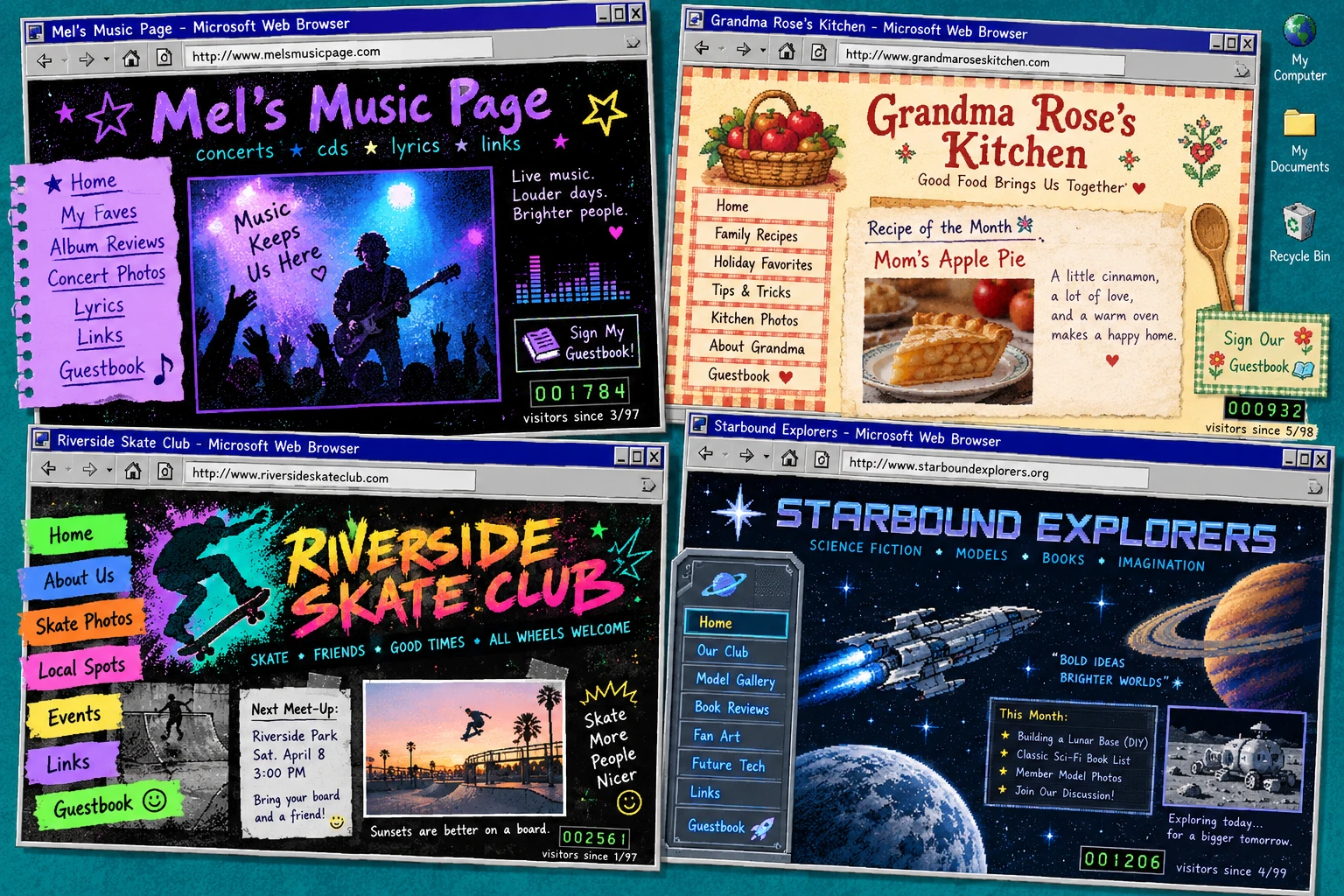
Over time, page-making tools grew easier and some homesteaders went much further than their starter layout. They changed backgrounds, built menus, added photographs, and wrote pages of advice. Guestbooks let visitors leave notes. Counters claimed to count visitors. Webrings linked sites that shared a theme. A tiny animated picture might shout that a section was still under construction, even when the webmaster had not touched it for two years.
Some people used richer editors or moved files with FTP, a tool for sending files from one computer to another. Others kept editing in a browser. The methods differed by year, skill, and account type. There was no single GeoCities screen or fixed set of tools for its entire life.
The Important Part Was the People Next Door
GeoCities pages could be clumsy and funny. Some had fierce colors, spinning pictures, and background music that started before a visitor could find the stop button. But a page did not need to look polished to be useful.
A person could post a family recipe, a club schedule, a guide to a favorite game, a collection of poetry, or careful notes about an illness or an unusual hobby. A visitor who shared that interest could send email or sign a guestbook. To a webmaster in a small town, a note from the other side of the world might be the most exciting part of the week.
And the neighborhoods were not just labels. Volunteers called community leaders welcomed members, helped solve page problems, pointed readers toward interesting sites, and sometimes organized local activities. The experience varied by neighborhood and by volunteer. Some places were active and friendly; others were quiet or messy.
The freedom to publish mattered especially to people whose interests were barely served by newspapers, television, or local clubs. A small personal page could find readers without a publisher’s permission. But community was not automatic. Not all members found welcoming neighbors. Pages could expose personal details, contain bad advice, or vanish when their authors moved on.
The web of the 1990s was not simply a better, kinder internet. It was a place where people were learning in public. Some learned how to code. Some learned how to argue. Some discovered that the world held far more fellow fans than their own neighborhood at home.
Free Space Had a Price
GeoCities had to pay for servers, staff, and traffic. The basic offer was simple: people made the pages, and the company sold advertising around them. It also sold paid plans with more space or fewer advertising annoyances. In 1998, a GeoPlus plan was advertised at $4.95 a month, according to contemporary reporting in Wired.
This created an awkward business. GeoCities had lots of readers, but advertisers could not always predict what would appear beside their banners. A page about gardening might sit near a strange joke or a sharp political complaint. In 1998, Wired reported that the company was finding it difficult to sell all its advertising space.
Members could also feel that the service was changing the rules of their little home. In June 1998—before Yahoo bought GeoCities—GeoCities introduced a floating brand watermark on member pages. People complained that it covered their work and slowed browsing. The page might be yours to design, but the company controlled the screen too.
There was a deeper problem than ugly advertising. In August 1998, the U.S. Federal Trade Commission accused GeoCities of misleading people about how personal information was collected and used. The FTC case record covers adults and children and the safeguards required by its eventual order. GeoCities agreed to settle; that did not amount to admitting every allegation. These privacy troubles, too, belonged to the period before Yahoo took control.
What Went Wrong Before Yahoo?
Advertising: Free hosting made page-building possible, but banners and the floating watermark could spoil work that members felt was their own.
Privacy: The FTC case revealed serious questions about how the service explained its collection and sharing of information.
Control: Members owned their creative efforts, yet the company owned the platform. That uneasy balance would soon become even more visible.
Yahoo Bought the City. Members Pushed Back.
GeoCities went public in 1998. Its rapid growth caught the eye of Yahoo, one of the giant gateways to the web. On January 28, 1999, Yahoo announced a stock deal widely valued at about $3.6 billion at the time. The company did not take over that day. Yahoo’s own financial filing says the acquisition was completed on May 28, 1999.
From Yahoo’s side, the purchase made sense on paper. Millions of people were building sites and returning to see their neighbors. Yahoo wanted visitors, useful content, advertising space, and stronger online communities.
For many homesteaders, though, a giant new owner felt less like a friendly neighbor and more like a landlord who had arrived with a new lease.
In late June 1999, revised terms gave Yahoo sweeping rights to use, alter, and share material posted on GeoCities. Reports sometimes described this as Yahoo taking ownership of members’ work. The legal point was more exact: the wording sought a very broad license to use it, rather than a straightforward transfer of copyright. For people who had spent years making their pages, that distinction did not settle the worry.
Some members protested by removing content or draining the color from their sites. The action became known as the Haunting of GeoCities. It turned the most personal thing a member owned—their homepage—into a protest sign. Researchers CJ Reynolds and Blake Hallinan later examined the episode and its meaning for online control in their study of the Haunting.
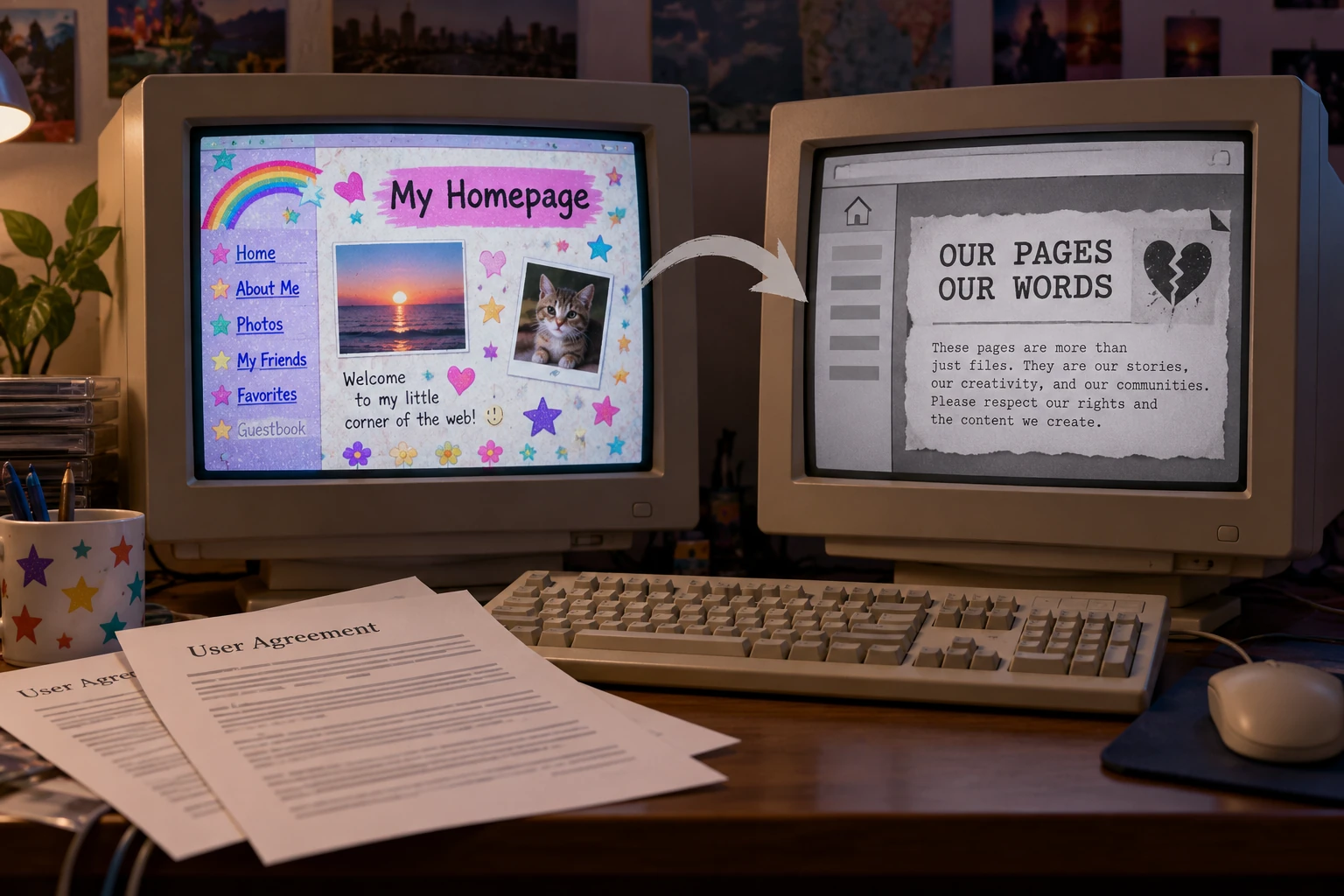
Yahoo revised the agreement more than once. By early July, the revised terms said Yahoo did not own members’ content and limited its license to displaying, distributing, and promoting their GeoCities sites. Contemporary Los Angeles Times reporting recorded the end of the boycott.
It is tempting to say Yahoo arrived and instantly destroyed the community. That would be too neat. The service kept going for another decade. Older neighborhood addresses stayed reachable for years. But Yahoo favored a more general account-and-services model, and the old neighborhood identity and volunteer culture became less central.
By then, the web was changing around GeoCities as well. Other free hosts competed for members. Blogs made frequent posts easier. Later, Myspace and Facebook asked people to build profiles and connections, rather than a whole site of linked pages. Plenty of GeoCities sites stayed useful or beloved, but the service no longer offered the easiest way for many people to speak online.
October 26, 2009: The Main Service Closes
In April 2009, Yahoo announced that it would stop taking new GeoCities accounts and close the service later in the year. The decision came as the company cut costs and focused on other products. Its free pages no longer fit Yahoo’s plans, even though people still visited them.
The final date for the main GeoCities service was October 26, 2009. Members had been warned to save their files and move their sites. Yahoo directed them toward other hosting choices, including its paid service. But plenty of pages had been left untouched by people who had lost passwords, changed email addresses, or simply moved on with life.
A page could still be valuable even when its author had forgotten it. Perhaps it held notes for a school club, a fan’s hand-built guide, or the only copy of a long family story. A link on somebody else’s page could suddenly point nowhere.
The closure was not quite worldwide on that date. Yahoo Japan’s separate GeoCities service continued until March 31, 2019, according to Japanese reporting on its final closure. So saying all GeoCities disappeared in 2009 leaves out an important ten-year afterlife.
The Pages That Escaped the Bulldozer
Not everyone accepted that millions of personal pages should simply vanish. Before the 2009 shutdown, volunteers rushed to copy them. Archive Team organized a rescue effort, while the Internet Archive carried out its own large crawl. These were separate efforts, not a single perfect backup. Archive Team’s project record names the work and describes the frantic months before closure.
Other projects saved or reassembled portions of the lost neighborhoods. Artists Olia Lialina and Dragan Espenschied studied the files in One Terabyte of Kilobyte Age. At the Computer History Museum, artist Richard Vijgen later turned a rescued set of files into Deleted City, a picture of an online metropolis made from surviving digital fragments.
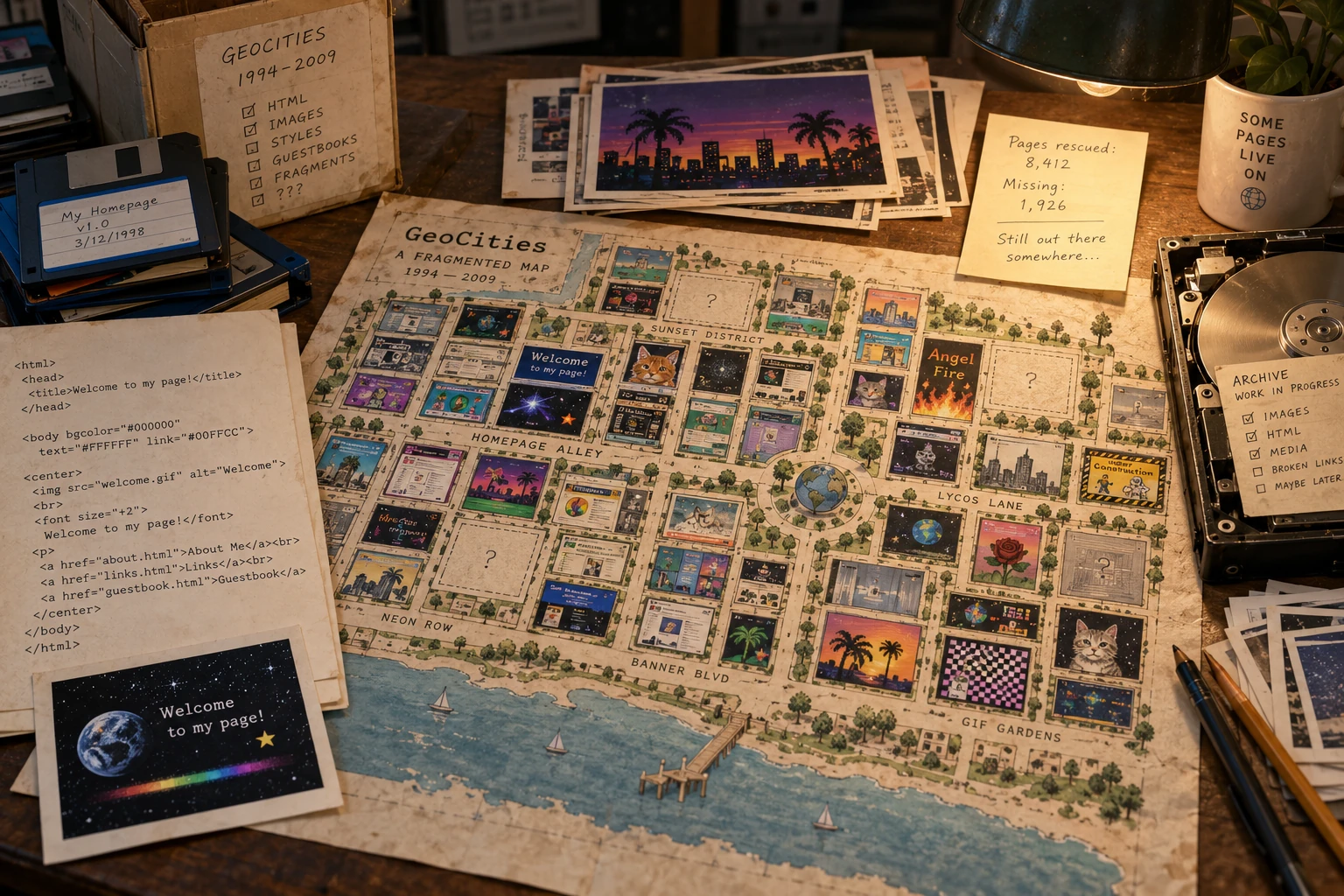
Rescue did not mean complete recovery. Some images were already missing when the crawlers arrived. Some pages relied on services that no longer worked. Some were never found. Even a page preserved byte for byte might lose its guestbook, music, search box, or links to vanished friends. The files could survive while the community around them did not.
Can You Visit Your Old GeoCities Page?
GeoCities no longer hosts new homesteads. If you remember an old address, try entering it in the Internet Archive’s Wayback Machine. The independent OoCities archive guide also explains ways to look for copies. Neither search is a promise that a particular page was saved. Treat an old archive as a historical copy, not a place to log in with passwords or download unknown files.
If what you miss is making a small personal website, that part is not gone. Neocities, a separate service established in 2013, offers a place to write and host handmade pages. It is not the original GeoCities, and it cannot restore the old neighbors for you. It does keep alive the idea that a web page can be yours to shape from the first line to the last picture.
The most telling detail may be the one Lialina noticed in those simple 1995 templates: a section for links to other sites. A new homesteader was not just asked to write about themselves. They were given a place to point to someone else.
GeoCities was never only its bright backgrounds and dancing pictures. It was also that gesture: Here’s my little corner. Now come and meet the neighbors.
Sources and Further Reading
- Olia Lialina, “Bruce’s Home Page. Part II” (2023) — Research into the 1995 homepage template, its surviving code, and Bohnett’s later account of the page generator.
- Marc Weber, Computer History Museum (2016) — GeoCities’ origins, neighborhoods, decline, preservation, and the Deleted City exhibition.
- Craig Bicknell, Wired (August 6, 1998) — Period account of advertising, paid plans, the floating watermark, and community tensions before Yahoo.
- Federal Trade Commission, GeoCities case — Official 1998–1999 privacy investigation and consent-order record.
- Yahoo financial filing, Securities and Exchange Commission (1999) — Record of the May 28 acquisition completion.
- CJ Reynolds and Blake Hallinan, “The Haunting of GeoCities” (2020) — Research on members’ protest and the licensing dispute after the acquisition.
- Archive Team, GeoCities Project — Direct account of the 2009 volunteer rescue and its limits.
- One Terabyte of Kilobyte Age, project history — The artists’ work with the rescued files and the difficulties of digital preservation.
- ITmedia News (October 1, 2018; Japanese) — Yahoo Japan’s closing timetable, distinct from the 2009 U.S.-based shutdown.