
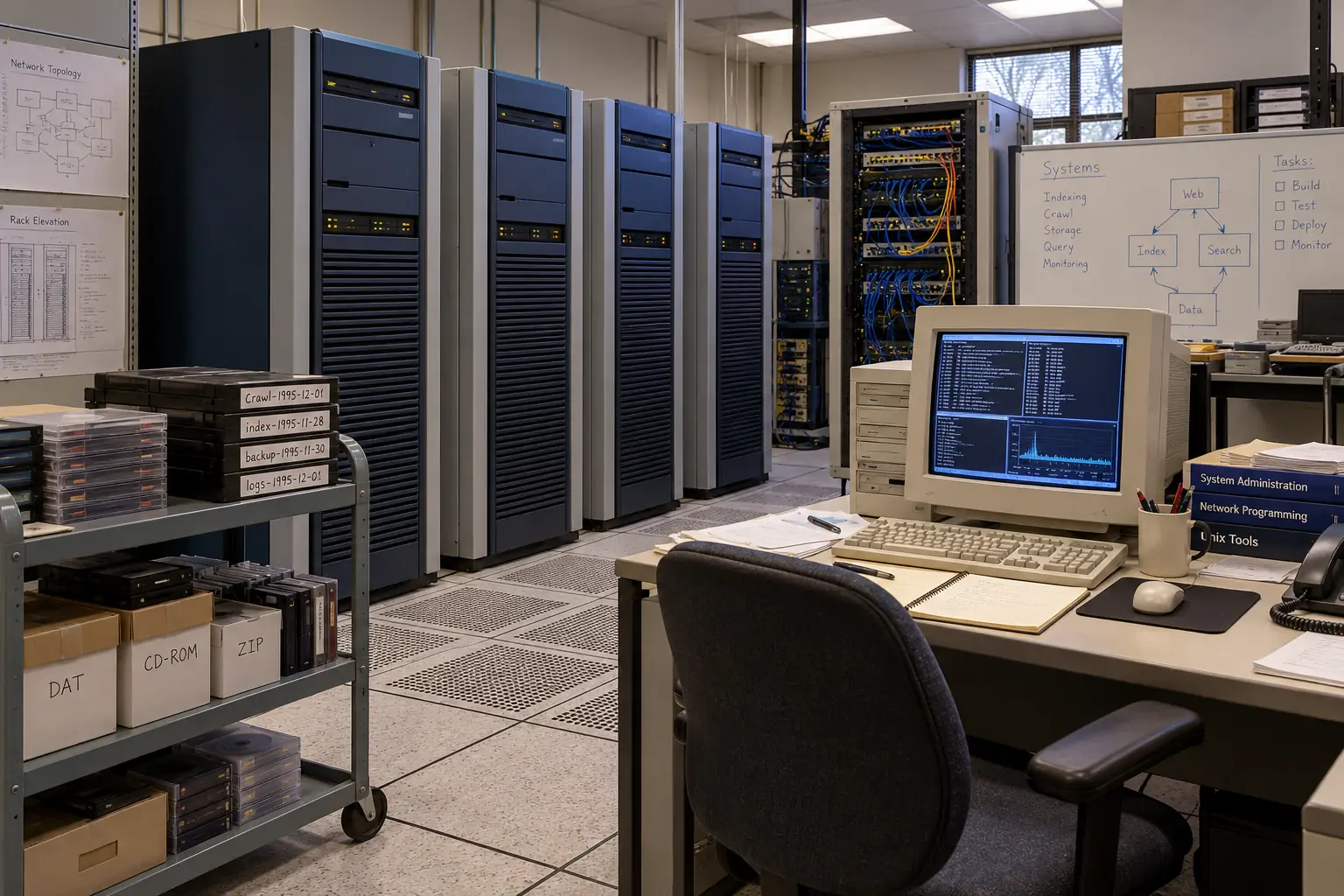
In January 1997, one of the Web’s busiest search engines had an awkward problem: its web crawler had not been running for more than a month.
That was the story engineer Louis Monier brought to a USENIX conference. AltaVista was answering millions of requests, but keeping its giant list of web pages fresh was another matter. The crawler brought complaints from website owners, and the team had to deal with the mail. Meanwhile, people kept searching.
It was quite a turn for a project that had started less than two years earlier as a way to show off a computer company’s hardware. Digital Equipment Corporation, usually called DEC or Digital, wanted the world to notice its powerful Alpha machines. Instead, the world noticed the search box.
AltaVista was not the first web search engine. Its achievement was to make searching a vast and messy Web feel quick, useful and almost ordinary. Then the service became valuable enough for other companies to fight over—and difficult enough to lose.
A Showpiece That Escaped the Lab
In 1995, DEC still made serious computers for serious work. Its Alpha family used 64-bit processors. That meant, among other things, the machines could work with very large amounts of memory and data. DEC needed a vivid public example of what such systems could do.
At its research labs in Palo Alto, California, a small group worked on fast web crawling and search. Among the people tied to the early effort were Louis Monier, Michael Burrows and Paul Flaherty. The work began in the summer of 1995. A later Stanford talk announcement described the original goal as a public demonstration of DEC’s computing and database strength, not the launch of a planned search giant.
On December 15, 1995, Digital opened an AltaVista public beta. Its original company announcement promoted a fast crawler and unusually broad full-text searching. DEC called its technology a “super spider.” That was marketing language, not proof that no other search software came before it.
It did not take long for the demonstration to develop a life of its own. In a 1997 conference account, Monier said the team had not expected the response. Within three weeks of launch, AltaVista was handling more than two million daily HTTP requests. By May 1996, its index contained more than 30 million pages, according to Monier’s USENIX abstract.
Those numbers need care. A request to a web server is not always a search by one person. Nor did the page count mean AltaVista had captured every page on the Internet. Still, the figures show why DEC’s experiment stopped looking like a modest showroom display.
A Different Way to Find a Page
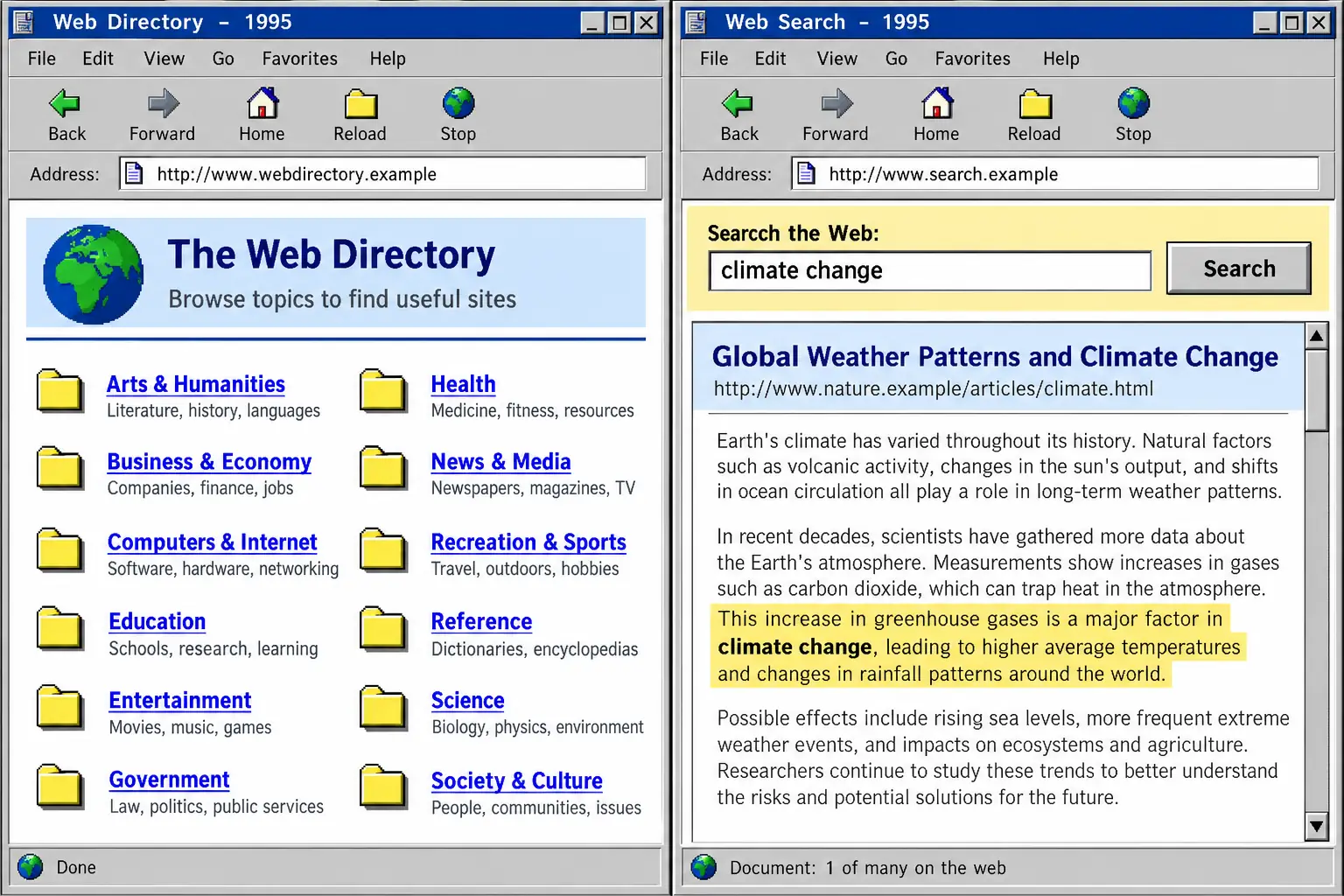
Before Google became a verb, finding things online took practice. Yahoo’s early directory was a collection of sites arranged into topics. WebCrawler, Lycos, Infoseek and other engines already offered automated searching. AltaVista did not invent that idea. It made the size and detail of its searchable collection a major attraction.
A directory worked well if someone had already placed a site in the right category. But what if the words you wanted appeared halfway down an obscure page? AltaVista tried to find words in the body of documents, not just tidy entries written by a directory editor.
For example, someone seeking an old printer error message could search the exact words from the screen. A researcher could look for an unusual person’s name or a phrase buried in a technical document. This is an example of the way the service could be used, not a record of one particular person’s search.
AltaVista was available through a web browser. You did not need to install a special AltaVista program or open a separate AltaVista account for ordinary public searches. You did need an Internet connection, which in many homes still meant an ISP and a dial-up modem. AltaVista could return answers quickly at its end; your phone line and the faraway website still had their own ideas about speed.
Its interface offered simple and advanced searches, plus a way to search Usenet discussions. That mattered when a fix for a broken computer or an answer to a specialist question might live in a newsgroup instead of on a polished homepage.
Remember the search tricks?
You could put a phrase in quotation marks, require a word with +, or exclude one with -. A late-1990s search might be narrowed piece by piece until the result list stopped looking like a phone book for the whole planet.
Those operators were practical knowledge, not just a hobby for computer experts. A September 1996 librarian’s comparison recorded AltaVista’s phrase, Boolean and field-search features beside those of rival engines.
It was not magic. Broad searches could produce mountains of poor matches. A 1998 newspaper guide described the need to add required words, exclusions and quoted phrases to narrow results. AltaVista gave users more control, but also asked them to learn how to ask good questions.
What the Alpha Machines Actually Did
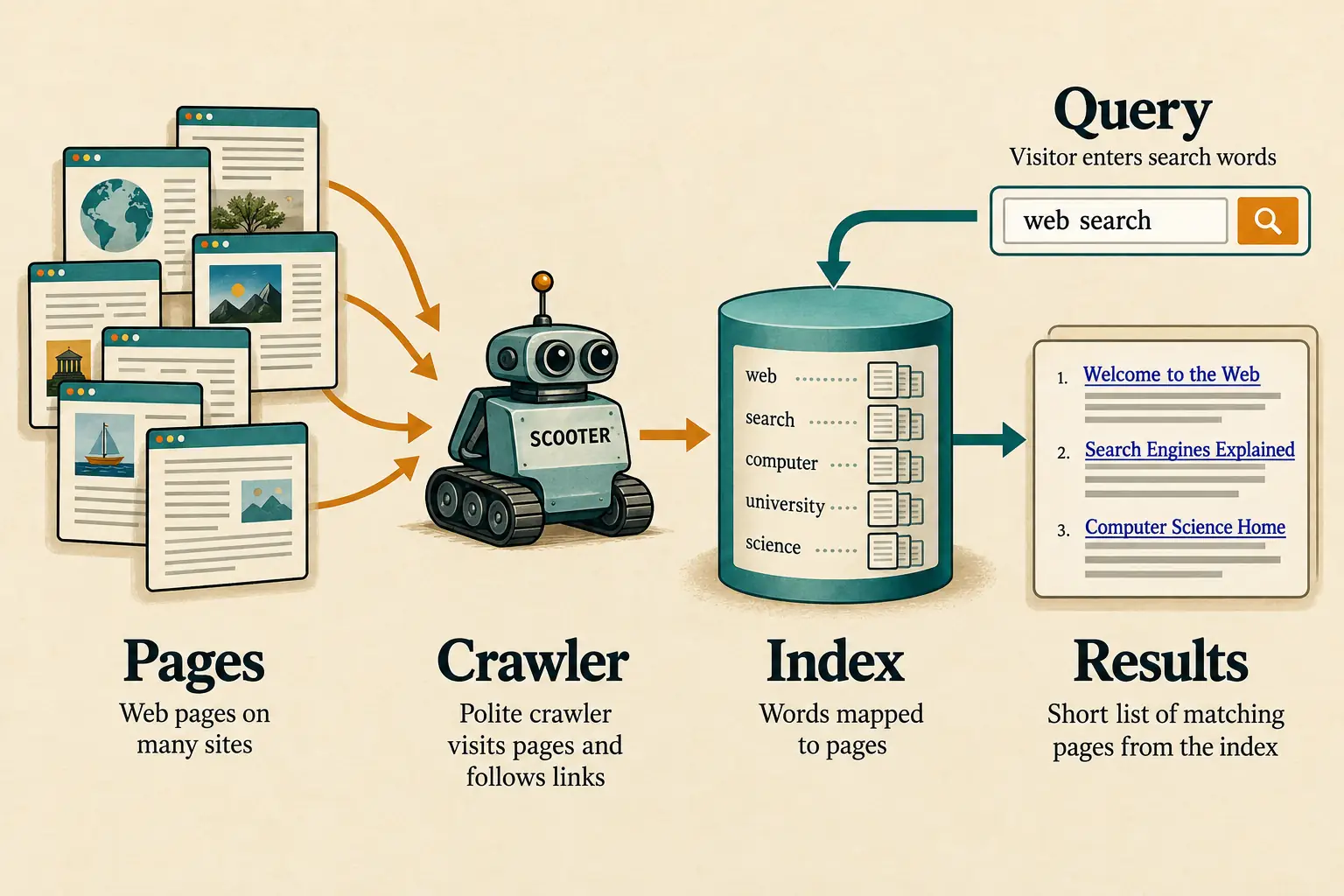
A search engine has two quite different jobs. First it must visit web pages and save enough information to search them. Then it must answer people who type questions. AltaVista put great effort into both.
Its crawler, known as Scooter, followed links from page to page. The search software built an inverted index. Think of the index at the back of a book: rather than reading every page each time, you look up a word and find where it appears. AltaVista did something similar on a much larger scale.
When a visitor entered words in the search box, the server could consult the index instead of asking millions of websites to search themselves. That is why the answer could arrive much faster than the original pages had been collected.
The hardware helped. In January 1997, Monier described an operation using nine Digital AlphaServer 8400 systems, with 80 processors in all, about 66 gigabytes of main memory and more than a terabyte of disk storage. That was a huge arrangement for the time. The software ran under Digital UNIX and was written in C.
He explained that 64-bit addressing was useful because the search service had files larger than the two-to-four-gigabyte range that had troubled many 32-bit designs. Plenty of memory was also important: the software mapped its index into memory and kept a cache of common follow-up requests.
This is the key to the DEC story. AltaVista was not fast simply because someone had bought a shiny new processor. Its engineers built a crawler, a large index, specialized software and a server system that made good use of the machines. Hardware and software were part of the same experiment.
Behind the Scenes: Scooter Was Supposed to Be Polite
In Monier’s January 1997 conference account, Scooter could run about 1,500 tasks at once and crawl roughly six million pages a day. Yet speed was not the only rule. It checked sites’ robot-exclusion instructions and adjusted how often it visited a server based on that server’s response time.
The Internet was full of machines far less powerful than DEC’s. A crawler that looked impressive in a laboratory could be a nuisance to someone maintaining a small website. Staff received so much mail from sites that keeping the crawler in operation became a human support problem. Monier said it had not run for over a month before his talk.
That is a revealing detail: the Web was not merely data waiting to be gathered. It belonged to people with limited bandwidth and computers to keep running.
The Search Box Met the Messy Web
The huge index caused another problem. Finding many pages was easier than deciding which ones would actually help.
Consider a short search such as china. Did the person mean a country, tableware, travel advice or business news? Monier raised this very example. Most people did not write careful search commands. The engine had to guess what they wanted.
Then there were the people trying to trick it. Some publishers repeated popular words again and again to push their pages toward the top. Today we would recognize that as search spam. AltaVista’s staff had to fight it while serving a growing audience.
Copies of the same document were troublesome too. If a popular technical FAQ appeared on dozens of sites, which copy should rank first? Monier’s answer at the time was often to group similar copies together and let the reader choose. Even then, the quickest or most reliable server might not be the one carrying the best copy.
All of this explains a central limit of early full-text search. A massive index could help you find a word. It could not always tell you whether the page was useful, honest, current or worth your time.
A Big Search Engine, but Not Yet a Global Language Machine
AltaVista reached people beyond the United States. By early 1997, Monier said it had mirror systems in Sweden and Australia, and he wanted more sites overseas. Copies closer to readers could reduce delays on the long links between continents.
Language was another matter. The early engine assumed Western European text and a character set called Latin-1. Searching Japanese, Chinese, Korean, Hebrew or Russian text meant handling writing systems and character encodings that were not yet treated equally. Monier openly discussed these problems as unfinished work.
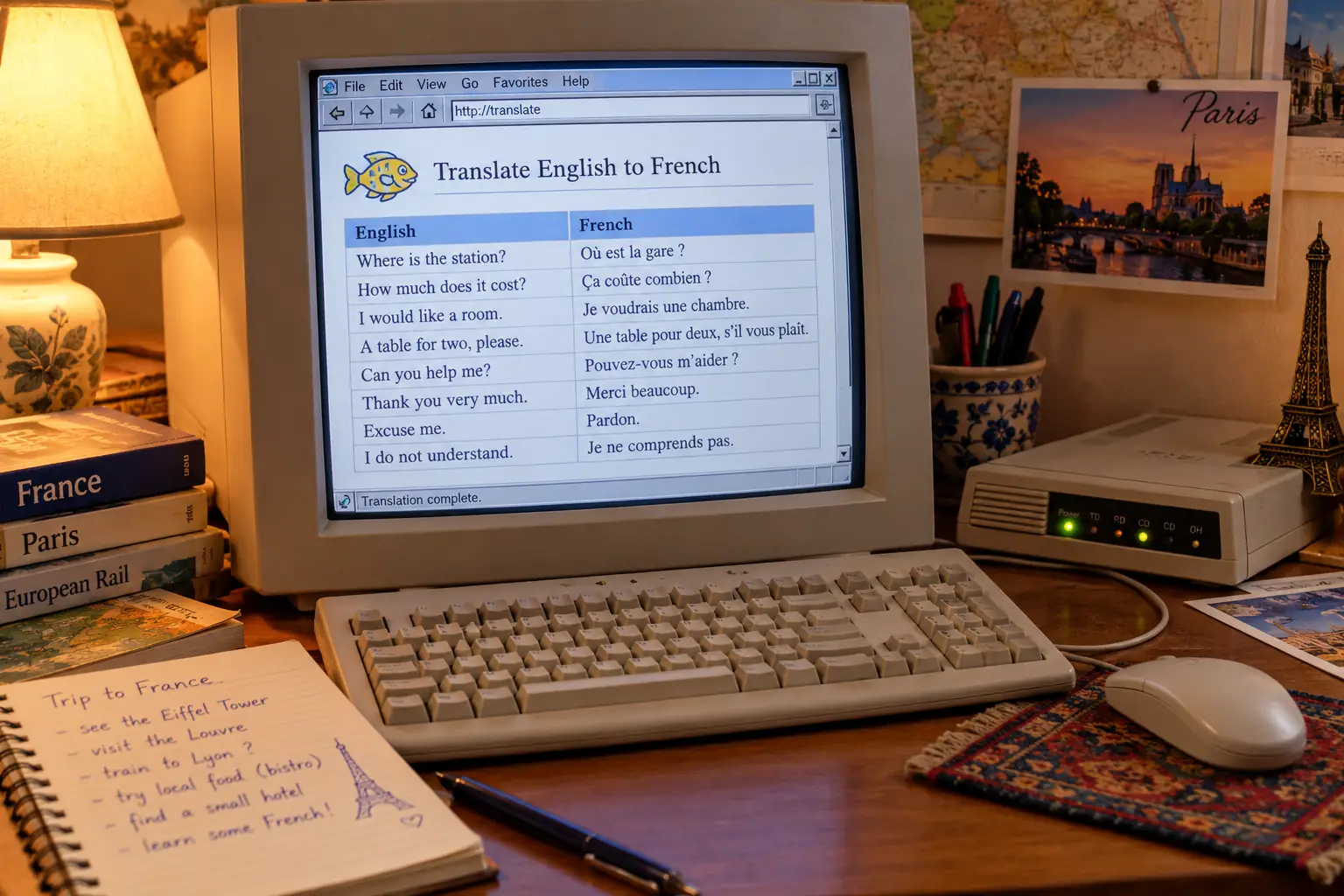
In December 1997, AltaVista added a memorable answer to part of the language barrier: Babel Fish. Built with translation technology from SYSTRAN, it let people paste text or translate web content between English and several European languages. It was free to use, and the results could be clumsy. For many people, though, seeing a foreign web page turned into readable words was astonishing.
A 1998 paper by SYSTRAN researchers gives the launch date as December 9, 1997, and describes what its users asked the system to translate. This was not the modern kind of machine translation we know today. It was an early public service built on a different generation of language technology.
From Search Engine to Portal to Sale
What do you do when millions of people visit a site that began as a hardware demonstration? DEC’s first answer was to use it to draw attention to its computers and network services. But as the commercial Web grew, traffic became valuable in its own right. Advertising, partnerships and the hope of turning visitors into customers pushed search sites to become full destinations.
In 1998, Compaq acquired Digital, bringing AltaVista along with the much larger computer business. AltaVista then faced another kind of engineering job: surviving its owners’ changes of plan.
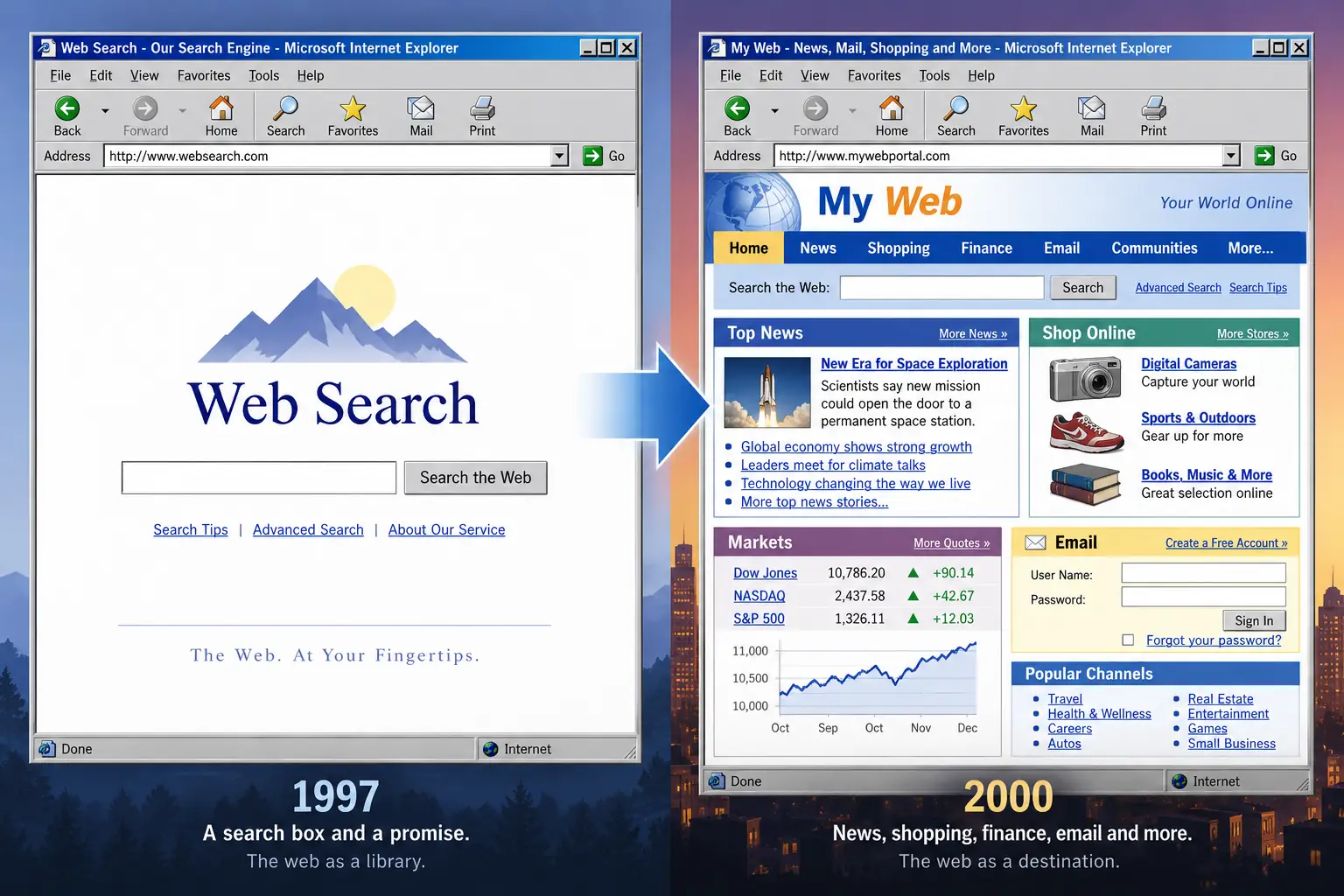
In the late 1990s, the fashionable idea was the portal: a web starting page filled with news, shopping, email, entertainment and other reasons to stay. AltaVista added portal features and advertising while competitors also fought to become people’s gateway to the Internet. None of this meant its search technology suddenly stopped working. It meant search now had to compete for money and attention inside a much larger business plan.
The figures behind the next sale tell their own story. In June 1999, Compaq agreed to sell control of its AltaVista-related business to internet investment firm CMGI. The announced deal was widely reported at about $2.3 billion. Yet Compaq’s later SEC filing says the completed August transaction covered an 81.5 percent interest in a package that included AltaVista, Shopping.com and Zip2, and records consideration valued at about $1.8 billion.
Those are not two prices for one identical, stand-alone search engine. The date, share value and bundle of assets matter. It is safer to say AltaVista was at the center of a huge dot-com-era transaction than to treat either number as a clean price tag for the original search software.
How AltaVista Lost Its Place
Google arrived in a world that AltaVista had helped make searchable. Its 1998 research paper described a different way to rank pages, using links between sites as a strong signal along with page content. That did not make every older engine instantly useless. But it gave people another way to find results that felt more relevant without learning so many search tricks.
AltaVista had problems beyond Google’s technology: shifting owners, the push toward portal features, advertising pressure and fierce competition. Google’s cleaner search focus mattered, but the decline was not a one-line story about one clever algorithm defeating one foolish rival. The Web, the search business and user expectations were all changing.
In February 2003, paid-search company Overture announced it would buy AltaVista for $140 million in cash and stock, a transaction discussed in contemporary reporting. Overture valued AltaVista’s search technology as well as its site. That same year, Yahoo agreed to buy Overture. A July Yahoo acquisition announcement placed the wider deal at about $1.63 billion.
AltaVista’s name continued online for years, but it was no longer the same independent search project from DEC’s research lab. By its final years, the site presented Yahoo-powered search. Yahoo closed AltaVista on July 8, 2013, after announcing the shutdown the previous month.
Legend vs. the Record: Did Google Simply Kill AltaVista?
The easy version: AltaVista was a weak old search engine and Google invented web search.
The record: WebCrawler, Lycos and others existed before AltaVista. AltaVista then made unusually large-scale full-text search widely available. Google’s link-based ranking work was a major advance, but AltaVista also struggled with ownership changes, a portal strategy and a changing market. No single event explains the whole decline.
Can You Still Search with AltaVista?
No. AltaVista’s original public search service ended in 2013. A domain that redirects to another search engine is not the same thing as bringing back its old crawler, index or ranking system. Modern search engines can search today’s Web, but they cannot recreate a live 1996 search just by using an old name.
What you can explore is the evidence that remains: period articles, dated conference reports and saved pages in web archives. An old homepage capture can show how the search form looked. It cannot make the original service work again or prove that every search result from that day has been preserved.
The lasting surprise is that AltaVista was never meant to become the world’s favorite place to ask questions. DEC built it to demonstrate the power of its computers. People turned it into a daily habit. Then the scale that made it wonderful exposed difficult problems—ranking, spam, global access, ownership—that still shape web search.
And that brings us back to the crawler that had been sitting idle. The remarkable part of AltaVista’s story is not just how quickly its computers could search. It is how fast a clever demonstration became a public service that people expected someone to keep running.
Sources and Further Reading
- DEC’s December 1995 announcement — contemporary wording for the public beta and DEC’s hardware claims; promotional claims are treated as such.
- Louis Monier’s USENIX talk summary — January 1997 operational details, reported by Jerry Peek and printed in ;login: in April 1997.
- Internet Scout’s 1996 search comparison — a librarian’s period record of operators and field searches.
- SYSTRAN’s 1998 Babel Fish paper — firsthand developer research into the 1997 translation service and its users.
- Brin and Page’s 1998 Google paper — original evidence for the role of links in Google’s search approach.
- Compaq’s 1999 quarterly filing — transaction completion, included businesses and recorded consideration.
- February 2003 Overture report — contemporary terms and purpose of the AltaVista purchase.
- Associated Press, July 8, 2013 — the final service shutdown and company history.